- op amp
- transimpedance amplifier
- TIA
- analog design
TLV9062 vs MCP6002 in a 100 kHz Transimpedance Front-End: A Datasheet-First Selection Framework
A datasheet-first guide to choosing between TLV9062 and MCP6002 for a 100 kHz transimpedance front end, with TIA-specific selection logic, replacement boundaries, and comparison anchors.
Quick facts
- This article is a datasheet-first selection framework, not a bench-measurement report.
- A 100 kHz TIA decision is not settled by one noise number alone; feedback resistor noise, source capacitance, GBW, and compensation margin all matter.
- TLV9062IDR usually enters the shortlist because it has much more bandwidth headroom than MCP6002-I/SN, not because every quoted noise number is lower.
- A possible replacement decision must stay conditional on the actual sensor capacitance, feedback network, supply headroom, and stability verification.
Many op-amp comparison posts collapse a transimpedance-amplifier decision into one or two headline numbers. That is fast, but it is not very trustworthy. A real 100 kHz TIA decision depends on more than a single noise-density line item. It depends on how the amplifier behaves once feedback resistance, source capacitance, bandwidth target, output swing, and compensation margin all begin to interact.
This article is intentionally narrower and more honest than a lab-note style benchmark. It is a datasheet-first selection framework, not a bench-measurement report. The goal is not to claim which part is universally best. The goal is to help an engineer or FAE decide whether TLV9062IDR, MCP6002-I/SN, OPA376AIDBVR, ADA4692-2ARZ, OPA2320AIDR, or MCP6022-I/SN belongs in the shortlist for a 100 kHz transimpedance front end, and where the replacement boundary becomes risky.
1. The 100 kHz TIA problem: why single-point specs fail
Before comparing parts, we need a consistent design window. In this article, a "100 kHz TIA" means a single-supply front end that converts a small sensor current into voltage, with the design target centered around roughly 100 kHz useful bandwidth rather than very low-frequency precision only.
For the discussion to stay concrete, the default mental model is a moderate-gain TIA with Rf roughly in the 50 kOhm to 200 kOhm range, plus a sensor or photodiode capacitance that is large enough to influence compensation. That assumption matters because the dominant limit can move with transimpedance gain: at very high Rf, resistor thermal noise and bias-current-related error terms grow in importance, while at lower Rf the op amp's voltage noise and high-frequency noise-gain behavior usually become more visible.
That does not uniquely determine one circuit. Several real implementations still fit under that label:
- a photodiode front end with moderate junction capacitance
- a PMT or current-output sensor stage with its own source-capacitance profile
- a transimpedance block ahead of additional filtering or ADC sampling
- a design that must trade low noise against low power and easy sourcing
The reason to define the problem this way is simple: once the target moves toward 100 kHz, bandwidth margin and stability start to matter more than they do in slower sensor loops. A device that looks acceptable in a low-bandwidth signal conditioner can become uncomfortable in a 100 kHz TIA once source capacitance and noise gain are included.
That is why this article does not ask, "Which op amp has the lowest noise number?" It asks, "Which op amp still looks defensible after the real TIA constraints are applied?"
The fastest way to misread this topic is to compare one line from the TLV906xS datasheet with one line from the MCP6001/2/4 datasheet and stop there.
That approach fails for four reasons:
| Problem | Why it creates a bad comparison |
|---|---|
| Noise numbers are quoted at different frequencies or under different conditions | A 1 kHz input-voltage-noise figure does not automatically settle broadband TIA performance. |
| TIA output noise is not only op-amp voltage noise | Feedback-resistor thermal noise can dominate the total budget, especially when transimpedance gain rises. |
| Source capacitance changes noise gain and stability | A photodiode or current-output sensor does not look like a simple resistor source. |
| A part can be quiet enough but still too slow or too marginally compensated | If GBW headroom is weak, the design can become fragile even before absolute noise becomes the main problem. |
This is also where many comparison drafts quietly go off the rails. In the original topic framing, TLV9062 was described as if 6.5 nV/√Hz were its noise figure. That is not correct. In TI's official product data, 6.5 is the typical slew rate for the device family, while the product page lists 16 nV/√Hz at 1 kHz for TLV9062. That one correction alone is a good reminder that headline parameter copying is not enough.
For the same reason, the MCP6002 comparison must also be read carefully. Microchip's product information lists MCP6002 as a 1 MHz, low-power dual op amp with 28 nV/√Hz input-voltage noise density, not the lower figure used in the original topic card. That does not automatically disqualify it. It simply changes how honest the comparison must be.
2. Key datasheet parameters and shortlist comparison
The right shortlist starts with the parameters that affect bandwidth margin, total noise, and loop stability together.
| Device | Type | GBW | Input-voltage noise | Notable angle for a 100 kHz TIA |
|---|---|---|---|---|
TLV9062IDR | dual | 10 MHz | 16 nV/√Hz at 1 kHz | Stronger bandwidth headroom than low-power 1 MHz devices; more plausible when compensation margin is tight |
MCP6002-I/SN | dual | 1 MHz | 28 nV/√Hz | Very low-power and common, but the 100 kHz target can consume too much of the available loop margin |
OPA376AIDBVR | single | 5.5 MHz | 7.5 nV/√Hz at 1 kHz | Useful low-noise reference anchor when precision and noise are more important than lowest-Iq behavior |
ADA4692-2ARZ | dual | 3.6 MHz | 3.1 nV/√Hz at 1 kHz | Relevant when the design wants a cleaner analog posture than the low-power baseline parts |
OPA2320AIDR | dual | 20 MHz | 8.5 nV/√Hz at 1 kHz | A higher-bandwidth, higher-headroom path when the TIA looks bandwidth- or settling-limited |
MCP6022-I/SN | dual | 10 MHz | 8.7 nV/√Hz | A useful Microchip anchor when the question is not "MCP6002 or nothing?" but "what if the Microchip path also needs more speed?" |
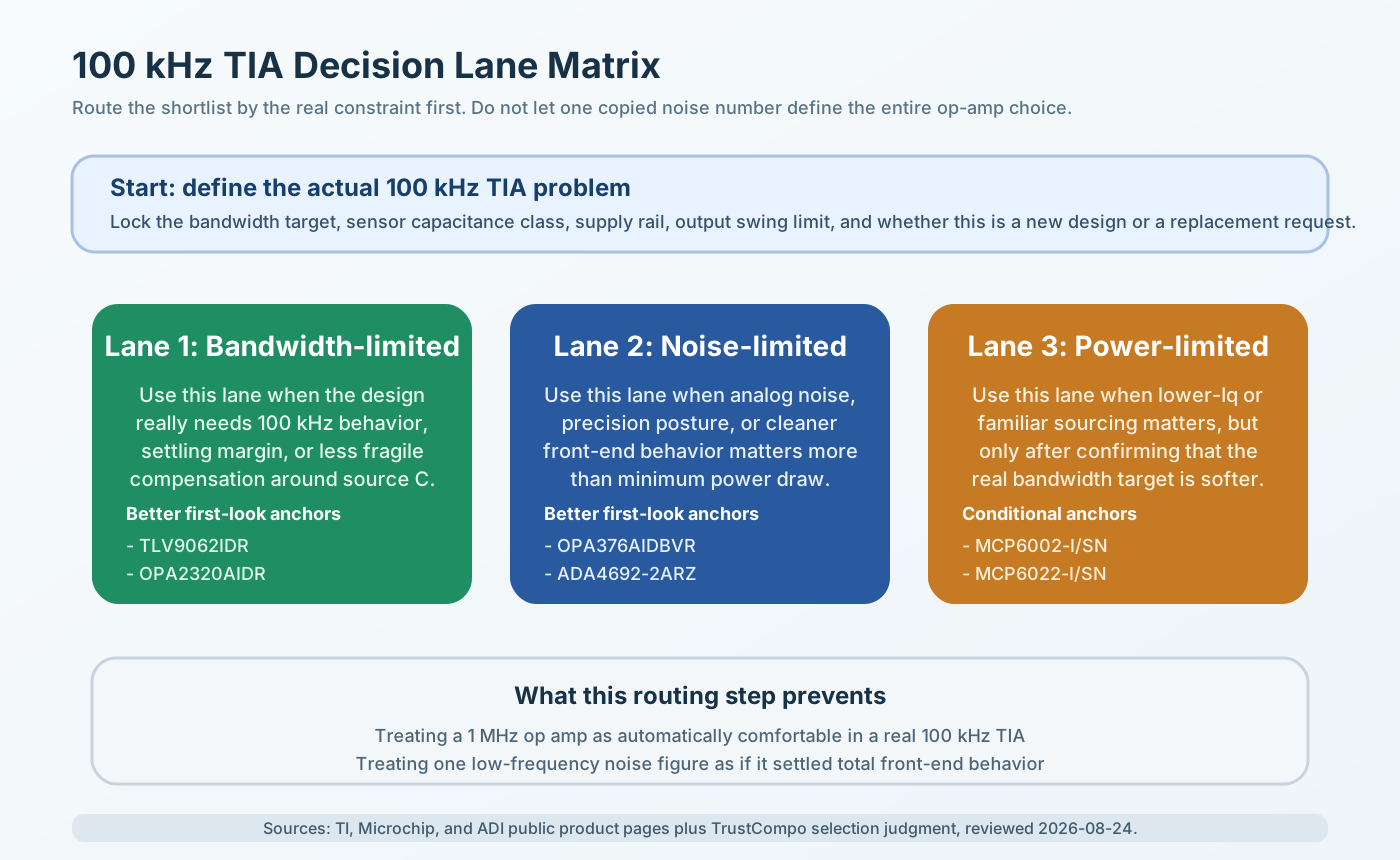
Three points matter more than the raw table suggests.
GBW is not just a comfort metric
At a 100 kHz target, a 1 MHz op amp such as MCP6002-I/SN is already spending a meaningful fraction of its open-loop bandwidth budget just to stay in the conversation. In plain terms, a nominal 1 MHz GBW-to-100 kHz target ratio is only about 10:1 before the design has paid for rising TIA noise gain, sensor capacitance, and real compensation needs. That does not mean it can never work. It means the rest of the design has far less room to absorb sensor capacitance, compensation adjustments, and layout variation before the loop starts to feel strained.
By contrast, TLV9062IDR, OPA376AIDBVR, MCP6022-I/SN, and especially OPA2320AIDR enter the same conversation with much more bandwidth headroom. In TIA work, that headroom is often the difference between a design that is merely simulated into place and one that remains easier to stabilize across production realities.
Two simplified equations are useful as a first-pass reality check:
$$ f_{-3\mathrm{dB}} \approx \sqrt{\frac{\mathrm{GBW}}{2 \pi R_f \left(C_s + C_{\mathrm{in}} + C_f\right)}} $$
$$ C_f \gtrsim \sqrt{\frac{C_s + C_{\mathrm{in}}}{2 \pi R_f \cdot \mathrm{GBW}}} $$
These are not a substitute for full loop analysis, but they are good enough to show why a low-GBW part can run out of room quickly. For example, if we assume Rf = 100 kOhm, Cs = 20 pF, op-amp input capacitance in the single-digit-pF class, and GBW = 1 MHz, the estimated closed-loop bandwidth lands only in the rough neighborhood of the target rather than comfortably above it. At that point, MCP6002-I/SN is no longer carrying generous phase-margin reserve; it is depending on careful Cf tuning and favorable parasitics. The same topology built around a 10 MHz-class part starts from a much healthier stability budget.
The lowest noise number is not the whole noise story
Input-voltage noise still matters. It absolutely belongs in the selection pass. But in a TIA, total output noise also sees:
- feedback-resistor Johnson noise
- source-capacitance interaction with noise gain
- the chosen compensation capacitor
- the frequency range over which the design is expected to stay useful
That is why a part such as OPA376AIDBVR can look compelling on noise, while TLV9062IDR can still remain a rational pick if the designer values wider bandwidth margin and easier 100 kHz positioning more than the last step of low-frequency noise improvement.
Input bias current and output swing still matter, but they are not the first split here
For some photodiode or picoamp-class problems, input bias current becomes a first-order concern. For some low-voltage single-supply designs, output swing and common-mode behavior become non-negotiable. Those are real gates, but they should be read after the larger question is answered: is the device fundamentally comfortable in a 100 kHz TIA loop at all?
In this specific comparison, that bias-current screen is easier to frame because TLV9062IDR, MCP6002-I/SN, OPA376AIDBVR, and the other reference anchors here are all CMOS-input amplifiers. That shared architecture is one reason picoamp-class input bias current is a native strength across the shortlist, and why the main selection tension in this article stays centered on GBW, noise gain, and compensation margin rather than on a bipolar-versus-CMOS input tradeoff.
That still deserves an explicit design rule: if the source current is very small, the source impedance is very high, or DC accuracy at very low signal level is a major constraint, run a separate bias-current suitability check before narrowing the shortlist on GBW and voltage-noise arguments alone.
3. Deep dive: TLV9062 vs. MCP6002 and replacement risks
TLV9062IDR usually makes more sense than MCP6002-I/SN when the design target is genuinely near 100 kHz and the engineer wants to avoid living at the edge of the op amp's bandwidth budget. That comparison becomes clearer when both parts are treated as design-position choices rather than as isolated spec tables.
The stronger case for TLV9062IDR looks like this:
- the bandwidth target is real, not nominal
- the source capacitance is not trivial
- the feedback network is likely to need tuning
- faster settling or less fragile compensation matters
- the team wants a better chance of reusing the front end across small sensor or layout changes
This is not the same as saying TLV9062IDR wins every TIA. It is saying that its 10 MHz GBW makes it a more natural starting point than a 1 MHz device when the design brief already says "100 kHz."
That difference also shapes replacement language. If a design was first tuned around TLV9062IDR, replacing it with MCP6002-I/SN is not a routine power-optimization exercise. It is a risk review.
It would be lazy to write MCP6002-I/SN out of the article just because its bandwidth and noise numbers look less favorable on paper. It still has legitimate use cases, especially when the real application is less aggressive than the title suggests.
MCP6002-I/SN can still be a defensible option when:
- the practical bandwidth target sits below the nominal 100 kHz headline
- the sensor capacitance is modest
- the front end is not trying to squeeze the last noise margin out of the design
- low supply current and simple availability matter more than high analog headroom
- the team is willing to validate a more conservative feedback-compensation choice
In other words, MCP6002-I/SN is not a "bad part." It is a part that can become too optimistic a choice when readers assume a 100 kHz TIA is a casual extension of a slower sensor front end.
The most commercially useful replacement answer is therefore simple:
Sometimes, but only after a real validation pass.
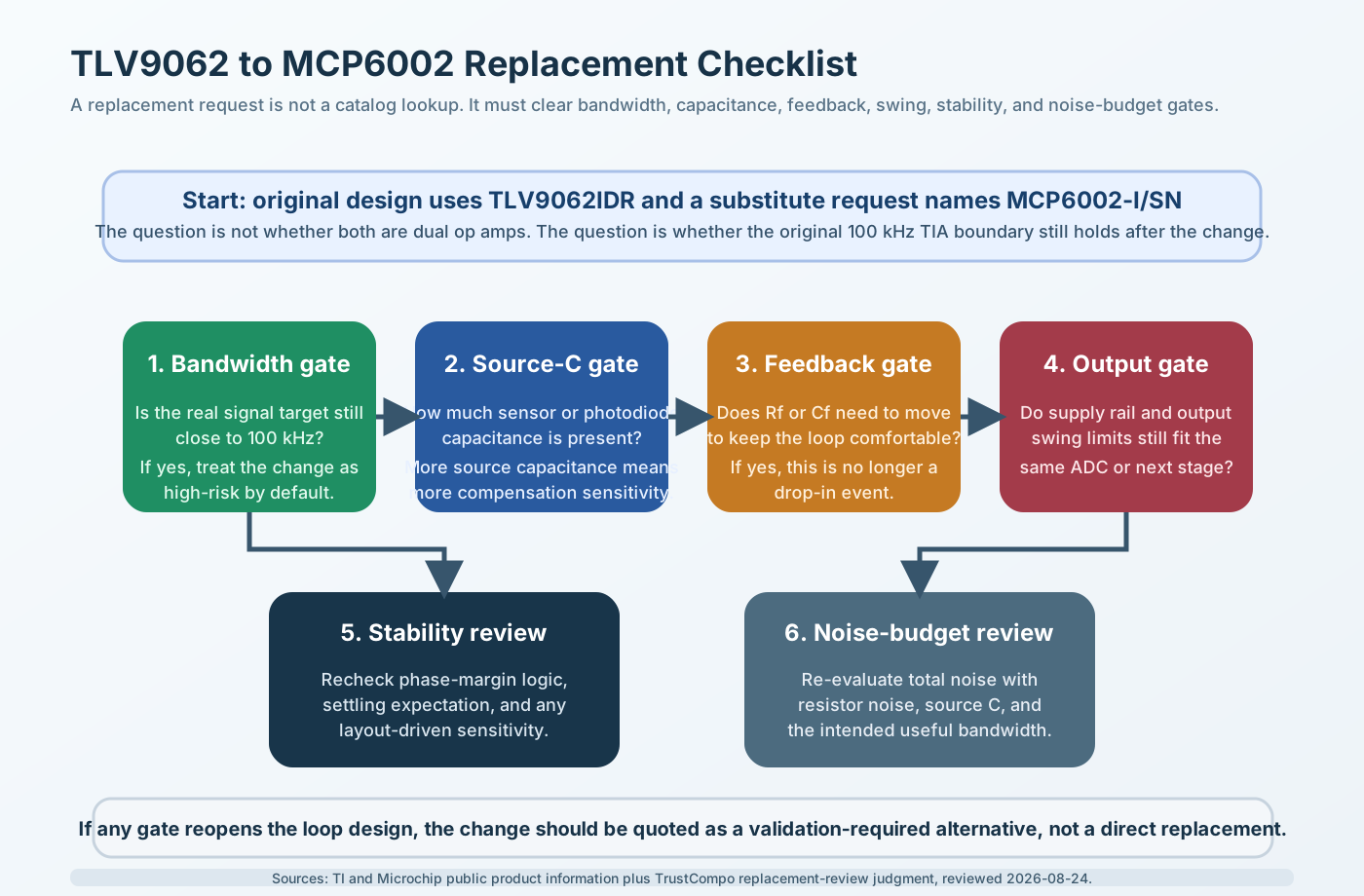
Use the checklist below before treating MCP6002-I/SN as a replacement path for TLV9062IDR:
| Check | Why it matters |
|---|---|
| Is the actual required signal bandwidth still close to 100 kHz? | If yes, the 1 MHz GBW of MCP6002-I/SN becomes much more uncomfortable. |
| What is the sensor or photodiode capacitance? | More capacitance usually raises TIA compensation sensitivity. |
| Does the feedback network need to change? | A replacement that forces new Rf/Cf tuning is not a drop-in event. |
| Is output swing still safe on the actual supply rail? | Single-supply headroom can invalidate a seemingly similar device. |
| Has the phase-margin assumption been rechecked? | A stable-looking DC design can still become peaky or marginal in the real loop. |
| Is the noise budget still acceptable after resistor and loop effects are included? | Even if the gain target is met, the front-end noise may no longer be acceptable. |
That is the right substitution posture for this topic: not "yes," not "no," but "possible only after design-specific review." If a design was first tuned around TLV9062IDR, replacing it with MCP6002-I/SN is not a routine power-optimization exercise. It is a loop-stability and margin review.
4. Beyond the binary: engineering decision matrix
One of the weaknesses of a strict two-part comparison is that it can trap the reader inside a false binary. Sometimes the right conclusion is not "TLV9062IDR or MCP6002-I/SN." It is that the design target is asking for a different class of amplifier.
That is where the reference anchors help:
OPA376AIDBVRis useful when the designer wants lower-noise precision behavior and can accept a single-channel path.ADA4692-2ARZis useful as a low-noise dual reference anchor when the team wants a cleaner analog posture than low-power baseline parts usually offer.OPA2320AIDRis useful when the problem is starting to look like a bandwidth- and settling-margin issue first.MCP6022-I/SNis useful when the reader still wants a Microchip dual option but needs a much faster family thanMCP6002-I/SN.
The matrix below is not a universal winner table. It is a fast routing tool.
| Design situation | Best first look | Why |
|---|---|---|
| A true 100 kHz TIA with meaningful source capacitance and limited appetite for compensation risk | TLV9062IDR | More bandwidth headroom than MCP6002-I/SN and a more natural fit for the stated target |
| A lower-speed or more relaxed current-to-voltage front end where power and availability matter strongly | MCP6002-I/SN | Can still be viable if the real bandwidth target is softer than the headline |
| A lower-noise single-channel path where precision matters more than lowest quiescent current | OPA376AIDBVR | Useful low-noise reference anchor with better analog polish than the baseline parts |
| A dual-channel, cleaner low-noise analog path | ADA4692-2ARZ | Good reference for teams who need a more performance-oriented dual option |
| A faster, wider-headroom route when 100 kHz already feels conservative | OPA2320AIDR | Helpful when the issue is no longer only noise but settling and bandwidth margin |
| A faster Microchip-family alternative to the 1 MHz baseline | MCP6022-I/SN | Keeps a Microchip option on the table while changing the speed class materially |
If the sensor is bias-current-sensitive, add one more filter before final selection: do not assume that a part wins simply because its GBW and voltage-noise lane looks better. In very small-current front ends, input bias current and input-current-noise behavior can still veto an otherwise attractive shortlist entry.
The useful decision rule is simple: start by deciding whether the design is bandwidth-limited, noise-limited, power-limited, or sourcing-limited. Only then compare part numbers inside the correct lane.
5. Scope boundaries and final takeaway
This article intentionally does not claim bench-measured noise plots, verified phase-margin data on a physical PCB, one universal winner across all TIA topologies, or a guaranteed drop-in replacement between TLV9062IDR and MCP6002-I/SN. It also does not claim that one quoted nV/√Hz figure alone predicts finished-circuit noise. That shortcut is exactly what causes readers to overtrust oversimplified op-amp comparison content.
The narrower and more useful takeaway is this: the official datasheets already show that TLV9062IDR and MCP6002-I/SN do not belong to the same comfort zone for a 100 kHz TIA, and the replacement question is fundamentally about loop stability and bandwidth margin rather than about one low-frequency noise line item. If the project really needs a 100 kHz transimpedance front end, TLV9062IDR generally starts from a much stronger position because the bandwidth headroom is more believable. MCP6002-I/SN may still be acceptable in softer or lower-stress designs, but it should not be treated as an automatic substitute. If the target is stricter, the right move is often to widen the shortlist toward OPA376AIDBVR, ADA4692-2ARZ, OPA2320AIDR, or MCP6022-I/SN instead of forcing a two-part comparison to answer a question it was not built to answer.
TrustCompo RFQ Support
If your team is deciding between TLV9062IDR, MCP6002-I/SN, OPA376AIDBVR, ADA4692-2ARZ, OPA2320AIDR, or MCP6022-I/SN, the useful next step is not a generic price check. It is a design-aware review of:
- target bandwidth
- source or photodiode capacitance
- feedback resistor and compensation capacitor range
- supply voltage and output swing limits
- whether the change is a new design choice or a replacement request
TrustCompo can support that review together with MPN-level RFQ follow-up, so the sourcing decision does not get detached from the real TIA boundary conditions.
If your team is building a broader component-comparison playbook, this article also pairs naturally with MOSFET Selection Guide for Power Design: A Buyer's Framework for Voltage Class, Losses, Package, and Sourcing Risk and Domestic vs. Imported Zener Diodes: When Can You Safely Cross-Refer?, because all three topics follow the same rule: shortlist by the real engineering boundary first, then let commercial screening happen inside the valid lane.
For direct sourcing next steps, use Alternative Solutions when the issue is replacement risk, or submit an RFQ when the shortlist is already narrow and the main question is availability, lead time, and controlled sample support.