- MOSFET
- power design
- selection guide
- TO-220
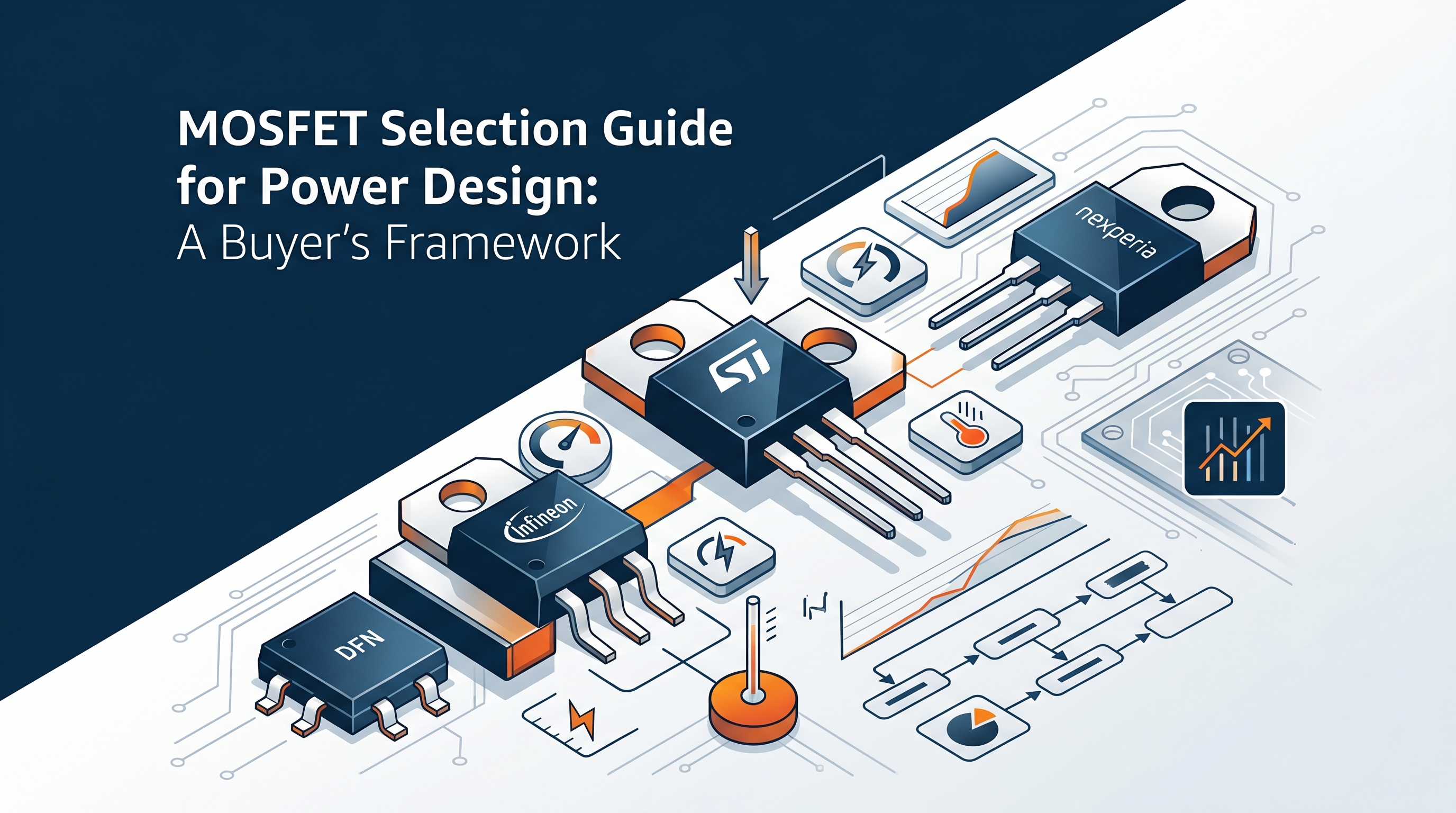
MOSFET Selection Guide for Power Design: A Buyer's Framework for Voltage Class, Losses, Package, and Sourcing Risk
A practical MOSFET selection guide for power design teams covering voltage class, Rds(on), gate charge, package thermal limits, and sourcing-safe alternative logic.
Quick facts
- The first MOSFET filter is the real operating voltage plus transient margin, not unit price or headline current.
- A lower-Vds MOSFET should never be approved as a substitute for a higher-voltage design slot.
- Package class such as LFPAK56, D2PAK, TO-220, and TO-247 changes thermal handling, serviceability, and PCB constraints.
- Rds(on) only becomes meaningful after voltage class, package, and gate-drive margin are already valid.
Many MOSFET selection guides start from the datasheet and stop at the datasheet. That is useful for device physics, but it is not enough for a real project handoff between engineering and procurement. In production, a power MOSFET decision is rarely about one parameter. It is usually a tradeoff between voltage class, conduction loss, switching behavior, package thermal headroom, driver margin, and whether the part can still be sourced six months from now.
This guide is written for that combined decision. It is meant for teams choosing between low-voltage synchronous designs, 250V industrial stages, 600V offline power, or a possible move into SiC. It is also meant for buyers who need a shortlist that does not create hidden redesign work. The framework is simple: select the right voltage class first, then narrow by loss and package, then check the sourcing risk before you approve any alternative.
1. Start with the four filters that eliminate most bad choices
The fastest way to avoid a wrong MOSFET is to stop comparing parts that should never be in the same shortlist.
| Filter | What to ask first | Why it matters |
|---|---|---|
| Voltage class | What steady-state bus voltage, surge margin, and topology stress does the switch actually see? | This removes invalid substitutions immediately. A 60V part does not belong in a 250V or 600V shortlist. |
| Loss balance | Is the design conduction-loss dominated, switching-loss dominated, or thermally constrained by both? | It tells you whether lower Rds(on), lower gate charge, or a different package creates more real value. |
| Package path | Does the design need LFPAK56, D2PAK, TO-220, or TO-247 class thermal behavior? | Package changes can turn a "simple source switch" into a PCB or heatsink change. |
| Supply posture | Is this a stable catalog part, a high-risk allocation family, or a part that needs immediate second-source work? | A technically acceptable part can still be the wrong commercial choice if lead time or supply concentration is too high. |
That sequence matters. Teams often start with current rating or unit price because those numbers are easy to compare. In practice, the safer order is Vds first, then thermal and switching behavior, then procurement risk. That is the order most likely to prevent a late-stage ECO.
2. Match the MOSFET to the real bus-voltage window
For most power designs, the best first-pass selector is voltage class plus application style.
| Design window | Typical applications | What usually matters most | Representative MPN anchors |
|---|---|---|---|
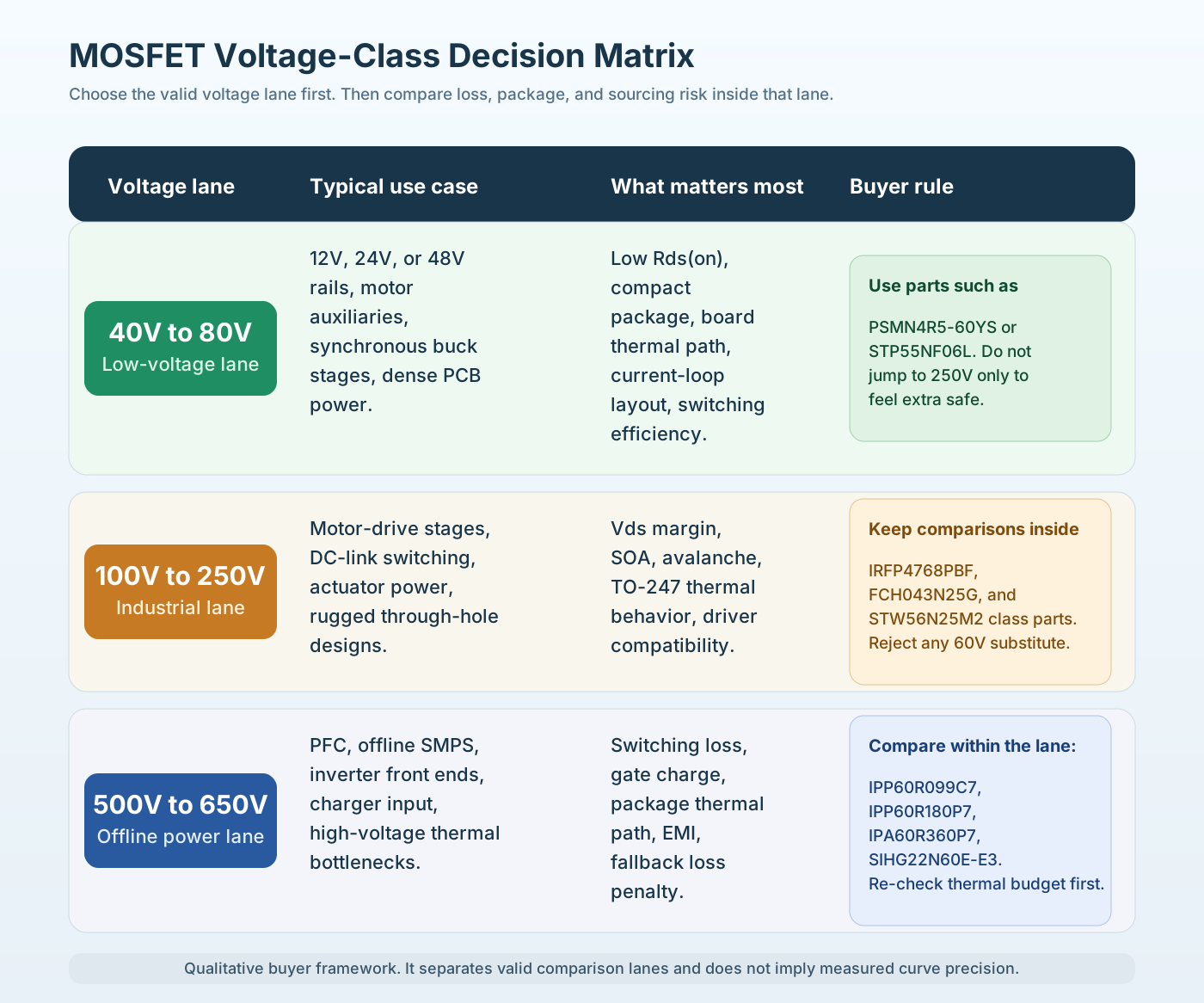
| 40V to 80V | 12V/24V/48V DC rails, motor control auxiliaries, synchronous buck stages | Very low Rds(on), package thermal resistance, current path layout | PSMN4R5-60YS, STP55NF06L |
| 100V to 250V | industrial motor drive, DC link switching, actuator power stages | Vds margin, SOA, avalanche behavior, TO-247 thermal handling | IRFP4768PBF, FCH043N25G, STW56N25M2 |
| 500V to 650V | PFC, offline SMPS, inverter front ends, charger input stages | switching loss, gate charge, package thermal path, EMI behavior | IPP60R099C7, IPP60R180P7, IPA60R360P7, SIHG22N60E-E3 |
| 650V and above | high-efficiency, higher-frequency, or thermally stressed stages | system-level efficiency, switching speed, driver design, EMI containment | SiC evaluation path after topology review |
The key judgment is straightforward: a part number should first earn the right to be on the shortlist by voltage class. Only after that should the team debate efficiency or price.
For example:
- PSMN4R5-60YS and STP55NF06L belong in low-voltage 60V conversations where conduction loss and compact package behavior are central.
- IRFP4768PBF, FCH043N25G, and STW56N25M2 belong in the 250V TO-247 conversation, where industrial robustness and same-class substitution logic matter more.
- IPP60R099C7, IPP60R180P7, IPA60R360P7, and SIHG22N60E-E3 belong in 600V offline power and PFC work, where switching loss and thermal headroom change the decision much faster than headline current rating.
3. Read the parameters that actually change field risk
Vds is a qualification gate, not a tuning knob
Drain-source voltage is the non-negotiable guardrail. If the original device is a 250V part, the alternative must stay at 250V or above. If the original device is a 600V part, the alternative must stay at 600V or above. That sounds obvious, but it is still the most expensive substitution mistake because a lower-voltage part can look attractive on price, current, or stock and still be physically wrong.
Rds(on) helps only inside the real thermal context
Low Rds(on) matters most when conduction loss dominates. That is common in lower-voltage rails and high-current stages. But a lower Rds(on) part is not automatically better if:
- the gate driver cannot switch it efficiently
- the package cannot remove the extra heat created elsewhere in the cycle
- the topology is actually switching-loss dominated
As a buyer-facing rule, Rds(on) should always be read together with package and gate charge. A part with modest Rds(on) but cleaner switching behavior can still win at the system level.
Gate charge decides whether the existing driver still has margin
Engineers often discover too late that the "drop-in" part asks more from the driver. Higher gate charge can slow transitions, increase switching loss, and stress timing margins in designs that were already tuned tightly. That is why procurement should treat gate-drive compatibility as part of alternative approval, not as an afterthought.
SOA and avalanche behavior matter most when the load is not polite
Motor drives, inductive loads, and industrial transients are where safe operating area becomes a selection issue instead of a datasheet footnote. If the application sees abnormal current pulses, startup stress, or imperfect snubbing, a neat parameter comparison is not enough. The device needs enough real operating margin in the failure cases too.
Package is a thermal and service decision
TO-220, TO-247, LFPAK56, and D2PAK are not cosmetic packaging choices. They affect heatsink strategy, creepage layout, service replacement, and assembly flow.
- LFPAK56 is attractive in dense low-voltage layouts where PCB thermal design does most of the work.
- D2PAK is a practical surface-mount option when assembly speed matters but the design still needs more copper-spreading and board-level thermal mass than small-outline packages can provide.
- TO-220 is often a practical middle ground for offline power when the thermal plan is controlled and assembly cost matters.
- TO-247 is still a dependable choice when higher power, larger thermal mass, or easier service handling is needed.
That makes package one of the clearest reasons a technically "close" part may still be a poor commercial substitute.
The package decision becomes easier when the team treats it as a system constraint instead of an aesthetic choice:
| Package | Typical use case | Main strength | Main caution |
|---|---|---|---|
| LFPAK56 | compact low-voltage rails, dense board layouts | low parasitics, strong board-level thermal path | depends heavily on PCB copper and assembly quality |
| D2PAK | higher-current surface-mount stages, power boards that avoid through-hole assembly | easier automated assembly with more thermal mass than smaller SMT packages | board area and thermal spreading must be designed deliberately |
| TO-220 | serviceable offline power and general industrial stages | simple heatsink strategy, broad availability | thermal result depends strongly on mounting method and interface material |
| TO-247 | higher-power industrial, inverter, and offline stages | stronger thermal headroom and easier manual service | larger footprint and higher mechanical volume |
4. A practical shortlist by design goal
The table below is not a universal AVL. It is a buyer-facing starting set for structured evaluation.
| Design goal | Example part | Voltage / package anchor | Why it stays on the shortlist | Approval caution |
|---|---|---|---|---|
| Low-voltage, high-current rail with strong conduction-loss pressure | PSMN4R5-60YS | 60V, LFPAK56 | Useful when PCB density and low-loss low-voltage switching are both important | Keep it inside 60V-class work only |
| Low-voltage legacy repair or broad TO-220 availability path | STP55NF06L | 60V, TO-220 | Common 60V-class anchor when teams need a more serviceable package path | Not a substitute for 250V or 600V positions |
| Industrial 250V baseline for motor-drive style work | IRFP4768PBF | 250V, TO-247 | Good reference point for rugged 250V industrial selection conversations | Verify gate-drive margin and thermal fit on the exact load profile |
| Same-class 250V alternative with similar package logic | FCH043N25G | 250V, TO-247 | Keeps the discussion inside the correct voltage and package class | Check Rds(on), current derating, and switching behavior before release |
| Secondary 250V alternative when pricing or supply posture shifts | STW56N25M2 | 250V, TO-247 | Gives buyers another same-class option instead of dropping voltage class | Confirm system loss and thermal response, not just package fit |
| Mainstream 600V offline power anchor | IPP60R099C7 | 600V, TO-220 | Strong benchmark for PFC and offline power comparison work | Review current availability because 600V families can tighten quickly |
| 600V alternative with closer loss profile than very high-Rds(on) fallbacks | IPP60R180P7 | 600V, TO-220 | Useful when the team needs to stay in the same bus-voltage class with less thermal penalty | Still validate conduction loss against the original |
| 600V contingency path when stock pressure is severe | IPA60R360P7 | 600V, TO-220 fullpack | Can keep a project moving when supply is the main problem | Its higher Rds(on) can force a thermal re-check |
| 600V TO-247 continuity option for industrial or offline stages | SIHG22N60E-E3 | 600V, TO-247 | Keeps the shortlist grounded in a higher-voltage through-hole package path | Validate avalanche, switching loss, and heatsink assumptions |
A practical inference from this list: the parts above do not compete on one line. They compete inside their own valid voltage and package lanes. That is why a serious MOSFET selection guide should look more like a decision matrix than a ranking list.
5. Two application scenarios where the shortlist changes for good reasons
The fastest way to misuse a MOSFET guide is to assume every project wants the same winner. It does not. The correct shortlist changes with the failure mode the team is trying to avoid.
Scenario A: 48V high-current rail where conduction loss dominates
In a 48V rail, the wrong move is often choosing a part that looks rugged but carries unnecessary switching or package penalty. This is where low-voltage parts such as PSMN4R5-60YS or a serviceable TO-220 path such as STP55NF06L make sense as discussion anchors. The review question is not "which one is bigger." It is:
- does the layout support the chosen thermal path
- does the package fit the assembly and field-service plan
- does the gate-drive and current profile justify the device
For this scenario, pushing the shortlist upward into 250V parts is usually a commercial mistake. The extra voltage class does not create value if the real operating window does not need it.
Scenario B: 600V offline PFC stage where switching loss and thermal headroom dominate
In an offline front end, the failure mode is different. The part has to survive the real bus and transient environment, and the thermal penalty of a fallback can become more expensive than the original stock problem. That is why IPP60R099C7, IPP60R180P7, IPA60R360P7, and SIHG22N60E-E3 belong in one review lane. Here the questions are:
- is the alternative still safely inside the 600V class
- does higher Rds(on) create an unacceptable conduction-loss penalty
- does the package and switching behavior still fit the thermal budget
This is also the point where SiC becomes a serious evaluation path. Not because it is fashionable, but because some designs run out of margin before they run out of alternatives.
6. Four substitution mistakes that turn a source fix into a redesign
1. Replacing across voltage classes
This is the hard stop. A 60V part cannot rescue a 250V slot, and a 250V part cannot rescue a 600V offline design. If the replacement drops Vds below the original requirement, the shortlist is already wrong.
2. Comparing Rds(on) without checking the switching penalty
A part can look better on conduction loss and still perform worse in the full cycle if gate charge is higher or the transition profile is slower. This is especially relevant when moving between 600V superjunction options in TO-220 packages.
3. Treating the same package as proof of drop-in compatibility
TO-247 to TO-247 does not guarantee the same thermal result. TO-220 to TO-220 does not guarantee the same pin behavior, EMI profile, or current capability under the real heatsink condition. Package match is helpful, but it is not final approval.
4. Ignoring sourcing concentration until the part is already in allocation
The engineering team may optimize around a beautiful device that the purchasing team can only buy from one fragile supply lane. That is a valid design choice only if the supply risk is explicit. Otherwise, it becomes an avoidable program risk.
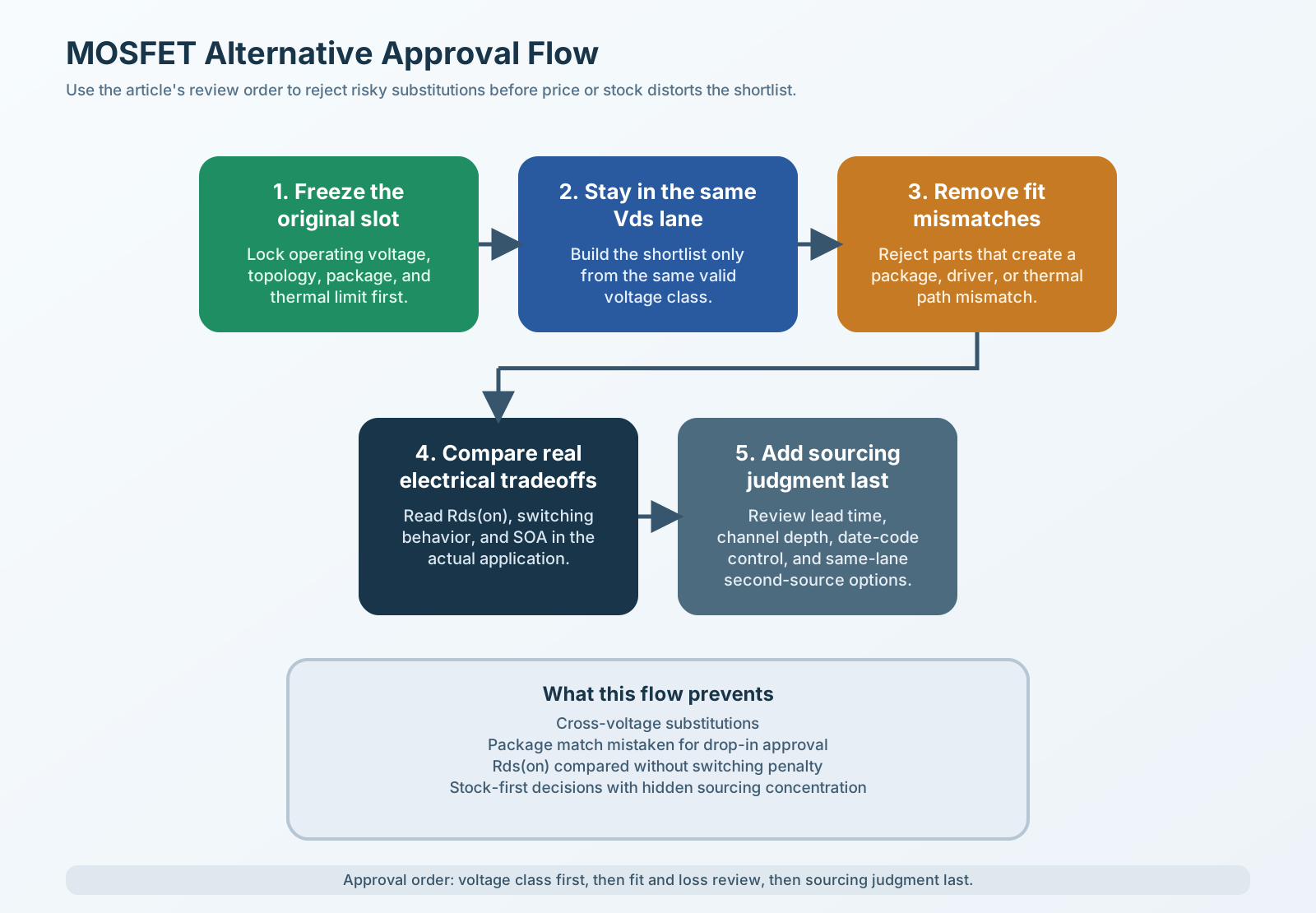
7. A decision table buyers can actually reuse
The table below is the part most teams can paste into an internal review note. It is deliberately simple: one column for the valid lane, one for the tempting but wrong move, and one for the approval logic.
| Original requirement | Valid comparison lane | Tempting but wrong move | Why it gets rejected |
|---|---|---|---|
| 48V or 60V-class rail, compact board, board-level thermal design | PSMN4R5-60YS, STP55NF06L, other 60V-class candidates | jumping to 250V TO-247 parts "for extra safety" | unnecessary voltage headroom can add package, cost, and switching penalty without solving the real loss problem |
| 250V industrial stage in TO-247 | IRFP4768PBF, FCH043N25G, STW56N25M2 | pulling in a 60V low-loss part because stock or price looks attractive | lower Vds invalidates the substitution immediately |
| 600V offline power stage in TO-220 or TO-247 | IPP60R099C7, IPP60R180P7, IPA60R360P7, SIHG22N60E-E3 | approving a higher-Rds(on) fallback without thermal re-check | the part may survive electrically but fail the efficiency or temperature budget |
| project under supply pressure with a technically valid alternative | same-voltage, same-package-class shortlist plus sourcing review | approving only on distributor stock screenshot | stock availability alone does not confirm driver fit, thermal fit, or field reliability |
8. Facts, inference, and TrustCompo judgment
To keep the article usable in review, these layers should stay separate.
Facts
- MOSFET alternatives must stay inside the required voltage class.
- Package class changes thermal and assembly behavior.
- Rds(on), gate charge, SOA, and avalanche behavior each affect whether an alternative is truly usable.
Inference
- The fastest way to reduce substitution errors is to sort candidate parts into valid voltage-package lanes before commercial comparison.
- Many cross-reference mistakes happen because buyers compare stock and current first, then discover package or voltage-class problems too late.
TrustCompo judgment
- For most operating teams, a buyer-facing MOSFET guide is more useful when it behaves like a rejection framework rather than a winner-picking ranking.
- The best internal review note usually starts with "which parts must be excluded" before it debates which candidate is cheapest or fastest to buy.
9. The buyer framework that survives beyond one BOM
If the goal is a repeatable process instead of one emergency substitution, use this sequence:
- Freeze the original device requirements: operating voltage, topology, package, and thermal limit.
- Build the candidate list only from the same valid voltage class.
- Remove any part that creates an obvious package or driver mismatch.
- Compare Rds(on), switching behavior, and SOA in the real application, not in isolation.
- Add procurement judgment last: lead time, channel depth, date-code control, and whether a second source exists in the same lane.
That approach creates a better internal handoff because engineering and sourcing are looking at the same boundaries. It also makes review faster: everyone can see whether the candidate failed on physics, thermal fit, or supply posture.
Conclusion
The most reliable MOSFET selection guide for power design is not the one with the longest parameter list. It is the one that prevents invalid comparisons early. Start with voltage class, keep the shortlist inside the right package lane, and read Rds(on) together with gate charge and thermal behavior. Then add sourcing judgment before the design is frozen.
Three actions are worth carrying into every new review:
- Keep low-voltage 60V parts such as
PSMN4R5-60YSandSTP55NF06Linside low-voltage work only. - Treat 250V TO-247 parts such as
IRFP4768PBF,FCH043N25G, andSTW56N25M2as one comparison lane, not as stand-ins for 600V offline parts. - For 600V decisions, compare
IPP60R099C7,IPP60R180P7,IPA60R360P7, andSIHG22N60E-E3with full attention to thermal consequences, not only stock status.
Need help turning the shortlist into a sourcing-safe AVL?
- Use submit a BOM review RFQ when you already know the exact MPN, package, and annual volume.
- Use Alternative Solutions when you need same-class options without dropping Vds or changing package logic blindly.
- Use Quality Assurance when the project risk is incoming authenticity, mixed date code, or uncontrolled open-market sourcing.