- automotive Ethernet PHY
- AEC-Q100
- 100BASE-T1
- 1000BASE-T1
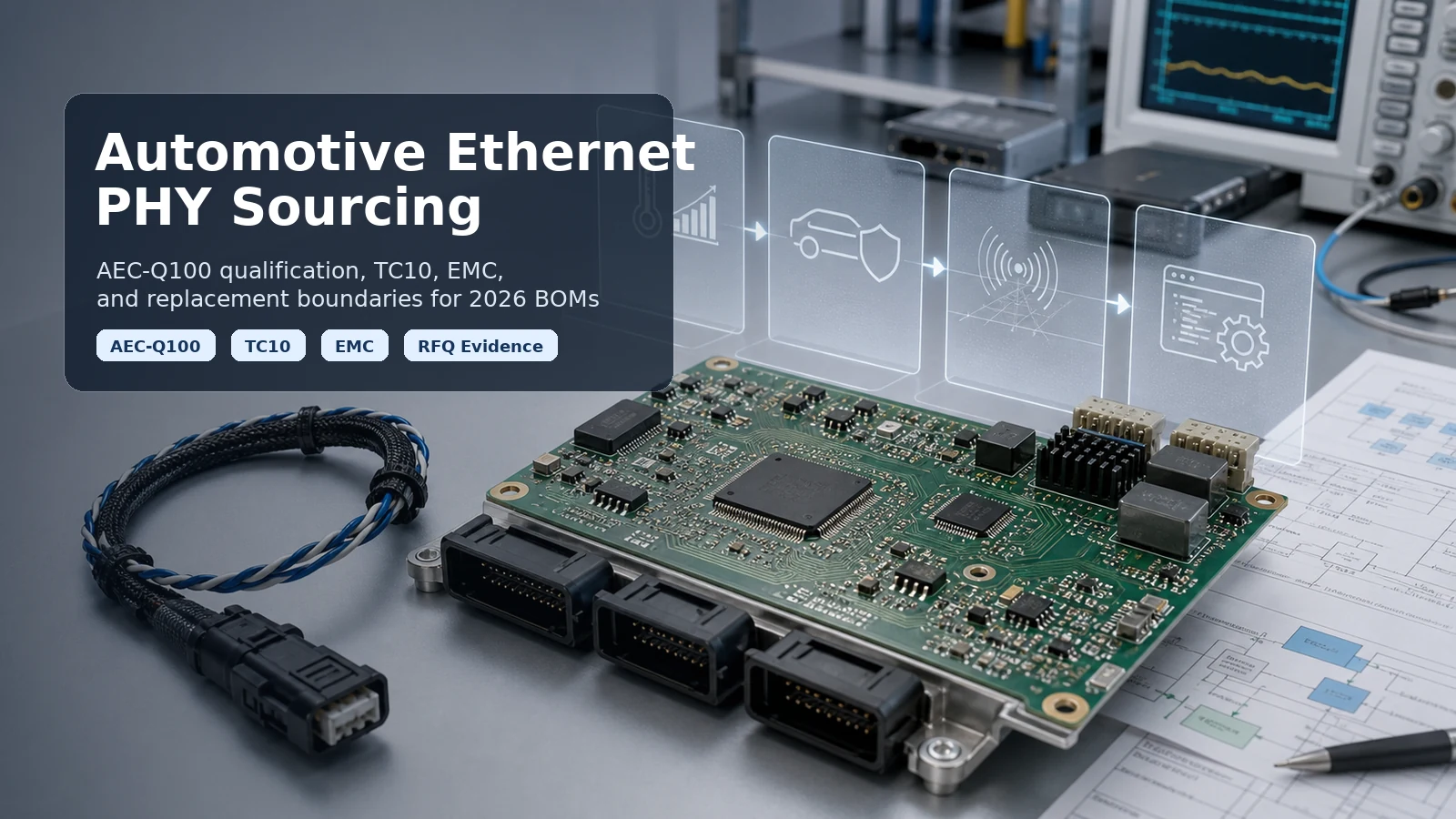
Automotive Ethernet PHY Sourcing in 2026: AEC-Q100 Qualification, Supply Risk, and Replacement Boundaries
A buyer and FAE guide to automotive Ethernet PHY sourcing in 2026, covering AEC-Q100 evidence, 10BASE-T1S / 100BASE-T1 / 1000BASE-T1 boundaries, TC10, EMC, software impact, and replacement risk.
Quick facts
- AEC-Q100 is only the first sourcing gate; buyers still need to verify speed class, host interface, package, TC10 behavior, EMC evidence, software support, and customer qualification scope.
- 10BASE-T1S, 100BASE-T1, and 1000BASE-T1 automotive Ethernet PHYs serve different network roles and should not be treated as interchangeable replacements.
- A credible RFQ for an automotive Ethernet PHY should request official qualification evidence, orderable MPN, package code, datasheet revision, distributor or allocation status, and engineering review notes.
Automotive Ethernet PHY sourcing in 2026 is no longer a narrow component search. For many gateway, ADAS, camera, radar, zonal controller, telematics, and infotainment programs, the PHY has become a qualification boundary between the digital design and the physical vehicle harness. A buyer can find a part that says "automotive Ethernet" in minutes. Proving that it belongs in a production BOM is the hard part.
The common shortcut is to screen only for AEC-Q100, data rate, and stock. That shortcut is dangerous. A 10BASE-T1S PHY for edge sensors, a 100BASE-T1 PHY for camera or domain links, and a 1000BASE-T1 PHY for backbone or high-bandwidth sensor aggregation may all sit under the "automotive Ethernet" umbrella, but they do not create the same design, EMC, software, or customer-approval burden.
The practical question for sourcing is not "which automotive Ethernet PHY is equivalent?" It is:
What evidence proves this device can enter the same production design without triggering an unacceptable requalification loop?
This guide treats automotive Ethernet PHY procurement as a buyer-plus-FAE workflow. It separates official facts, channel observations, and TrustCompo sourcing judgment so the decision does not collapse into a one-line cross-reference.
Start With The Replacement Boundary
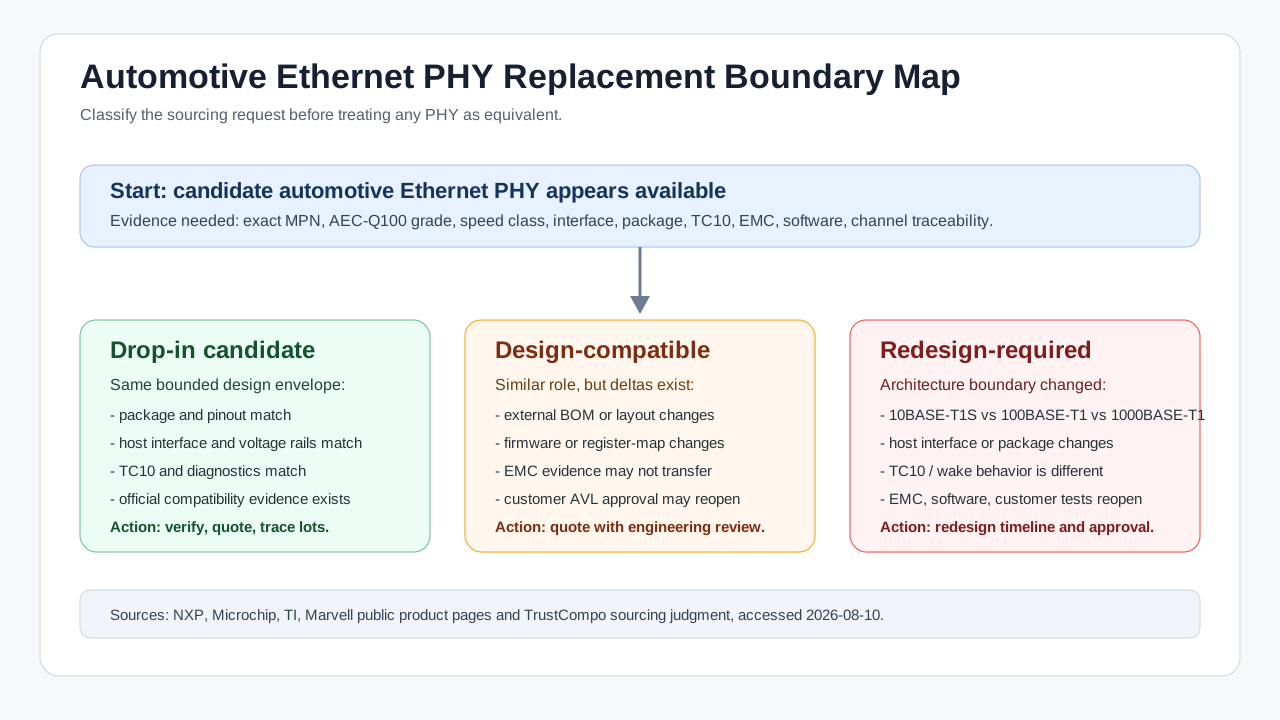
Before comparing part numbers, classify the sourcing request into one of three replacement categories.
| Replacement category | What it means | Buyer action | Engineering action |
|---|---|---|---|
| Drop-in candidate | Same vendor family or documented compatible assembly option; package, pinout, host interface, voltage rails, and software impact are bounded | Request official compatibility statement, latest datasheet, lifecycle status, lot traceability, and channel evidence | Confirm schematic, layout, register configuration, TC10 behavior, diagnostics, and EMC assumptions |
| Design-compatible substitute | Similar network role and speed class, but pinout, BOM, firmware, or validation evidence differs | Treat as a sourcing rescue path, not an instant substitution | Run schematic review, PCB impact review, driver/register delta, EMC risk review, and customer approval check |
| Redesign-required alternative | Different speed class, topology, package, host interface, safety feature set, or wake/sleep behavior | Quote only with redesign lead time and qualification assumptions attached | Reopen architecture, harness, PHY/MAC interface, software, EMC, and system validation |
TrustCompo judgment: most automotive Ethernet PHY "equivalents" belong in the second or third row until proven otherwise. Even when the headline data rate matches, the PHY can change the analog front end, diagnostics, wake behavior, layout constraints, and customer qualification package.
The map below turns that judgment into a buyer-facing triage step.
The Minimum Qualification Matrix
For a serious RFQ, buyers should not ask only for price and lead time. They should ask suppliers to complete a matrix like this before procurement commits to a substitute.
| Example MPN | Manufacturer | Network role | Speed class | Host interface | Package / physical clue | Qualification and design notes to verify |
|---|---|---|---|---|---|---|
TJA1101BHN/0Z | NXP | Established 100BASE-T1 PHY for automotive Ethernet | 100 Mbps | MII / RMII family context | HVQFN36 | NXP package/quality data lists TJA1101BHN/0Z as active under the TJA1101B HVQFN36 package. Verify the latest datasheet, TC10 behavior, and customer-specific qualification package before sourcing. |
TJA1103BHN/0J | NXP | Newer 100BASE-T1 PHY for edge and domain-controller links | 100 Mbps | Family documentation under NDA for some materials | HVQFN36 | NXP package/quality data lists TJA1103BHN/0J as active; the older TJA1103BHN/0Z ordering code should not be treated as the default because NXP marks it no longer manufactured. Treat TJA1103 as an engineered family choice, not a generic replacement. |
LAN8770M-E/PRAVAO | Microchip | 100BASE-T1 automotive PHY | 100 Mbps | MII / RMII for LAN8770M; RGMII belongs to LAN8770R variants | VQFN-32 | Microchip positions LAN8770 for IEEE 802.3bw 100BASE-T1, TC10, and Grade 1 automotive use cases. The owner has confirmed LAN8770M-E/PRAVAO as the complete MPN; still verify lot traceability, ordering-code evidence, and project-specific qualification scope during RFQ. |
LAN8670C2-E/LMX | Microchip | 10BASE-T1S edge / multidrop PHY | 10 Mbps half-duplex | MII / RMII / SC-MII family context | 32-VQFN for LAN8670 family | LAN8670 is a different topology class from 100BASE-T1 point-to-point links. The C2 orderable path should be checked against the buyer's packaging preference, but the family belongs in 10BASE-T1S edge and multidrop discussions, not 100BASE-T1 replacement lists. |
DP83TC812RRHATQ1 | Texas Instruments | TC10-capable 100BASE-T1 automotive PHY | 100 Mbps | MII / RMII / RGMII / SGMII family context | 36-pin VQFN wettable-flank package | TI lists this orderable part as active, automotive, RHA 36-pin VQFN, -40°C to 125°C, and TC10 compliant. Verify I/O voltage and MAC-interface mode. |
DP83TG720RWRHATQ1 | Texas Instruments | 1000BASE-T1 automotive PHY | 1000 Mbps | RGMII | 36-pin VQFN wettable-flank package | TI lists this orderable part as active, automotive, RHA 36-pin VQFN, -40°C to 125°C, and 1000BASE-T1 with RGMII. TI also states pin compatibility with its 100BASE-T1 PHY with required BOM change; TC10 support must not be assumed for the gigabit path. |
88Q2112-A2-NYD2A000 | Infineon Technologies | Current 88Q211x automotive Ethernet PHY OPN with Marvell legacy context | 100 / 1000 Mbps family context | RGMII / SGMII family context | PG-VQFN-48 | Infineon lists 88Q2112-A2-NYD2A000 as active and preferred under the 88Q211x family. Legacy public references may still use Marvell branding, so buyers should verify the latest Infineon support package, gated datasheet access, TC10/LPSD behavior, and customer qualification scope. |
This table is not a substitute approval list. It is the evidence structure a buyer should use before asking engineering to bless a substitution.
Why AEC-Q100 Is Necessary But Not Enough
AEC-Q100 matters because automotive ICs face temperature, stress, reliability, and documentation expectations that commercial parts are not built to satisfy. For many customers, a non-automotive-grade Ethernet PHY is not a cheaper substitute; it is a quality escape waiting to happen.
But AEC-Q100 is not a universal compatibility stamp. The practical sourcing questions are more specific:
- Which exact MPN and suffix are qualified?
- What grade and temperature range apply?
- Is the package the same as the package on the approved AVL?
- Does the qualification evidence match the customer use case?
- Does the supplier provide the reliability, PPAP, functional-safety, or traceability documents the customer expects?
- Is the device active, recommended for new design, or only available through residual channel inventory?
Official fact boundary: manufacturer product pages and datasheets are the source of truth for device status, qualification language, interface modes, package options, and documented features.
Channel observation boundary: distributor listings can help confirm market availability and package/orderable suffixes at research time, but they should not override manufacturer documentation.
TrustCompo judgment: if the qualification evidence is not tied to the exact orderable MPN, do not treat the part as approved for an automotive BOM.
Do Not Mix The Three Ethernet Classes
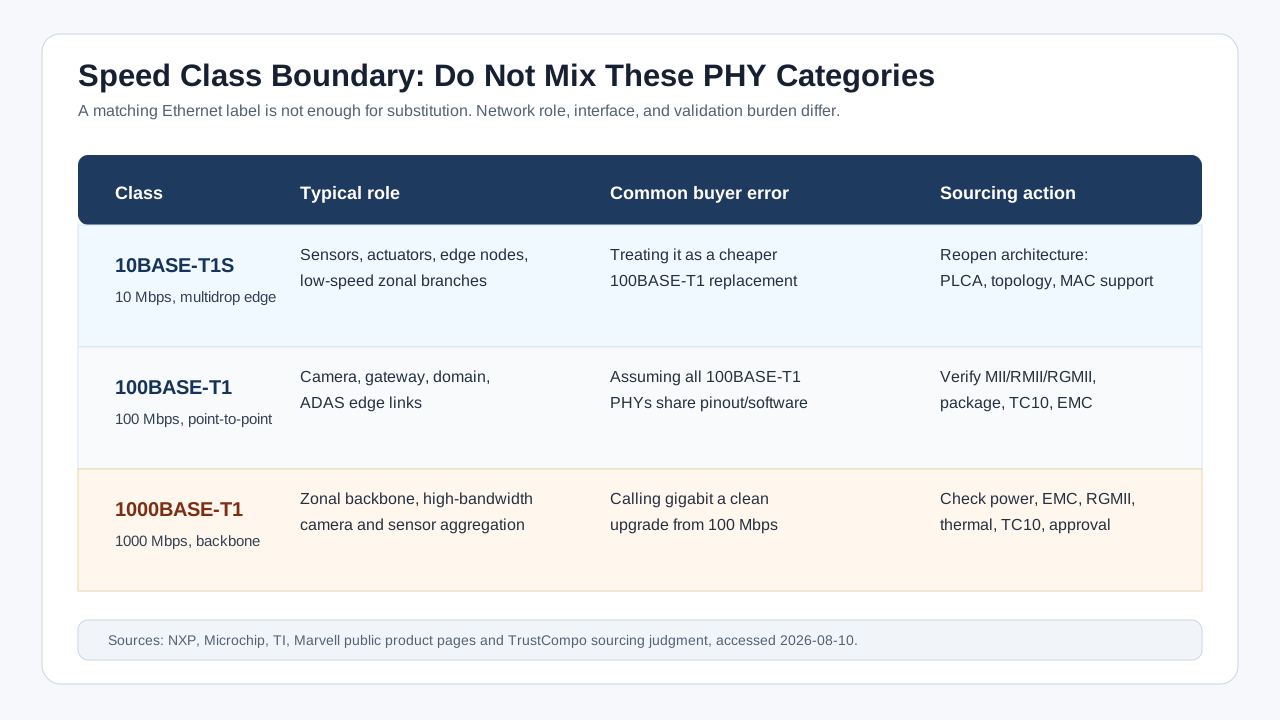
Automotive Ethernet sourcing gets messy because the marketing category is broad while the electrical and architecture choices are narrow.
| Class | Typical role | What buyers often get wrong | Procurement implication |
|---|---|---|---|
| 10BASE-T1S | Low-speed edge nodes, sensors, actuators, multidrop segments | Treating it as a cheaper 100BASE-T1 replacement | It is a topology and speed-class decision; confirm MAC support, PLCA, wake behavior, and network architecture |
| 100BASE-T1 | Point-to-point camera, gateway, domain, and edge links | Assuming every 100BASE-T1 PHY can drop into the same board | Verify MII/RMII/RGMII, pinout, package, external BOM, diagnostics, TC10, and EMC evidence |
| 1000BASE-T1 | High-bandwidth backbone, camera, ADAS, zonal aggregation | Assuming gigabit is a clean upgrade from 100 Mbps | Check power, thermal, EMC, RGMII timing, software, cable/harness assumptions, and customer requalification |
The right replacement sometimes stays within the same speed class. Sometimes the right answer is to re-source the original device, not redesign around a superficially available alternative.
The speed-class matrix below is meant to stop a common RFQ failure: treating every automotive Ethernet PHY as one interchangeable bucket.
TC10, Wake/Sleep, And Partial Networking Are Sourcing Risks
TC10 sleep/wake behavior is easy to miss in procurement because it does not look like a price or stock field. In the vehicle, it can matter as much as the speed rating.
If the original design depends on sleep/wake forwarding over the data line, partial networking, ultra-low sleep current, or a specific wake pin behavior, the substitute has to preserve that behavior. A PHY that passes the link test in the lab may still be wrong for the ECU if it changes wake timing, standby current, interrupt behavior, or system power sequencing.
For each candidate, ask:
- Is TC10 support explicitly documented for this exact part or family?
- Is wake supported over MDI, local wake pin, or both?
- Are
WAKE_IN,WAKE_OUT,INH, or equivalent pins present and mapped the same way? - Does the software stack expect a specific register map or interrupt behavior?
- Does the ECU power architecture depend on the PHY to enable or disable downstream supply rails?
This is where a purchasing-only replacement decision often fails. TC10 is not a checkbox to paste into an RFQ spreadsheet; it is part of the ECU power-state design.
EMC And Layout Decide Whether A Substitute Is Real
Automotive Ethernet PHYs sit at the border between silicon and the vehicle harness. That makes EMC and layout part of the sourcing decision.
Even when two parts support the same standard, the design may depend on:
- integrated or external line filtering
- common-mode choke choice
- ESD protection strategy
- MDI pin routing and symmetry
- single-pair cable assumptions
- connector and magnetics path
- return-loss and mode-conversion performance
- conformance test history for the customer's harness and ECU enclosure
If the original part was validated with a specific layout, external BOM, and EMC report, replacing the PHY can reopen that evidence package. A part with stronger integrated diagnostics or filtering can be attractive, but it still has to be validated in the actual board and cable context.
TrustCompo sourcing rule: do not call an automotive Ethernet PHY substitute "low risk" unless the buyer can point to the schematic delta, layout delta, software delta, and validation delta.
Software And Diagnostics Are Part Of The BOM
The physical part number is only one part of the replacement. The MAC interface, PHY address, management interface, register map, strap pins, diagnostics, driver support, and AUTOSAR or Linux integration can decide whether the substitute is feasible.
For example, a buyer comparing TJA1103BHN/0J, a candidate LAN8770M automotive orderable suffix, and DP83TC812RRHATQ1 may see "100BASE-T1 automotive PHY" in all three cases. Engineering will see a deeper list:
- Is the host using MII, RMII, RGMII, or a specific xMII mode?
- Are the required I/O voltages available?
- Does the ECU firmware use cable diagnostics or link quality monitoring?
- Does the customer require safety manual, FMEDA, or diagnostic coverage evidence?
- Is there an AUTOSAR driver, Linux driver, or vendor software package already used by the program?
- Are any documents gated by NDA, and can the buyer actually obtain them before committing?
If the software team cannot absorb the register and driver impact, the replacement is not procurement-ready.
A Practical RFQ Checklist
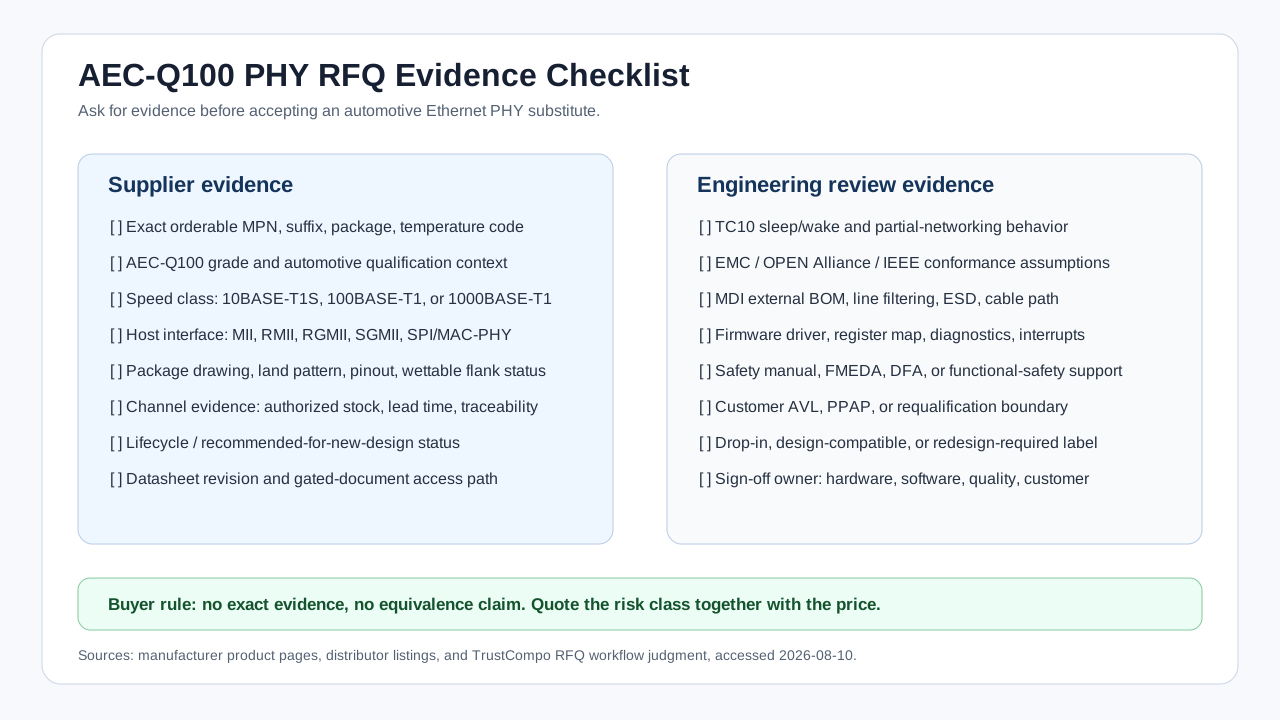
Use this checklist before accepting a quote for an automotive Ethernet PHY substitute.
| Gate | What to request | Why it matters |
|---|---|---|
| Exact orderable MPN | Full part number, suffix, package, temperature code, tape/reel code | Prevents quoting a family name instead of the approved purchasable device |
| Qualification evidence | AEC-Q100 grade, automotive rating, temperature range, reliability documents | Confirms automotive suitability for the exact device context |
| Network class | 10BASE-T1S, 100BASE-T1, or 1000BASE-T1; point-to-point or multidrop | Avoids false equivalence between different Ethernet architectures |
| Host interface | MII, RMII, RGMII, SGMII, SPI/MAC-PHY where relevant | Determines processor compatibility and software impact |
| Package and pinout | Package drawing, land pattern, pinout, wettable flank status | Determines whether the board can absorb the change |
| TC10 / wake behavior | Sleep current, wake path, INH / WAKE pins, partial networking notes | Protects ECU power-state behavior |
| EMC and conformance | OPEN Alliance, IEEE clause, EMC class, test references where available | Flags whether validation evidence can transfer |
| Software package | Driver, AUTOSAR package, safety manual, FMEDA, register documentation | Determines whether firmware and safety workflows can proceed |
| Channel evidence | Authorized distributor availability, lead time, allocation notes, traceability | Separates a real sourcing path from a search result |
| Customer approval boundary | Whether the substitute needs customer, PPAP, EMC, or design review approval | Prevents a quote from becoming an unplanned redesign |
The checklist may feel heavy for a single IC. In automotive Ethernet, that heaviness is the point: the PHY is small, but the validation envelope around it is large.
The checklist below is the short version a sourcing team can attach to an RFQ or escalation note.
When The Buyer Should Escalate
Escalate to hardware, software, quality, or the customer approval owner when any of these are true:
- the proposed part changes speed class
- the proposed part changes host interface
- package or pinout is not the same
- TC10 behavior is not explicitly matched
- the existing design uses vendor-specific diagnostics
- the official datasheet is gated, outdated, or not available for the exact suffix
- distributor stock exists but the manufacturer page does not confirm active status
- the substitute requires a different external BOM around the MDI pins
- the program is already in PPAP, SOP ramp, or customer-controlled AVL state
At that point, the sourcing task becomes a controlled engineering change, not a purchasing substitution.
Example Decision Paths
If The Original Is A 100BASE-T1 NXP PHY
A buyer replacing TJA1101BHN/0Z with another NXP 100BASE-T1 family member should still verify exact suffix, package, TC10 behavior, software impact, and whether the target device documentation is public or NDA-gated. NXP's TJA1103BHN/0J family signal is attractive because it sits in the same broad 100BASE-T1 automotive PHY space and brings ASIL B positioning, but it should be treated as a qualified engineering candidate rather than a blind replacement.
If The Candidate Is Microchip LAN8770M-E/PRAVAO
LAN8770M-E/PRAVAO belongs in the 100BASE-T1 sourcing conversation as a complete MPN confirmed by the owner. The buyer should still verify whether the design needs MII/RMII or the RGMII-capable LAN8770R path, whether the exact suffix matches the temperature and package requirement, and whether Microchip's functional-safety support package is accessible for the customer's workflow.
If The Candidate Is Microchip LAN8670C2-E/LMX
LAN8670C2-E/LMX is valuable, but it belongs to a different class: 10BASE-T1S. It is a strong candidate for edge sensor/actuator and multidrop use cases, not a direct replacement for a point-to-point 100BASE-T1 link. If it appears in a replacement list for TJA1101BHN/0Z, TJA1103BHN/0J, LAN8770M, or DP83TC812RRHATQ1, the buyer should stop and reopen the architecture discussion.
If The Candidate Is TI DP83TC812RRHATQ1
DP83TC812RRHATQ1 should be evaluated as a 100BASE-T1 automotive PHY with TC10 positioning and multiple host-interface options. The RFQ should ask for current datasheet revision, I/O voltage needs, and whether existing firmware already supports TI's register and diagnostics model.
If The Candidate Is TI DP83TG720RWRHATQ1 Or Infineon 88Q2112-A2-NYD2A000
DP83TG720RWRHATQ1 and 88Q2112-A2-NYD2A000 move the discussion into current gigabit Ethernet PHY sourcing. The Infineon-listed 88Q2112 OPN also carries Marvell legacy context, which is useful when older validation material, development boards, or customer AVL records still use Marvell naming. For any gigabit path, the buyer should expect EMC, power, thermal, software, wake/sleep, and customer-approval work. TI's public positioning around pin compatibility with a 100BASE-T1 PHY is useful, but even that language includes a BOM-change boundary, and TC10 support must not be assumed for the gigabit path.
Source Discipline For This Article
The article should be reviewed with three evidence buckets:
| Evidence bucket | Examples used here | How to use it |
|---|---|---|
| Official facts | NXP TJA1101B / TJA1103 product pages; Microchip LAN8770 / LAN8670 product pages; TI DP83TC812R-Q1 / DP83TG720R-Q1 product pages; Infineon 88Q2112-A2-NYD2A000 product page and legacy Marvell 88Q2112 public releases | Use for standards claims, status, temperature, package, speed, interface, TC10, safety, and documented features |
| Channel observations | Mouser, DigiKey, Arrow, Farnell-style listings discovered in research | Use for current availability and orderable suffix checks, but recheck before quote or publication |
| TrustCompo judgment | Replacement categories, escalation gates, RFQ checklist, qualification boundaries | Use as buyer guidance, not as a claim that any two parts are approved substitutes |
This separation protects the article from two common failures: copying a manufacturer page without adding buyer value, or overclaiming a cross-reference that engineering has not validated.
Conclusion
Automotive Ethernet PHY sourcing in 2026 should be treated as a qualification workflow, not a keyword search. AEC-Q100 is mandatory for many programs, but it is only the first gate. The real sourcing decision depends on the exact MPN, speed class, package, host interface, TC10 and wake behavior, EMC evidence, software support, channel traceability, and customer approval boundary.
For buyers, the safest language is not "equivalent." It is one of three labels: drop-in candidate, design-compatible substitute, or redesign-required alternative. That framing gives procurement, engineering, quality, and the customer approval owner a shared way to decide whether a quote can move forward.
TrustCompo RFQ Support
TrustCompo can help source automotive Ethernet PHYs such as TJA1101BHN/0Z, TJA1103BHN/0J, LAN8770M-E/PRAVAO, LAN8670C2-E/LMX, DP83TC812RRHATQ1, DP83TG720RWRHATQ1, 88Q2112-A2-NYD2A000, and related 100BASE-T1 / 1000BASE-T1 / 10BASE-T1S devices.
For automotive programs, send:
- the original approved MPN and any target replacement candidate
- application block, required speed class, host interface, and temperature grade
- TC10, EMC, software, safety, PPAP, AVL, or customer-controlled approval constraints
- preferred manufacturers, current quote gap, and required delivery window
We will separate stock availability from qualification risk so the RFQ does not turn into an uncontrolled redesign.