- mosfet
- supply-continuity
- allocation
- power-semiconductor
Power MOSFET Supply Continuity 2026: Vishay, Onsemi, Infineon, and Second-Source Checks
A 2026 power MOSFET supply-continuity framework for Vishay, Onsemi, Infineon, and adjacent Nexperia exposure, with Vds, Rds(on), Qg, package, thermal, and traceability checks.
Quick facts
- The article treats 2026 MOSFET risk as selective family-level exposure, not a brand-wide or portfolio-wide stockout.
- High-voltage 600V and 250V power-MOSFET BOM slots need separate review from 60V LFPAK or logic-level parts.
- Second-source approval should verify Vds, Rds(on), Qg, package, thermal path, avalanche rating, and gate-driver compatibility.
- Nexperia 60V LFPAK context is adjacent only; it is not a replacement path for 250V or 600V MOSFET positions.
The useful 2026 question is not whether every Vishay, Onsemi, and Infineon MOSFET is in shortage. They are not. The useful question is which power MOSFET positions on a production BOM deserve supply-continuity review because the same MPN combines high voltage, constrained package class, limited second-source readiness, price-change exposure, or weak traceability.
This framework keeps the market signal below the engineering checks. It reviews 600V CoolMOS and Vishay E-Series parts, 250V TO-247 industrial MOSFET positions, and adjacent 60V Nexperia LFPAK exposure, then turns those signals into a second-source checklist based on Vds, Rds(on), Qg, package, thermal resistance, avalanche rating, gate-drive compatibility, and receiving traceability.
Evidence Boundary and Source Basis
The article uses public market notes and product-page anchors as buyer inputs, not as proof that every vendor line is constrained. Treat the table below as the boundary for the claims that follow.
| Evidence lane | What it supports | What it does not prove | Buyer use |
|---|---|---|---|
| Public price and allocation notes from Feb-May 2026 | Price-change and allocation-review signals for selected MOSFET and power-device families | Exact live inventory, final negotiated price, or universal brand-wide shortage | Trigger MPN-level RFQ refresh and supply agreement review |
| TrustCompo product anchors for IPP60R099C7, IRFP4768PBF, SIHG22N60E-E3, and related candidates | Concrete voltage, package, and family examples for BOM triage | Automatic drop-in equivalence | Start datasheet comparison from exact MPNs |
| Datasheet-style parameter review | Electrical and mechanical boundaries for second-source screening | Production approval by itself | Route engineering checks before PO substitution |
| TrustCompo procurement judgment | Which families deserve earlier review based on voltage class, package, application, and source signals | A guaranteed shortage forecast | Decide whether to lock supply, qualify alternates, or monitor |
What happened, and how should buyers read it?
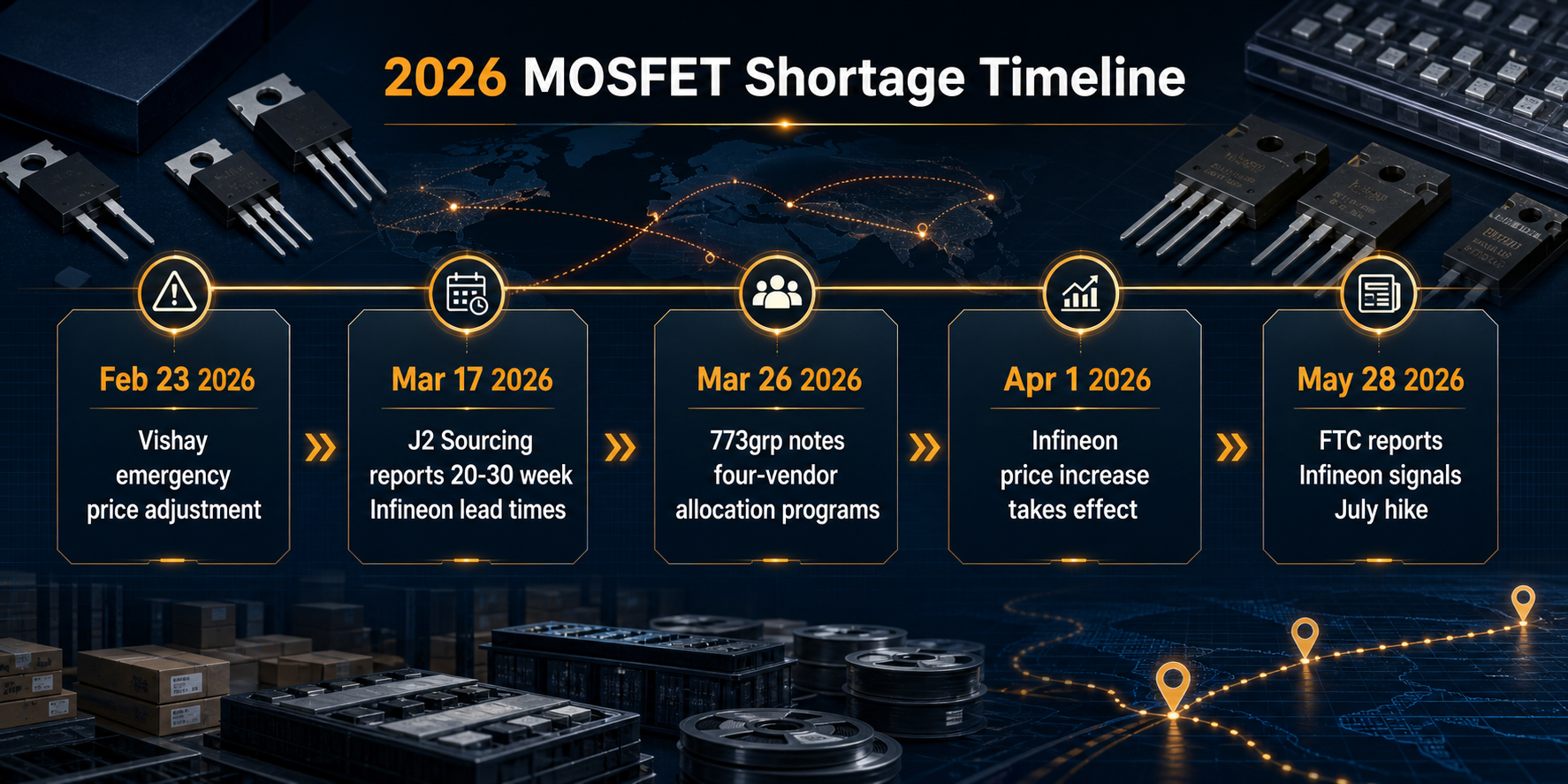
The current review window has four source signals from the first half of 2026:
- Feb 23 – Mar 1, 2026 — Vishay Intertechnology confirmed emergency price adjustments across its MOSFET and IC portfolios, citing sustained increases in raw-material costs (FTC Electronics, Mar 2 2026).
- Apr 1, 2026 — Infineon Technologies put a price increase on power switches and power ICs into effect, with IGBTs and MOSFETs explicitly in scope (J2 Sourcing, Mar 17 2026).
- Mar 26, 2026 — A widely cited market note reports that Vishay, Infineon, Onsemi and STMicroelectronics have all implemented allocation programs on certain MOSFET families (773grp, Mar 26 2026).
- May 28, 2026 — Infineon was reported to have signaled a further price increase starting July 2026, citing AI data-center demand and continued power-semiconductor pressure (FTC Electronics, May 28 2026).
The buyer takeaway is narrower and more useful than a blanket market alert: refresh RFQs and evidence files for the exact Infineon power-device sourcing page, Vishay power-device sourcing page, and Onsemi MOSFET lines on the BOM. A single-source 600V or 250V power slot with no qualified alternate belongs in continuity review; a low-voltage commodity MOSFET with authorized inventory may only need monitoring.
Why this matters beyond a single supplier
Two practical differences from the 2020-2022 cycle are worth naming explicitly:
- Allocation is family-level, not brand-level. A buyer with an LTA, authorized-channel history, and forecast discipline can sit in a different risk class from a spot-market buyer using the same headline MPN. That is why the review has to happen at exact part number, package, and application level.
- Power MOSFETs and SiC touch the same capacity conversation but are not drop-in substitutes. EV powertrain and AI data-center PSU demand can pull attention toward 600V CoolMOS and SiC at the same time. SiC may be a redesign path in some high-voltage stages, but it is not a casual substitute for a silicon MOSFET on an existing board.
The Nexperia situation is a separate but adjacent thread. Reports around Nexperia power-device sourcing page and Wingtech create a reason to review 60V LFPAK continuity, but this lane must stay separate from 250V and 600V replacement work. A 60V LFPAK candidate is not a fallback for a high-voltage TO-247 position.
Which products, specs and applications are most exposed
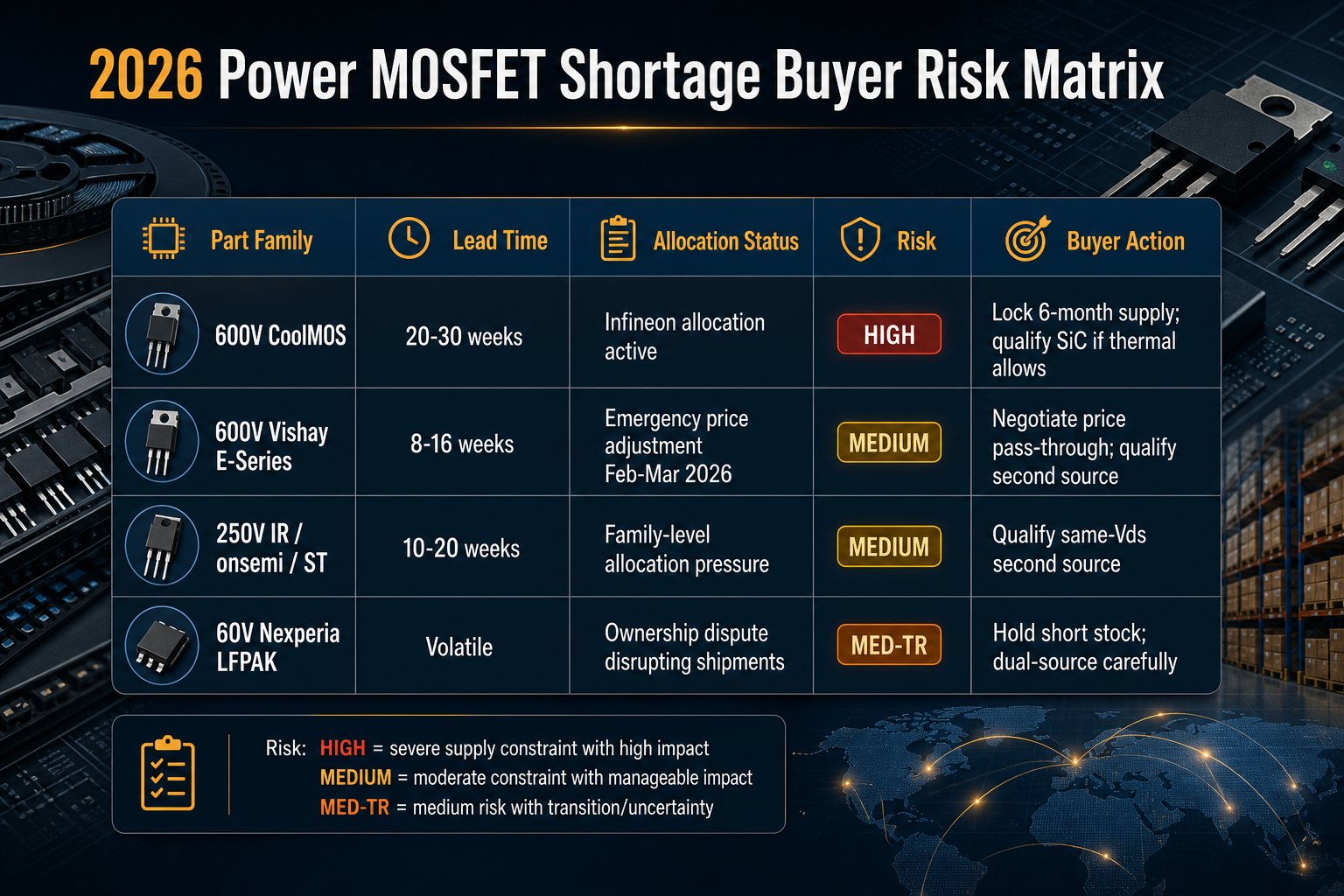
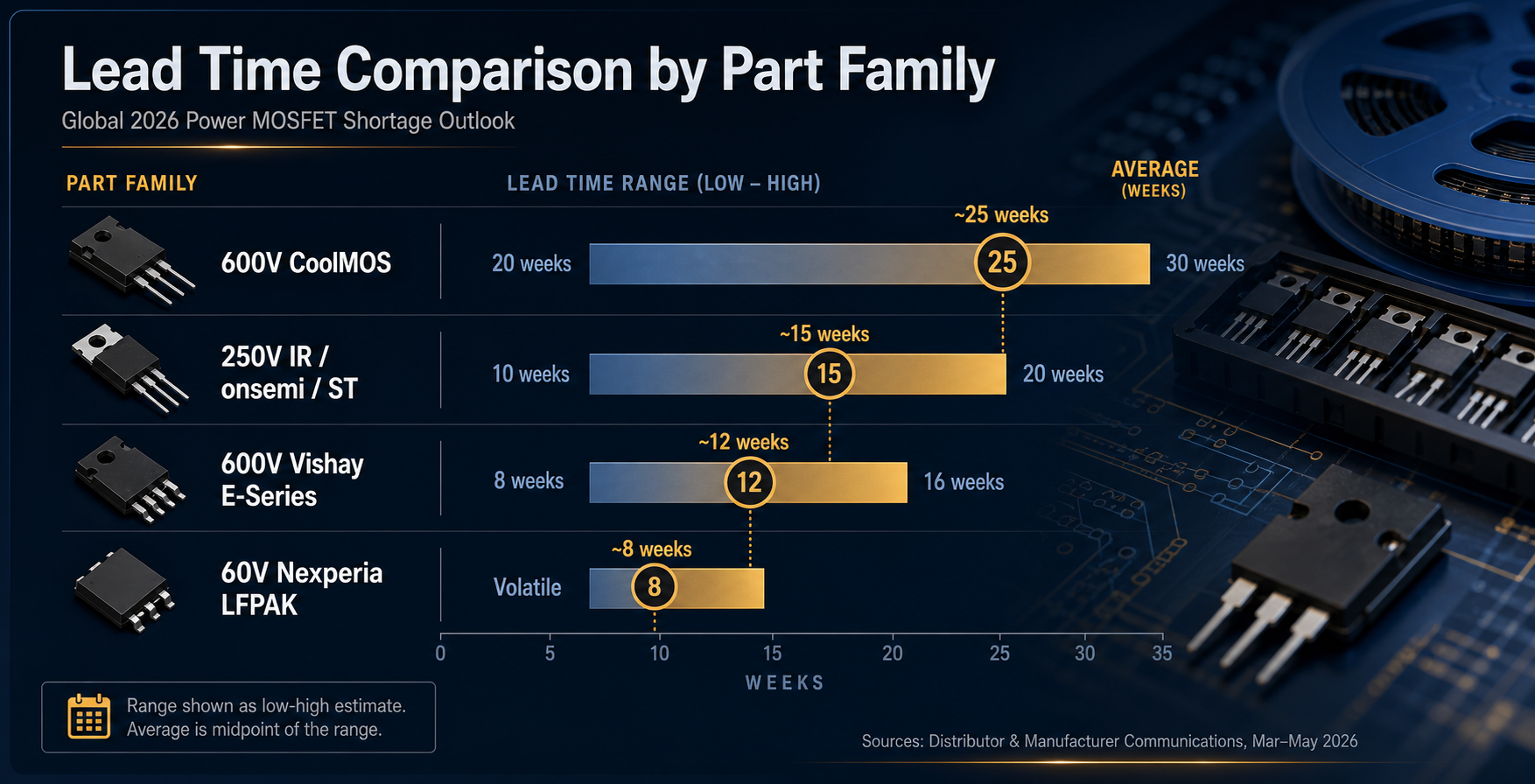
Not all MOSFETs are equally exposed. The risk matrix below is organized by Vds (drain-source voltage), package, and application lane. If your BOM search terms look like TO-220 MOSFET shortage, TO-247 power semiconductors, 600V CoolMOS allocation, or MOSFET second source checks, the rows below are the ones buyers and design engineers should review first.
| Part family and voltage lane | Evidence signal | Engineering constraint | Source / boundary | Continuity risk | Buyer action |
|---|---|---|---|---|---|
| 600V CoolMOS — TO-220 / TO-247 (Infineon C7/P7, e.g. IPP60R099C7) | Reported Infineon price and allocation pressure | PFC / high-voltage SMPS losses, Qg, thermal path, driver margin | J2 Sourcing (Mar 17 2026); 773grp (Mar 26 2026); FTC Electronics (May 28 2026) | HIGH | Lock forecast-backed supply; review same-Vds silicon alternatives and SiC only as a redesign path |
| 600V Vishay E-Series — TO-247 (e.g. SIHG22N60E-E3) | Vishay emergency price-adjustment reports | TO-247 thermal fit, avalanche rating, Rds(on), current derating | FTC Electronics (Mar 2 2026); J2 Sourcing (Mar 17 2026) | MEDIUM | Negotiate price pass-through; screen VBP16R20S only after datasheet comparison |
| 250V Infineon IR / Onsemi / ST — TO-247 (e.g. IRFP4768PBF) | Family-level allocation and price-pressure reporting | Vds floor, Qg, avalanche rating, package thermal resistance, gate-drive compatibility | 773grp (Mar 26 2026); TrustCompo judgment based on family-level notes | MEDIUM | Qualify same-Vds second source: FCH043N25G (Onsemi) or STW56N25M2 (ST). Do NOT use 60V parts as substitutes. |
| 60V Nexperia LFPAK — LFPAK56 (e.g. PSMN4R5-60YS) | Adjacent Nexperia continuity reports | Low-voltage layout, LFPAK footprint, Rds(on), thermal pad, automotive approval | Fusion Worldwide (Jan 20 2026); Automotive Logistics (Jan 20 2026) | MEDIUM (adjacent only) | Hold short stock only for 60V lanes; review STP55NF06L as same-voltage context, not as a high-voltage replacement |
For context on the P0 representative MPNs and the same-Vds second-source candidates:
- Infineon IPP60R099C7 — CoolMOS C7 family, 600V, Rds(on) ~99 mΩ, TO-220 package. This part sits in the active Infineon allocation program. The product page is live on TrustCompo.
- Infineon IRFP4768PBF — IR MOSFET series, 250V, 93A continuous drain, TO-247, Rds(on) 17.5 mΩ. Allocation pressure noted at the family level in Mar 2026 reports.
- Vishay SIHG22N60E-E3 — E-Series Power MOSFET, 600V, 21A continuous drain, TO-247, lead-free / halogen-free. Vishay emergency price adjustments in Feb–Mar 2026 affect this family.
- Onsemi FCH043N25G — 250V N-channel MOSFET, TO-247, ~43 mΩ, ~75A continuous drain. Same Vds and same TO-247 footprint as IRFP4768PBF; verify Rds(on), gate charge and current derating against the original before substituting.
- ST STW56N25M2 — 250V MDmesh M2 series, TO-247, ~41 mΩ, 56A continuous drain. Same Vds and same TO-247 footprint; verify avalanche rating and thermal performance.
- Infineon IPA60R360P7 — CoolMOS P7 family, 600V, Rds(on) ~360 mΩ, TO-220 fullpack. Same Vds as IPP60R099C7 but higher Rds(on) — see note below on thermal impact.
- Vishay VBP16R20S — 600V N-channel power MOSFET in a TO-247 package. It is useful as a Vishay-family continuity anchor for SIHG22N60E-E3, but buyers should verify avalanche rating and thermal behavior from the official datasheet before approving it as a second source.
- Nexperia PSMN4R5-60YS — 60V LFPAK56 MOSFET with very low Rds(on). This part belongs only in low-voltage 60V sourcing conversations and should never be treated as a replacement for 250V or 600V positions.
- ST STP55NF06L — 60V STripFET MOSFET in TO-220. Use it as a same-class 60V contingency anchor only; it is not a valid fallback for IRFP4768PBF, SIHG22N60E-E3, or any other higher-voltage BOM slot.
Applications needing closer continuity review: EV powertrain (OBC, DC-DC), AI data-center PSU, solar inverter / Energy Storage Systems (ESS), industrial motor drives, PFC front ends, and high-voltage industrial SMPS. Applications usually outside this article's scope: small-signal MOSFETs below 30V, prototype-only builds, and designs already redesigned around SiC with a separate qualification plan.
What procurement and BOM risks buyers should expect
Three categories of risk go beyond the obvious "lead time is long":
- Counterfeit and refurbished risk. Allocation pressure is exactly when open-market brokers push mixed-date-code and refurbished parts as "factory original". A buyer who has not put date-code and lot-trace verification into the receiving SOP is the easiest target.
- Cross-reference that doesn't cross. Trade-press articles and distributor cross-reference tools will give you a list of "equivalents". Many of those equivalents have a different Rds(on), Qg, avalanche rating, package thermal performance, or temperature grade. A second source that doesn't drop in is a re-spin, not a substitution.
- Price-pass-through timing. Infineon's Apr 1 increase is already in effect. The July 2026 increase is signaled but not yet effective. A buyer who is buying on spot rather than contract will absorb both. A buyer with a 6-month agreement will absorb the first one and partially the second.
A useful mental model: treat each affected MPN as having three risk dimensions — availability (lead time + allocation status), price stability (contract vs spot, and which price-increase round it sits in), and second-source readiness (is there a datasheet-compatible drop-in alternative qualified today, or is it a re-spin?).
| Approval dimension | Minimum check before PO substitution | Why it matters |
|---|---|---|
| Voltage and transient margin | Vds, avalanche rating, SOA, clamp and surge assumptions | Same package with lower voltage can fail catastrophically |
| Conduction and switching loss | Rds(on), Qg, Coss, switching frequency, gate resistance | A "same voltage" part can exceed thermal budget or EMI margin |
| Package and thermal path | TO-220 / TO-247 / LFPAK footprint, pinout, RthJC / RthJA, heatsink interface | Mechanical fit does not guarantee equal heat flow |
| Drive and protection circuit | Gate-driver current, Miller behavior, UVLO / clamp behavior, snubber values | Higher Qg or different capacitance can break timing and protection assumptions |
| Quality and traceability | date code, lot code, reel / tube condition, chain of custody | Allocation pressure raises mixed-lot and refurbished-stock risk |
What buyers can do now: sourcing, substitution, QC and lead-time planning
A pragmatic buyer action list, in priority order:
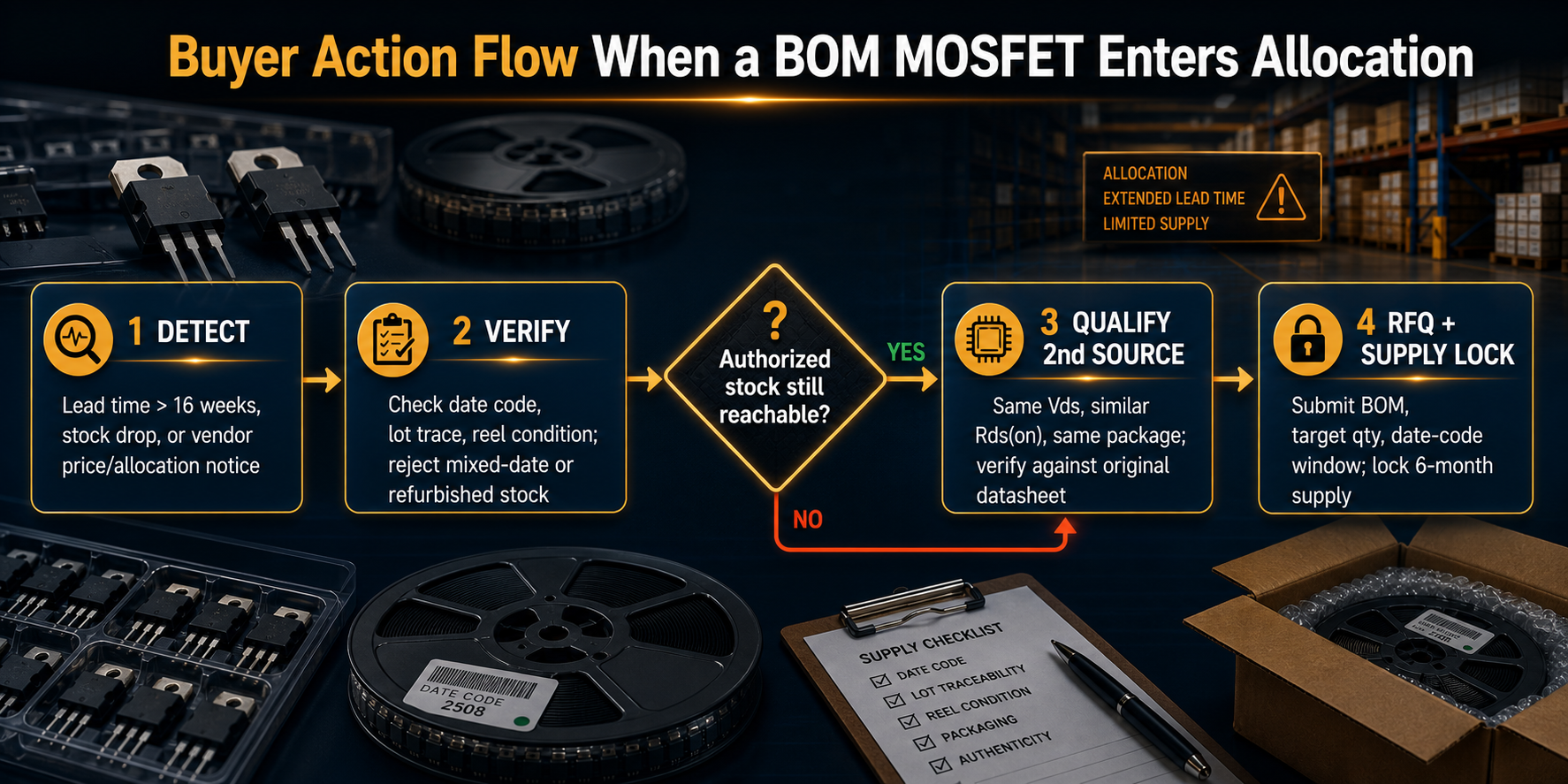
- Lock forecast-backed supply on the highest-risk 600V positions first. The goal is not to overbuy every MOSFET; it is to protect production slots where a high-voltage MOSFET has no approved alternate and long validation lead time.
- For each affected P0 MPN, identify one datasheet-compatible second source and qualify it now — not when the original is out of stock. The alternative table below is a starting point, not a final answer: every substitute needs Vds, Rds(on), package and temperature-grade verification against the original datasheet.
| Original P0 | Possible Second Source | What to verify before substituting |
|---|---|---|
| IPP60R099C7 (Infineon CoolMOS C7, 600V, 99 mΩ, TO-220) | Infineon CoolMOS P7 same-family: IPA60R360P7; or SiC only if the design owner accepts redesign work | Vds ≥ 600V, Rds(on), Qg, Coss, TO-220 pinout, creepage / clearance, heatsink interface, gate-driver margin. Note: IPA60R360P7's 360 mΩ Rds(on) is ~3.6x the IPP60R099C7 original, so conduction losses may exceed the thermal envelope. Review IPP60R180P7 or a 650V SiC redesign path only with engineering approval. |
| IRFP4768PBF (Infineon IR, 250V, 93A, TO-247) | Primary: Onsemi FCH043N25G (250V, 75A, TO-247). Secondary: ST STW56N25M2 (250V, 56A, TO-247) | Vds ≥ 250V (mandatory), Rds(on), TO-247 pin-out, gate charge, avalanche rating, current derating. Never substitute with 60V parts such as PSMN4R5-60YS or STP55NF06L — these will fail in any circuit operating above 60V. |
| SIHG22N60E-E3 (Vishay E-Series, 600V, 21A, TO-247) | Vishay VBP16R20S as a Vishay-family review candidate | Vds ≥ 600V, Rds(on), TO-247 pinout, avalanche rating, Qg, thermal resistance, and official Vishay datasheet evidence before any approval |
- Put date-code and lot-trace verification into the receiving SOP. This is the buyer-framework part that survives the current allocation window. It costs little during normal supply and reduces the chance that mixed-date-code or refurbished parts reach production.
When buyers approve a MOSFET alternative with noticeably higher gate charge or a materially different switching profile, the gate driver should be re-checked as part of the same ECO. A practical reference point is MIC4452YN, a high-speed MOSFET/IGBT gate driver often used to sanity-check whether a "same-voltage" alternative still fits the existing drive margin.
What this article does not claim
Three boundaries worth naming so the framework doesn't get misapplied:
- Prototype buyers under 100 pcs / year are unlikely to see the same exposure. Allocation typically affects production-volume orders first.
- Buyers already on long-term agreements with Infineon or Vishay are partially insulated from the April price increase; the July 2026 round will still affect renewal pricing.
- 30V small-signal MOSFETs are not in scope. This article covers power MOSFETs in the 60V / 250V / 600V range. Logic-level and small-signal MOSFETs have a different supply chain.
Approval Rule
Do not approve a MOSFET substitution because the voltage and package look close in a distributor table. Approve it only when engineering has checked Vds, Rds(on), Qg / capacitance, avalanche rating, SOA, package thermal path, gate-driver behavior, and production traceability against the original BOM position.
For a BOM buyer, three things change after this review:
- Lock supply selectively. Forecast-backed agreements make sense for high-voltage, single-source, production-critical MOSFET positions; they do not need to cover every low-voltage commodity part.
- Qualify a datasheet-verified second source before the next stockout. The alternatives table above is a starting point, not a final approval list. Never substitute a lower-Vds part into a higher-Vds slot.
- Treat receiving SOP as part of the sourcing strategy. Date-code, lot-trace, and packaging-condition checks are procurement controls, not only IQC paperwork.
This article was last reviewed on 2026-08-05. It should be refreshed again when newer primary manufacturer notices, PCNs, distributor lead-time evidence, or confirmed allocation changes materially alter the risk lanes above.
Need a verified second source on your BOM?
If any of the P0 part numbers above (or a same-Vds variant of them) is on your BOM and you need a datasheet-verified second source list, the fastest paths are:
- Submit your BOM through our shortage sourcing intake — we respond with current stock, date-code verification and second-source qualification options for the affected lines.
- Request verified stock and pricing via RFQ — include the MPN, target quantity, date-code window and packaging condition; we will return current inventory, authorized-channel options and any same-Vds second-source candidates.
- Review our incoming quality SOP — for date-code and lot-trace verification standards on incoming MOSFET lots during allocation pressure.