- wide-bandgap semiconductors
- SiC
- GaN
- power electronics
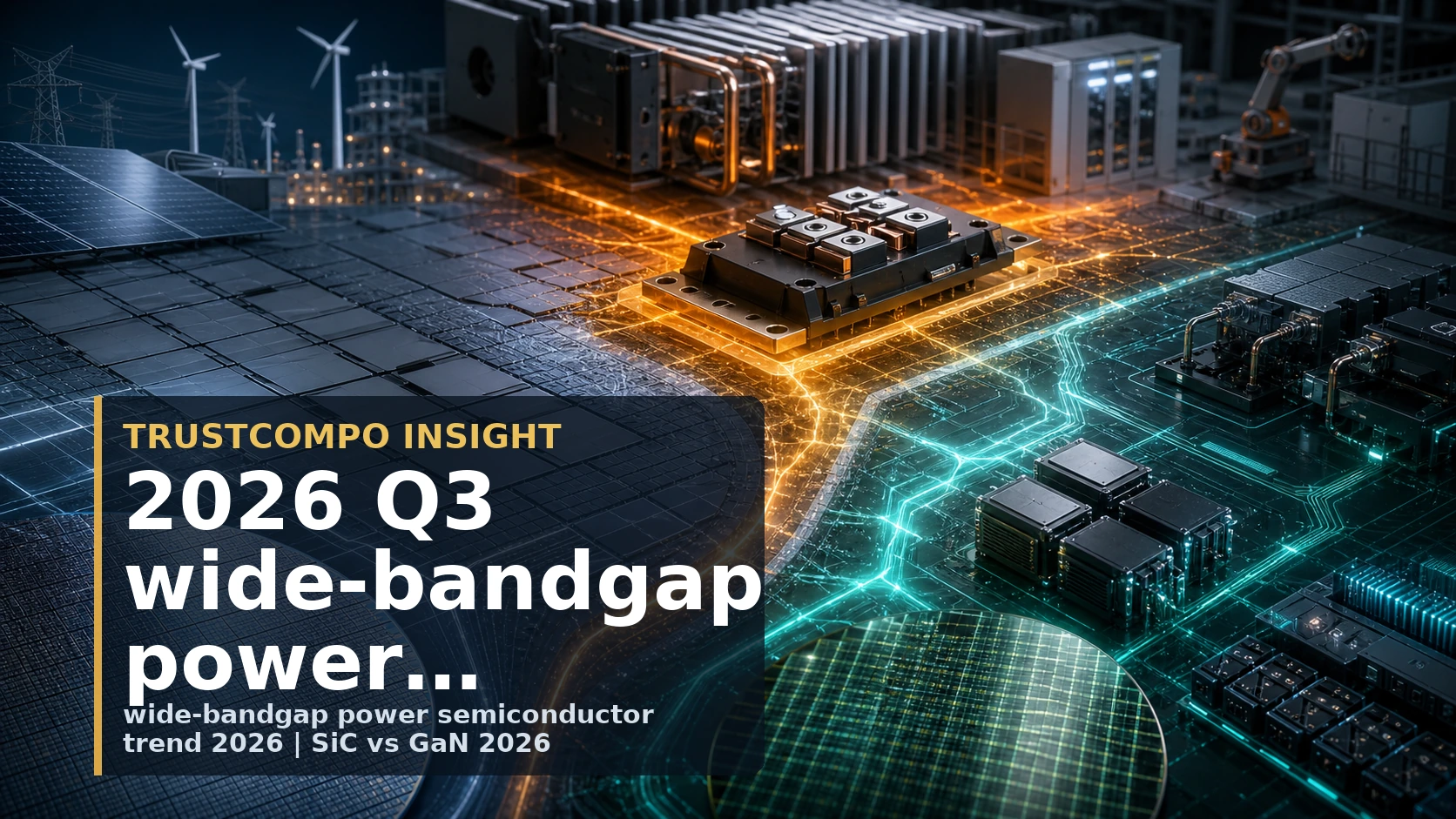
SiC vs GaN vs Silicon in 2026: Power-Stage Design and Sourcing Checks
A 2026 engineering and sourcing guide to SiC vs GaN vs silicon, covering wide-bandgap power semiconductor decisions for PFC, LLC, data-center power, EV OBC, solar inverter, and motor-drive stages.
Quick facts
- By Q3 2026, the strongest wide-bandgap conclusion is not 'silicon is finished' but 'application-level power stacks are becoming more mixed.'
- Recent public signals around ST and Wolfspeed show that SiC is now a factory-ramp and capital-execution question, not only a device question.
- A June 24, 2026 technical review on GaN in AI data centers argues that GaN delivers a stage-dependent rather than universal advantage.
- PFC, LLC, data-center power, EV OBC, solar inverter, and motor-drive stages need different SiC / GaN / silicon decisions.
For SiC vs GaN decisions in 2026, the useful question is not whether a wide-bandgap power semiconductor is fashionable. It is whether a specific power stage can pass real power-stage design checks against the silicon baseline. Silicon carbide keeps attracting factory-scale investment, and gallium nitride keeps appearing in high-density conversion designs, but neither signal is enough to approve a design change or sourcing switch by itself.
The better Q3 2026 read is that power design is becoming more mixed, not fully rewritten. SiC is strongest where high voltage, switching loss, and thermal stress justify its cost and qualification burden. GaN is strongest where frequency, density, and converter efficiency repay extra design discipline. Silicon still holds many cost-sensitive and qualification-heavy programs because supply depth, validation history, and unit economics remain decisive.
This article uses the market signals as context, then turns them into a stage-level review for engineers and sourcing teams. The goal is not to ask whether SiC or GaN is "better" than silicon in the abstract. The useful question is whether a specific PFC, LLC, data-center power, EV OBC, solar-inverter, or motor-drive stage can justify the electrical, thermal, packaging, second-source, and qualification cost of switching.
Evidence Boundary and Source Basis
This article was last reviewed on August 5, 2026 and reflects publicly available sources reviewed through that date. It is framed as a Q3 2026 engineering and sourcing review: public sources are used as directional evidence, then separated from engineering inference and TrustCompo sourcing judgment. It is not a market-share forecast, a universal substitution guide, or a claim that one device material is always superior.
| Dated source basis | What it supports | Buyer use |
|---|---|---|
| Official STMicroelectronics Catania SiC facility announcement, plus European public-support records | On October 5, 2022, ST announced an integrated SiC substrate facility in Catania; the European project record ties public support to SiC substrate capacity and a target for additional output by Q2 2026. | Treat SiC as a serious review candidate in high-voltage stages, then validate package, qualification, and continuity for each exact family. |
| Official Wolfspeed CHIPS funding announcement | On October 15, 2024, Wolfspeed announced proposed U.S. CHIPS Act funding and private financing tied to North Carolina and New York SiC manufacturing expansion. | Use as a factory-ramp signal, not proof that any one SiC MOSFET is risk-free to source. |
| TI SM1 Sherman production announcement | On December 17, 2025, TI announced production had started at its SM1 300mm fab in Sherman, Texas, for foundational analog and embedded chips. | Keep silicon as the baseline for cost, qualification, supply depth, and existing production control. |
| Intal and Ebong technical review on GaN data-center power | On June 24, 2026, Intal and Ebong published a GaN data-center power review arguing that GaN provides a stage-dependent, not universal, advantage. | Review GaN where switching frequency and density create system value; do not approve it by material label alone. |
| TrustCompo engineering and sourcing interpretation | As of the August 5, 2026 review, TrustCompo treats the practical 2026 decision as stage-specific: PFC, LLC, data-center power, EV OBC, solar inverter, and motor drive all have different proof burdens. | Require datasheet, package, lifecycle, traceability, and engineering sign-off before PO release for any SiC or GaN-driven change. |
Update Log
- July 11, 2026: Initial Q3 2026 draft created with a synthesis angle focused on SiC capacity execution, GaN stage-specific adoption, and silicon's continued production relevance.
- July 11, 2026: Canonical TrustCompo product-detail links were backfilled for all six anchor parts after catalog publish / update.
- August 5, 2026: Reworked the article toward an engineering procurement guide, added a power-stage decision matrix, source-basis table, anchor-part comparison table, and tighter fact / inference / TrustCompo judgment boundary after Google AI review and E-E-A-T rewrite planning.
The Q3 2026 Shift Is Real, but It Is Not One Single Shift
Three separate developments are easy to blur together:
- device-level performance progress
- factory and supply-chain expansion
- actual production adoption in specific converter stages
They move at different speeds.
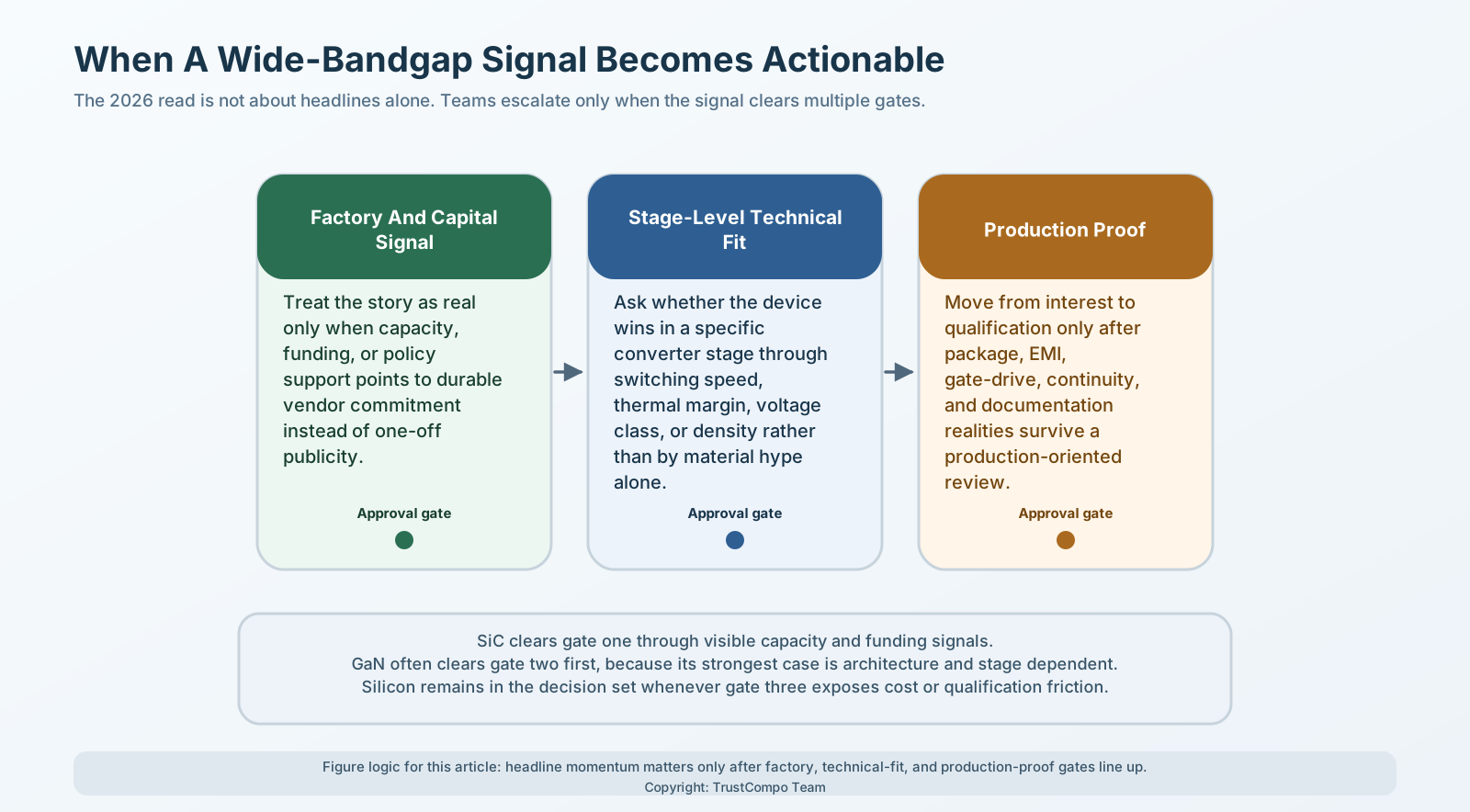
At the factory level, SiC now looks much more like a manufacturing-scale contest than a niche-technology contest. Publicly reviewed reporting around STMicroelectronics' Catania investment and Wolfspeed's U.S. manufacturing support points in the same direction: SiC is no longer a laboratory-adjacent device category. It is a capital, policy, and execution problem.
At the system level, the latest GaN signal is different. A June 24, 2026 technical review focused on AI data-center power concludes that GaN should be treated as a stage-dependent system lever, not a universal winner. Our inference: the market is no longer asking only whether GaN works. It is asking where its advantages are worth the design and qualification cost.
And at the platform level, silicon is still very much alive. TI's continuing silicon manufacturing expansion is the clearest reminder that mainstream power and analog platforms are not retreating quietly. They are still being scaled for automotive, battery, industrial, and infrastructure demand.
TrustCompo judgment: the biggest mistake in 2026 is not underestimating wide-bandgap. It is over-generalizing it.
Why SiC Now Looks Like an Execution Check
Silicon carbide has spent years being described in terms of device advantages: higher breakdown voltage, lower switching losses in the right conditions, and better high-temperature behavior than mainstream silicon devices. That is still true, but it is no longer the most useful summary.
The more useful summary in Q3 2026 is that SiC has become an execution test.
When we say "execution," we mean:
- who can ramp capacity on time
- who can keep yields and packaging stable
- who can serve automotive and industrial programs without qualification disruption
- who can keep high-voltage families available in a way that supports real production design-ins
That is why public attention around ST and Wolfspeed matters even beyond their own catalog lines. These signals are not just company branding. They show that SiC demand is strategic enough to support policy attention, multiyear plant planning, and heavy capital commitments. TrustCompo judgment: those signals make SiC more credible for review, but they do not remove the need to verify package, thermal, qualification, and continuity risk at the device-family level.
For engineers, that means SiC is no longer an exotic exception. Representative anchors like E3M0065090D (650V / 90mOhm class), IMZA65R040M2H (650V / 40mOhm class), SCT1200W7K0C3 (1200V SiC MOSFET), and NVBG070N120M3S (1200V EliteSiC position) now belong in mainstream platform discussions whenever the design problem includes:
- high bus voltage
- severe switching-loss pressure
- aggressive thermal limits
- traction, inverter, charger, or industrial power stages that justify a higher device and qualification bill
What has changed is not only that SiC devices exist. What has changed is that more teams now assume they should at least evaluate SiC first in those windows.
The timing of that shift is easier to understand when the capacity and funding signals are put on one line. Figure 1 is meant to do exactly that by separating dated public milestones from the broader procurement conclusion they support.
Where GaN Is Actually Winning in 2026
GaN is easier to overstate because its strongest advantages can look dramatic in the right stage. Higher switching frequency, density gains, and converter-level efficiency improvements are real. But the article by Intal and Ebong published on June 24, 2026 is valuable precisely because it does not flatten the conclusion. Its core point is that GaN delivers a stage-dependent advantage.
That is the right framing.
GaN is strongest when the system rewards:
- very fast switching
- density and size reduction
- converter stages where magnetics and thermal budgets matter as much as raw device cost
- architectures where system efficiency compounds across multiple power stages
In practice, that means the most convincing 2026 GaN conclusion is not "GaN replaces everything." The more useful rule is: evaluate GaN in the stages where switching speed and density create a measurable system payoff.
That is why parts such as GS-065-004-1-L (650V / 4mOhm class GaN FET) and EPC2302 (100V / 1.8mOhm GaN FET) matter as anchors in this article. They do not represent one universal migration path. They represent two different expressions of the same trend:
- higher-voltage GaN power switching for compact, efficient power stages
- discrete, high-speed GaN design space where system integration choices still matter a great deal
TrustCompo judgment: in 2026, GaN is best read as a system-architecture technology, not just a better transistor.
Why Silicon Still Matters More Than Some Headlines Admit
The phrase "the end of the silicon-first default" works as a directional summary because it captures a change in design psychology. More teams now start some power-stage discussions with SiC or GaN on the table instead of treating them as late alternatives.
But the phrase fails if it is read literally.
Silicon still matters for three big reasons.
First, manufacturing scale still matters. Large silicon fabs are still being built and expanded because mainstream power, analog, and embedded demand is enormous.
Second, qualification comfort matters. Many organizations know how to review, source, and debug silicon power devices with much less friction than they do for wide-bandgap options.
Third, cost discipline matters. In a large class of designs, the extra value delivered by SiC or GaN does not yet repay the added device cost, redesign effort, EMI work, packaging constraints, or sourcing complexity.
This is why TI's ongoing silicon buildout is such an important counter-angle. It keeps the market honest. If the future were simply "SiC and GaN take over now," the scale of continued silicon investment would make far less sense than it does.
The real market transition is not silicon disappearing. It is silicon losing its automatic right to be the only serious answer in certain power-stage decisions.
A More Useful 2026 Review Is Application by Application
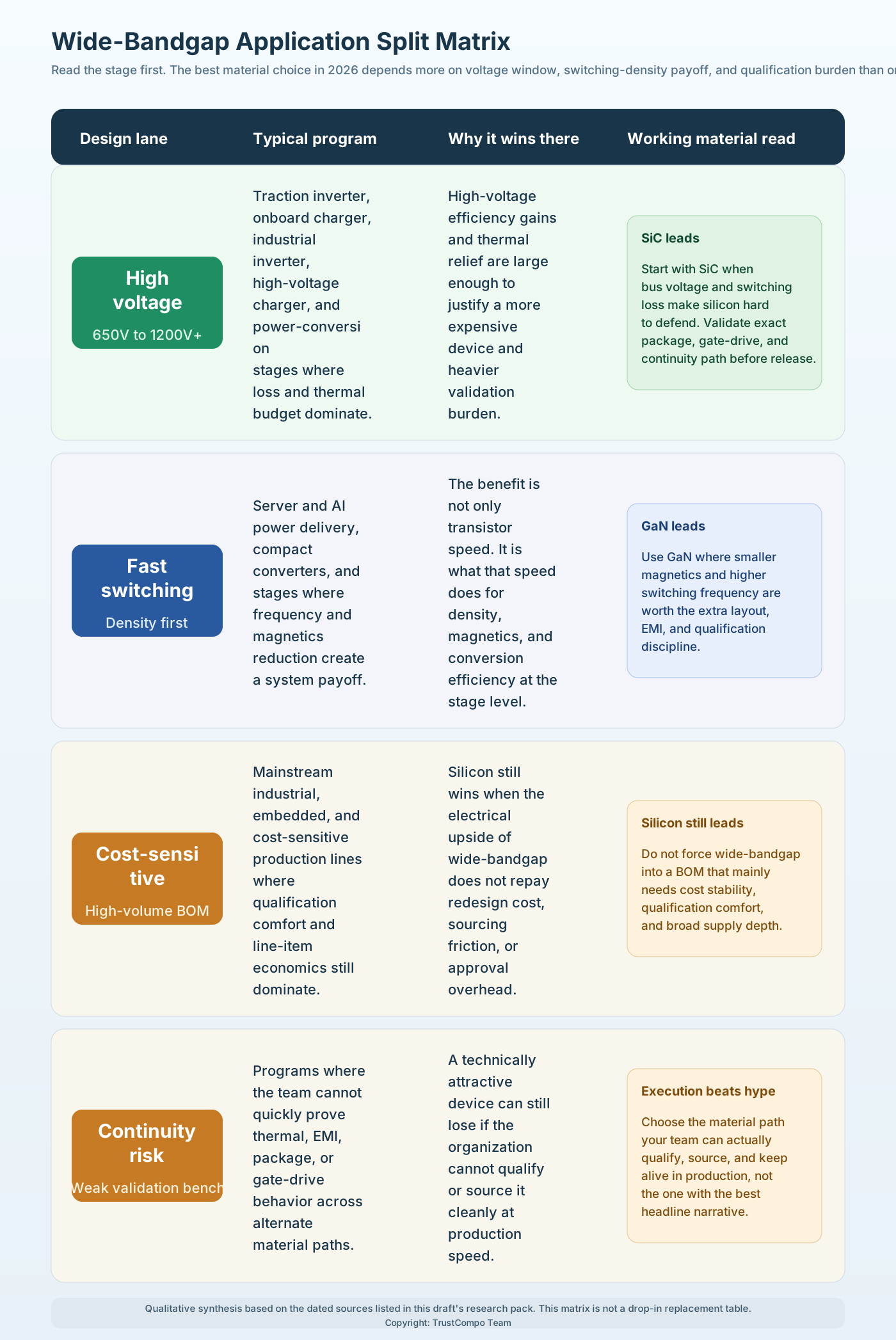
The cleanest way to read the market is to stop asking "Which material wins?" and start asking "Which material wins in which stage?"
| Power stage | Silicon default | SiC review trigger | GaN review trigger | Thermal and package check | Second-source risk | Qualification cost |
|---|---|---|---|---|---|---|
| PFC front end | Strong where cost and mature controller ecosystems dominate | Stronger candidate at higher bus voltage, hard efficiency targets, or thermal stress | Candidate for high-frequency, density-driven designs if EMI and gate-drive discipline are available | Compare heat-sink area, switching loss, layout sensitivity, and package creepage | SiC depth varies by voltage / package; GaN may be more vendor-architecture-specific | Medium to high because control loop, EMI, and thermal validation can change |
| LLC / DC-DC stage | Strong for mature, cost-controlled designs | Candidate when high voltage and loss reduction outweigh added cost | Strong candidate where frequency increase shrinks magnetics and improves power density | Verify transformer / magnetics impact, package inductance, and cooling path | GaN alternatives may not share package, drive, or protection behavior | High if the magnetics, controller, and layout need redesign |
| Data-center power | Still relevant for many supporting rails and mature server supply blocks | Useful in high-power conversion where voltage and efficiency targets justify it | Strong review candidate for high-density AI-server converter stages | Check airflow, hot-spot behavior, switching-node layout, and EMI containment | Ecosystem maturity matters more than nominal Rds(on) | High; reliability, firmware, thermal, and service expectations are strict |
| EV onboard charger | Strong in lower-pressure auxiliary or mature cost windows | Strong candidate for 650V / 1200V high-efficiency charger stages | Selective candidate in compact high-frequency sections, not a blanket replacement | Confirm isolation, creepage, surge, thermal cycling, and module/package constraints | Automotive-grade continuity and PPAP-style evidence may narrow choices | Very high because vehicle qualification and change control are demanding |
| Solar inverter | Strong where cost and known reliability dominate | Strong candidate for high-voltage, high-temperature, and efficiency-critical inverter paths | Selective candidate for fast-switching auxiliary or compact conversion blocks | Review heat sink, outdoor temperature profile, surge exposure, and long service life | Long-life field support can outweigh short-term availability | High because field lifetime and certification exposure are large |
| Motor drive / industrial inverter | Strong where ruggedness, cost, and existing gate-drive designs dominate | Strong candidate when switching loss, bus voltage, and cabinet thermal limits are binding | Usually selective; fast edges can increase EMI and motor insulation concerns | Check dv/dt, cable length, EMI filter burden, and package thermal impedance | Real alternates must match package, protection, documentation, and lifecycle | Medium to very high depending on safety, EMI, and customer approval scope |
This application-by-application view is also the safest way to talk about part anchors without implying false equivalence.
Representative Anchor Parts: Context, Not Drop-In Advice
The parts below make the wide-bandgap discussion concrete, but they are not presented as equivalents. A real alternate decision still needs datasheet review, package drawing, gate-drive validation, thermal modeling, EMI testing, lifecycle review, and approved sourcing evidence.
| Anchor part | Material / device type | Voltage / conduction context | Package | Why it is only an anchor |
|---|---|---|---|---|
| E3M0065090D | Wolfspeed SiC MOSFET | 650V, 90 mOhm max Rds(on) class | TO-247-4 | Useful for 650V automotive SiC discussion; Kelvin-source layout, thermal path, and qualification still decide fit. |
| IMZA65R040M2H | Infineon CoolSiC MOSFET | 650V, 40 mOhm max Rds(on) class | TOLT | Shows vendor and package diversity inside 650V SiC; package mechanics and gate behavior are not automatically interchangeable. |
| SCT1200W7K0C3 | STPOWER SiC MOSFET | 1200V, 7 mOhm max Rds(on) class | TO-247-4L HV | Relevant to high-voltage SiC review; pin assignment, switching energy, insulation, and thermal validation remain mandatory. |
| NVBG070N120M3S | onsemi EliteSiC MOSFET | 1200V, 70 mOhm max Rds(on) class | TO-247-4L | Useful as a 1200V SiC competitor anchor; real use depends on gate-resistance strategy, package parasitics, and lifecycle support. |
| GS-065-004-1-L | GaN Systems enhancement-mode GaN transistor | 650V, 4 mOhm typical Rds(on) class | GaNPX | Represents higher-voltage GaN conversion; layout, cooling, drive control, and protection behavior are part of the approval boundary. |
| EPC2302 | EPC enhancement-mode GaN transistor | 100V, 133A, 1.8 mOhm class | 3mm x 5mm QFN | Represents lower-voltage, high-current GaN density; it is not comparable to 650V or 1200V SiC positions by part label alone. |
Figure 2 turns that reading into a compact decision matrix. It is the quickest way to see where SiC, GaN, and silicon each have the strongest current case instead of forcing every program through the same material label.
For example:
- E3M0065090D and SCT1200W7K0C3 point to the high-voltage SiC conversation
- IMZA65R040M2H and NVBG070N120M3S show how vendor competition inside SiC is becoming more important
- GS-065-004-1-L and EPC2302 reflect the fact that GaN adoption is as much about voltage window and architecture choice as it is about the device label
None of these parts should be treated as drop-in replacements for one another. That is not the point of the table. The point is to show where the market's attention is concentrating and which engineering checks decide whether that attention is useful for a real BOM.
What Engineers and Sourcing Teams Should Watch Next
The next phase of wide-bandgap adoption will be less about broad persuasion and more about disciplined proof.
Engineers should watch:
- whether the promised efficiency or density gain survives the full converter design
- how much extra EMI, gate-drive, and thermal work the technology introduces
- whether package and layout constraints erase part of the theoretical benefit
- whether the selected voltage class, Rds(on), transient behavior, and package family still fit the real protection and reliability model
Sourcing teams should watch:
- whether vendor capacity expansion arrives on time
- whether qualification continuity stays stable across ramp periods
- whether second-source options are real ecosystem alternatives or only superficial part-list lookalikes
- whether an eye-catching device family can actually support the volume and documentation needs of production
- whether alternates are backed by datasheets, lifecycle evidence, traceability, and approved distributor or manufacturer documentation before PO release
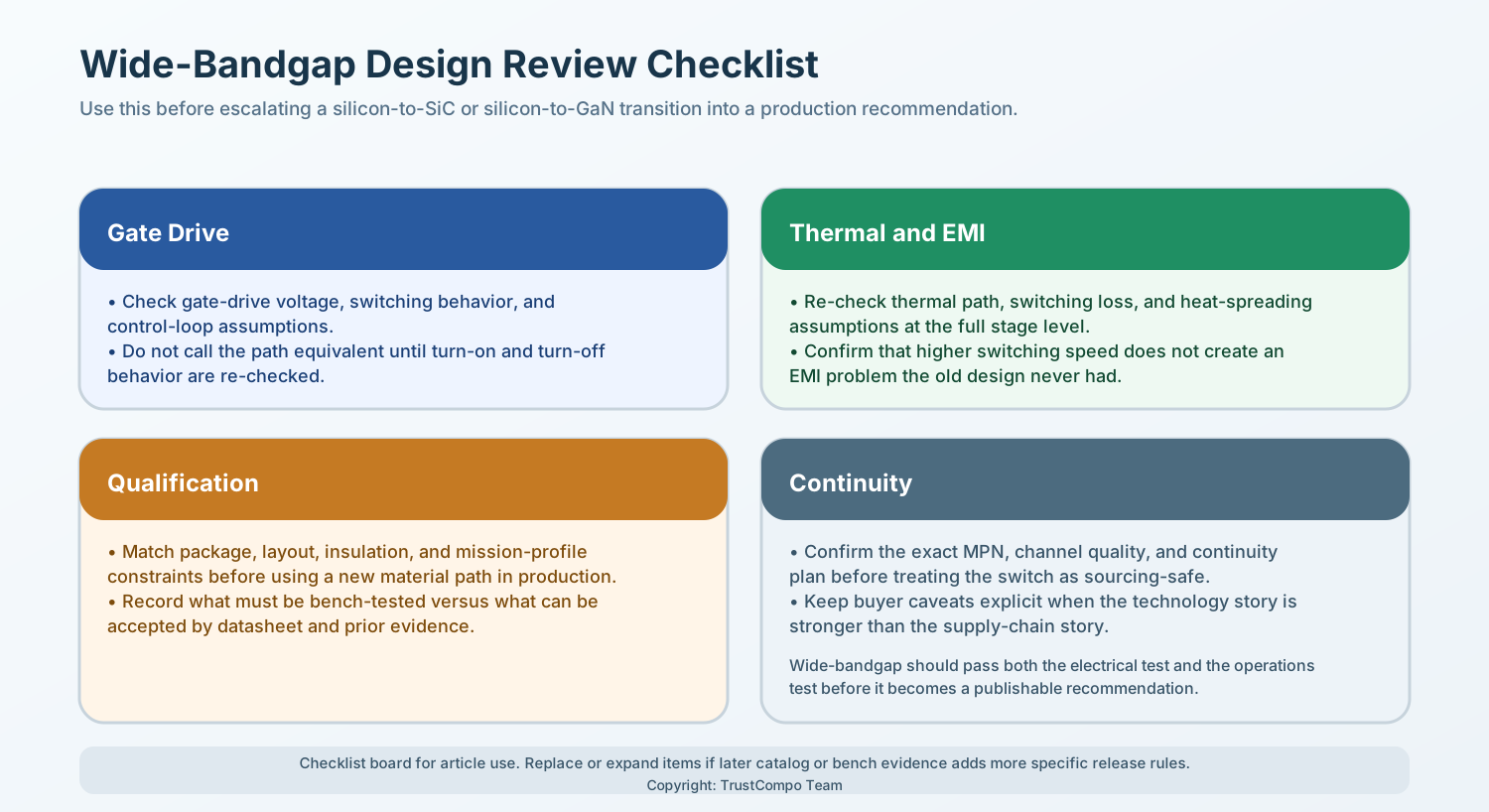
That is why the right internal next step after reading an article like this is not a blanket migration memo. It is a structured review:
Figure 3 summarizes that review sequence as a checklist. It is intentionally operational: the point is to stop teams from moving from trend signal to redesign before they have checked gate-drive, thermal, EMI, qualification, and continuity constraints.
- request an alternative-parts review
- start a shortage or continuity sourcing discussion
- upload a BOM for risk screening
- send a quick quote request for representative device families
Before a buyer releases a PO for a wide-bandgap-driven change, the minimum evidence pack should include the manufacturer datasheet, package drawing, qualification or reliability summary where available, lifecycle / PCN review, distributor or manufacturer traceability, and an engineering sign-off that covers gate drive, thermal model, EMI, protection behavior, and production test impact.
Bottom Line
The wide-bandgap power semiconductor transition in Q3 2026 is real, but it is uneven.
SiC is scaling because high-voltage and efficiency-critical applications keep justifying serious capacity investment. GaN is winning where switching frequency, density, and converter-level efficiency create a system payoff that silicon struggles to match. Silicon, however, still matters too much in cost, volume, and qualification-heavy production to be treated as yesterday's answer.
So the most accurate line is not "silicon-first is over."
The more useful approval rule is this: do not move a stage to SiC or GaN because the material trend is strong. Move it only when the measured efficiency, density, thermal, lifetime, supply-continuity, and qualification evidence is stronger than the silicon baseline for that exact stage.