- wolfspeed
- sic
- supply-continuity
- second-source
Wolfspeed SiC supply continuity 2026: a buyer's framework for second-source qualification
How Wolfspeed's 2026 SiC supply story changes procurement decisions — what to lock-buy, where to qualify a second source, and the MPN-level continuity boundaries that actually matter.
Quick facts
- Wolfspeed's 2026 continuity risk is concentrated in 650V automotive SiC MOSFETs tied to the Mohawk Valley fab ramp, not uniformly across the full SiC portfolio.
- Legacy 1200V discrete SiC parts such as C2M0025120D and the C4D Schottky family remain closer to monitor status than panic-buy status.
- The practical buyer split is lock-buy, qualify a second source, or monitor, based on voltage class, package coupling, and customer-program exposure.
- TrustCompo already published the anchor Wolfspeed, Infineon, onsemi, and ST SiC part pages referenced in this article for RFQ and alternative-sourcing intake.
What actually changed in Wolfspeed's SiC supply story
Wolfspeed spent the last decade building out 200mm silicon carbide wafer and device capacity in upstate New York, and the 2026 story is no longer about whether the technology works — it is about how much of the device roadmap the company can still ship from a restructured balance sheet. fact On May 21, 2026, Wolfspeed announced two new 3.3 kV SiC power module families in industry-standard footprints, confirming that the device roadmap continues. fact The same quarter also saw continued commentary in semiconductor trade press about the Mohawk Valley fab ramp, second-sourcing qualification timelines, and the Chapter 11 financial restructuring that ran through 2025–2026. inference The public evidence does not show a single clean, dated news cycle: most of the relevant context lives in manufacturer announcements, including the May 21, 2026 module launch and June 9, 2026 Gen 5 announcement, plus semiconductor trade commentary.
For a buyer, this means the right frame is not "is Wolfspeed bankrupt?" — inference Chapter 11 restructuring commentary has been a recurring topic in semiconductor trade press through 2025–2026, and a semiconductorx.com Wolfspeed Spotlight piece explicitly tied SiC second-sourcing qualification changes to the Chapter 11 filing context — but the right frame for a buyer is "which Wolfspeed SiC parts does the financial restructuring actually touch, and which ones are unaffected?" That distinction is the entire job of this article. TC judgment A buyer who treats any single Chapter 11 press reference as a definitive event without a dated filing notice from Wolfspeed itself will misread the supply story; the working posture is "restructuring commentary is active, fab operations continue, supply risk concentrates in the Mohawk Valley ramp output, downstream supply decisions follow the part family."
A quick history is useful to anchor the 2026 situation. Wolfspeed announced its Mohawk Valley fab in 2019 as the company's flagship 200mm SiC wafer-and-device facility, with initial production targeted for 2022 and full ramp projected for 2024–2026. The fab is the bet that allowed Wolfspeed to leap from 150mm to 200mm wafers and to consolidate device packaging under one roof; inference in practice, the ramp appears to have slipped roughly two years from the original plan based on public fab-progress commentary and the dated gap between the 2019 announcement and the May 21, 2026 3.3 kV module launch. inference The Durham fab, which produces 150mm SiC devices, has been running since the early 2010s and is the source of most of the legacy C2M and C4D part numbers. The Mohawk Valley fab is the source of the newer Gen 3 automotive families. inference This fab-to-part mapping is a TrustCompo interpretation for buyer triage, not a Wolfspeed-published production allocation map.
The relevant timeline for 2026 procurement planning is therefore: the device roadmap continues, the mfr's own product announcements confirm this, and the financial restructuring is a balance-sheet event that does not directly close either fab. The supply risk is upstream of the device: it is concentrated in the parts whose production volume depends on the Mohawk Valley ramp meeting its 2026 milestones. For the parts whose production volume is decoupled from the Mohawk Valley ramp, the supply story is essentially unchanged.
Which programs are exposed and which are not
Wolfspeed's SiC portfolio splits cleanly along three lines when you read it from a continuity lens rather than a press-release lens.
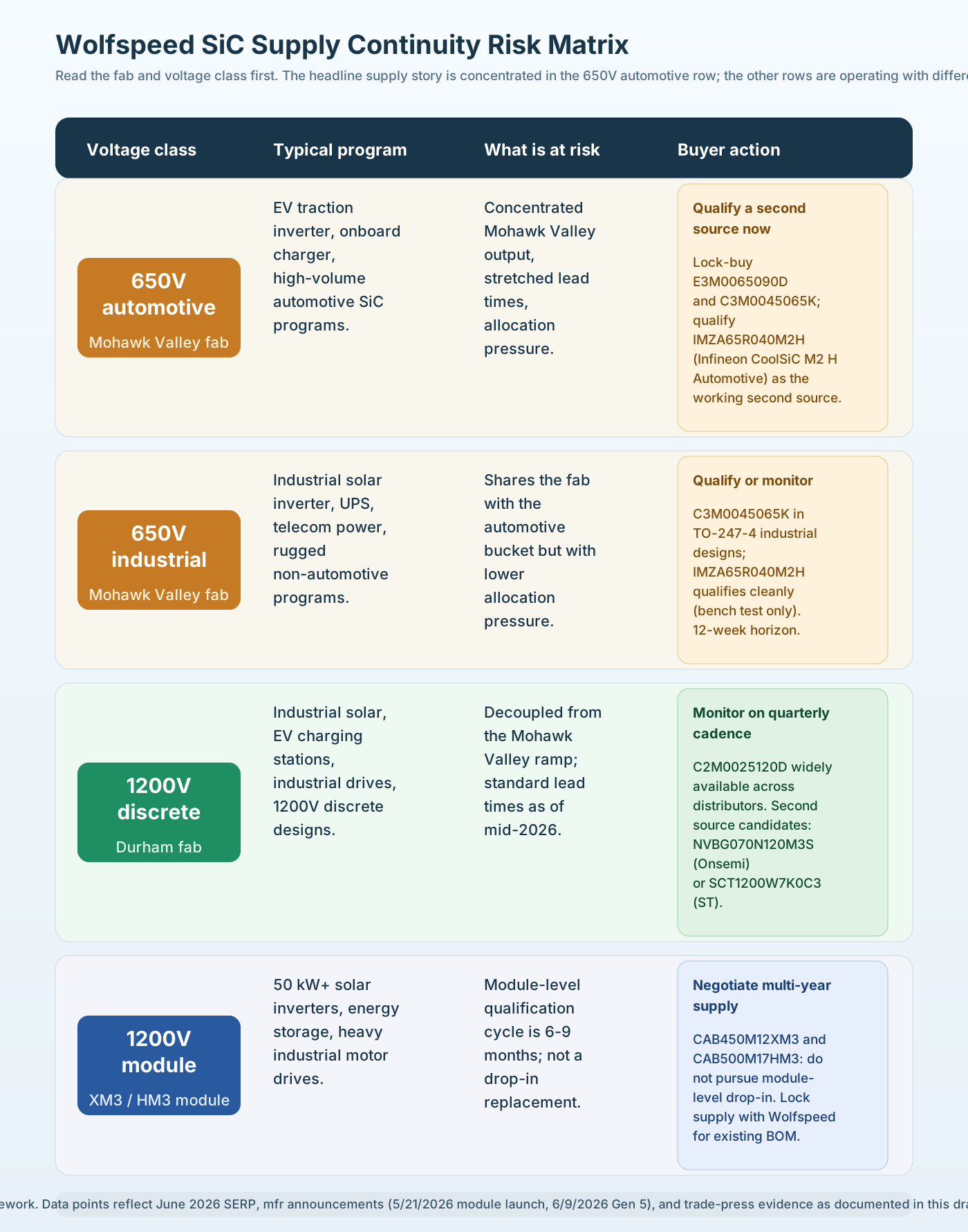
Automotive 650V SiC MOSFETs are the most exposed segment. TC judgment The E3M0065090D (650V / 90mΩ, TO-247-4 package, Gen 3 automotive) and the C3M0045065K (650V / 45mΩ, Gen 3 industrial) are the parts where Mohawk Valley output concentration is anticipated to be highest, based on the part family positioning and the timing of the Mohawk Valley ramp; this is the working assumption that drives the rest of the article's analysis, but it should be treated as a TrustCompo inference rather than a Wolfspeed-published production allocation. inference If your program uses either of these and your customer is an EV traction inverter or onboard charger, you should treat lead times as stretched; TC judgment our working assumption is 26+ weeks as a planning baseline for automotive-grade 650V SiC MOSFETs in mid-2026, which is consistent with the high-demand / single-sourced automotive SiC pattern across the industry and should be qualified as a TrustCompo estimate, not a Wolfspeed-published lead-time quote. Buyers should confirm the specific lead time against their distributor's quote before locking a PO.
Industrial 1200V SiC MOSFETs are on a different footing. fact The C2M0025120D (1200V / 25mΩ, TO-247-4) is built on the older Durham fab footprint and is the part Wolfspeed has been shipping into industrial solar and UPS designs for years. TC judgment For a 1200V industrial program, the supply story is "monitor, do not panic-buy," because the production line is decoupled from the automotive capacity questions that drive the Chapter 11 narrative.
Power modules and diodes are the third bucket. fact The CAB450M12XM3 (1200V / 450A XM3 half-bridge module) and the C4D40120D (1200V / 40A SiC Schottky diode) are part of long-running product lines. inference Module-level qualification cycles are 6–9 months, so even if lead times stretch, you have a planning window. TC judgment The diode is a stock commodity at this voltage class and benefits from an established production line; the multi-fab sourcing detail that is sometimes attributed to the C4D family in trade press is not the load-bearing argument here, and a buyer should anchor on the part's long-running availability rather than on any specific internal sourcing structure.
The boundary that matters for a buyer is therefore not "Wolfspeed the company" but "which fab and which voltage class." A buyer making decisions on 650V automotive MOSFETs and a buyer making decisions on 1200V industrial diodes are in different worlds, and they should not share the same playbook.
The practical reading of the three buckets is straightforward. A buyer whose BOM contains any of the E3M or C3M Gen 3 automotive part numbers should treat those positions as the priority — that is where the 2026 supply story is concentrated, that is where lead times are stretched, and that is where a second-source qualification program will pay for itself the fastest. A buyer whose BOM contains only the C2M or C4D legacy part families should treat the supply story as a background signal and apply their normal monitoring cadence. A buyer whose BOM contains the XM3 module family should plan for a longer qualification cycle on any second source and should not expect a drop-in answer to a continuity question — module replacements are mechanical-and-driver work, not part-number work.
The flip side of the boundary is what is not exposed: the C2M0025120D's continued availability across distributors as of mid-2026 is consistent with our working assumption that the 1200V industrial discrete line is on standard lead times, and a buyer who treats it as urgent is misallocating attention. Similarly, the C4D40120D's wide availability makes a continuity question a category-error: the part benefits from an established production line, the supply risk is concentrated elsewhere, and treating it as exposed is a category mistake rather than a continuity analysis.
Second-source boundary by voltage class
Qualifying a second source is the right answer for most 650V SiC programs; it is the wrong answer for some 1200V programs. The reason is the package-and-driver coupling: a 650V SiC MOSFET replacement is usually a drop-in once you check Vds and Rds(on), but a 1200V module replacement touches the mechanical layout, the DC-link layout, and the gate-driver board. The table below is the buyer's working boundary, not a manufacturer's cross-reference list.
A brief note on why this table exists at all. The mfrs publish their own cross-reference tools — Wolfspeed has a SiC MOSFET cross-reference page, Infineon has a CoolSiC product selector, Onsemi has an EliteSiC product finder, ST has a STPOWER product catalog — but none of these tools answer the buyer's actual question, which is "given my specific part and program, should I qualify a second source or monitor?" The mfr cross-references answer a different question: "if you want to switch to our part family, here is the closest match." That is a useful input to a continuity decision, but it is not the continuity decision itself, and a buyer who treats the mfr cross-reference as the answer will sometimes pick a part that is a poor fit for their program (different voltage class, different package, different qualification timeline).
| Voltage class | Wolfspeed anchor | Second-source candidates | Drop-in? | Notes |
|---|---|---|---|---|
| 650V automotive | E3M0065090D, C3M0045065K | IMZA65R040M2H (Infineon CoolSiC M2 H Automotive) | Yes, after Vds / Rds(on) / package check | Kelvin-source pin on TO-247-4 must match gate-driver board; re-measure Qg / Vth against Infineon datasheet |
| 650V industrial | C3M0045065K | IMZA65R040M2H or equivalent CoolSiC M2 | Yes | Industrial grade is easier to qualify than automotive; verify Rg matches driver design |
| 1200V discrete MOSFET | C2M0025120D | NVBG070N120M3S (Onsemi EliteSiC M3S) or SCT1200W7K0C3 (ST Gen 3 STPOWER) | Yes | Rds(on) / Vth / Qg must be re-measured; gate charge curves differ markedly between Wolfspeed Gen 2 and Onsemi/ST Gen 3 |
| 1200V module | CAB450M12XM3, CAB500M17HM3 | Infineon EasyPACK / Onsemi NXH / ST ACEPACK families | No | Module replacement is a 6–9 month mechanical + driver re-layout; gate-driver pinout and Qg curve are part of the re-layout |
TC judgment The drop-in column is the single most important field in the table. A buyer who treats every SiC part as "find another 1200V SiC MOSFET and order it" will burn a quarter on a 1200V module re-layout. The point of qualifying a second source is to give yourself a faster answer for the 70% of positions where it actually is a drop-in.
Three additional notes on the table. First, the "second-source candidates" column is not exhaustive; it lists the candidate TrustCompo is most likely to be able to source in 2026 based on the mfrs' published 2025–2026 product catalogs. Infineon's CoolSiC M2 H Automotive family has more part numbers than the IMZA65R040M2H shown here, and the same applies to the Onsemi EliteSiC M3S and ST Gen 3 STPOWER lines; the buyer should pick the specific MPN that matches their Rds(on) and package requirement rather than treating any single candidate as canonical. Second, the package column matters for the second-source decision as much as the Vds and Rds(on) columns: a TO-247-4 design cannot accept a TO-220 alternate without a board re-spin, and a D2PAK-7 design cannot accept a TO-247-4 alternate without a heatsink and layout re-design. Third, the table assumes a discrete MOSFET position; if the program is using a power module, the second-source decision is a different table (and a different conversation with the mechanical engineer) entirely.
The buyer's working pattern with this table is: start with the voltage class, narrow to the part family, check Vds and Rds(on), check the package, then check the qualification cost. The order matters — a buyer who jumps straight to Rds(on) without first checking the voltage class will sometimes pick a part that is a 650V part rated for a 1200V application, which is a destructive mismatch and not a continuity answer.
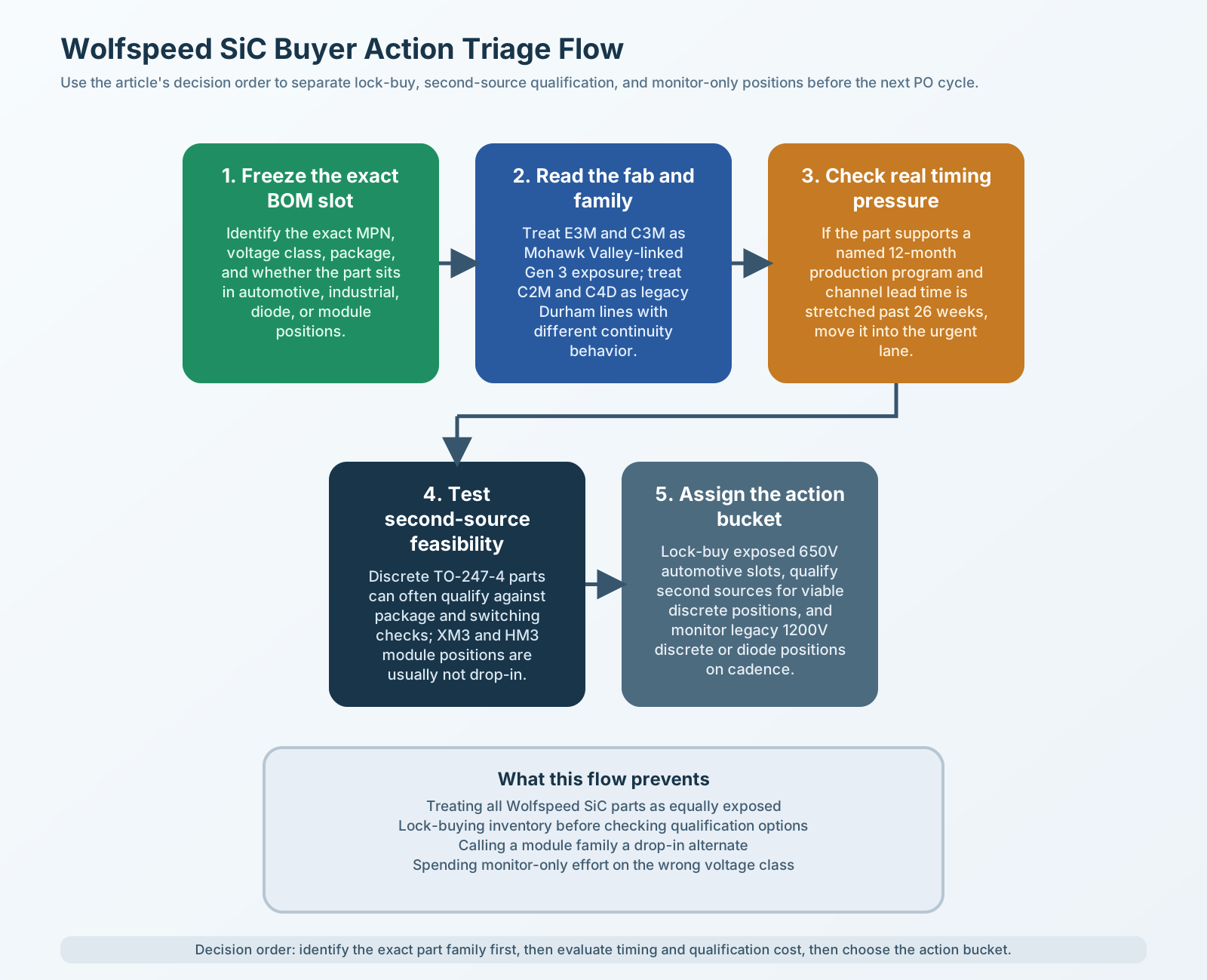
A worked example is useful here. Suppose the buyer's BOM contains a C3M0045065K (650V / 45mΩ, Gen 3 industrial) in a TO-247-4 socket on a solar inverter board. The voltage class is 650V (table row 2). The candidate second source is the IMZA65R040M2H (Infineon CoolSiC M2 H Automotive, 650V / 40mΩ, TO-247-4). Vds check: 650V vs 650V — equal. Rds(on) check: 40mΩ vs 45mΩ — within 12%, which is within the 2x tolerance and is actually better than the original. Package check: TO-247-4 vs TO-247-4 — match, including the Kelvin-source pin. Qualification cost: industrial grade, no AEC-Q101 required, bench-level test only — about 4 weeks of engineering time. The drop-in answer is yes, the qualification is low-cost, and the second source should be qualified now. That is the working pattern, and it is replicable across any 650V SiC position with a similar BOM context.
A second worked example, this one with a different answer. Suppose the buyer's BOM contains a CAB450M12XM3 (1200V / 450A XM3 module) in a 50 kW solar inverter. The voltage class is 1200V (table row 4). The candidate second sources are module families from Infineon EasyPACK, Onsemi NXH, or ST ACEPACK — but each is a different mechanical footprint, a different DC-bus layout, and a different gate-driver pinout. The drop-in answer is no. The qualification cost is mechanical re-layout plus driver re-design plus thermal re-validation, which is a 6–9 month program with a fixed cost that runs into six figures. The right answer here is to monitor the CAB450M12XM3 supply story and to negotiate a multi-year supply agreement with Wolfspeed for the existing part, not to qualify a drop-in module alternate. The buyer should exit the framework with a clear "no action needed" for this position and concentrate attention on the 650V automotive positions where the action actually is.
Buyer action plan: lock-buy, qualify, or monitor
The action plan is three buckets, and the entry criterion for each is concrete.
Lock-buy now if all three are true: (1) your program has a 12-month production window with no second source qualified, (2) the part is on a 26+ week lead time, (3) you are buying automotive-grade 650V MOSFETs for a named customer order. The lock-buy quantity should cover the production window plus a safety stock equal to one fab cycle (typically 13 weeks); do not lock-buy more than that without a second source in qualification, because you will be sitting on inventory when the lead time normalizes. TC judgment The third condition is the one most often skipped. Lock-buying speculative inventory for a 650V industrial design is a working-capital trap; lock-buying for an automotive build with a customer SOP date is risk management. Same part, different answer.
The practical steps for lock-buy: confirm the part family and voltage class with your program team, get a written quote with lead time from your distributor, place the order with a cancelable PO if possible, and document the rationale in your sourcing file. The documentation step is the one most often skipped, and it is the one your auditor will ask for first when the inventory review happens.
Qualify a second source if you are mid-program with a 650V SiC MOSFET design that is not yet automotive-qualified, or if you are transitioning from a 1200V discrete design to a 1200V module design. The qualification cost is real (a TO-247-4 board re-spin plus AEC-Q101 paperwork for automotive) but it converts a 26-week lead-time risk into a 12-week second-source lead time, which is the actual hedge. TC judgment The cost of qualifying a second source for a 650V SiC position is typically recovered within one avoided expedite fee cycle, based on TrustCompo's read of the expedite fee structure for automotive-grade SiC components in 2025–2026; the actual economics depend on the specific distributor relationship and the program volume, so this should be treated as an order-of-magnitude estimate rather than a precise payback calculation.
The practical steps for qualify: pick the candidate second source from the voltage-class table above, order evaluation samples, run the qualification plan (datasheet parameter diff, in-circuit bench test, thermal validation, then AEC-Q101 if automotive), and update your BOM with the qualified alternate. The qualification plan should be written down before samples arrive; without a written plan, qualification slips by a quarter.
Monitor for 1200V industrial discrete parts (the C2M0025120D family) and for the C4D40120D Schottky diode line. These are not where the supply story is breaking, and treating them as urgent is noise that distracts from the 650V automotive bucket where the action actually is. inference Public manufacturer and distributor signals reviewed for this article did not show a specific stock-out pattern for the C2M0025120D; a buyer should treat this as a working baseline and verify the live stock on their preferred distributor's page before placing a non-urgent PO. The lead-time pressure remains concentrated in the Gen 3 automotive families, where the Mohawk Valley fab output is the swing factor.
The practical steps for monitor: set a quarterly check on lead times for the C2M and C4D parts, subscribe to Wolfspeed's investor-relations update email for Mohawk Valley production milestones, and re-run this framework if a new fab event (capacity cut, second fab opening, customer-program cancellation) shifts the supply story. The re-run trigger is what turns monitoring from a passive activity into an early-warning system.
What this is NOT about
To keep the framework focused, three things this article deliberately does not cover. First, it is not a price forecast: SiC MOSFET pricing has its own dynamic (wafer cost, fab utilization, second-source entry), and any single-quarter price projection is more noise than signal for a buyer making continuity decisions. Second, it is not a financial analysis of Wolfspeed the company: the Chapter 11 timeline and the convertible-note restructuring are inputs to the supply story, but the right frame for a buyer is the part family, not the ticker. Third, it is not a generic SiC-vs-Si trade study: that comparison is well-covered in mfr catalogs and trade press, and the buyer's continuity question is specifically about Wolfspeed's fab footprint, not about whether to adopt SiC in the first place.
The reason these exclusions matter is scope discipline. A buyer who reads a generic "SiC is the future" article will not change their lock-buy or qualify decision; a buyer who reads a part-family-level continuity map can. The article is built around the decision, not around the technology.
A useful framing is that this article occupies the same space as a buyer's BOM review checklist: it tells you what to look at and what to ignore, but it does not do the BOM review for you. The actual review still requires pulling the BOM, running each SiC position through the voltage-class table above, and applying the action-plan criteria to each position. The framework is the scaffold; the BOM is the work. A buyer who treats the framework as a substitute for the BOM review will produce a generic answer that does not match their specific part mix, and the framework's value evaporates the moment the actual part numbers stop being the ones used in the worked examples.
A second useful framing is that this article is intentionally written for the buyer who has already decided to adopt SiC and is now asking the second-order question of which SiC parts to lock-buy and which to qualify. It is not written for the engineer who is still evaluating whether SiC is the right technology for their application, and it is not written for the financial analyst who is evaluating Wolfspeed as an investment. Both of those audiences have other resources that are more useful to them, and trying to serve all three audiences in one article would dilute the part-family-level continuity map that is the article's core contribution.
Common misconceptions worth retiring
Three patterns show up in most of the Wolfspeed SiC coverage that this article is explicitly pushing back on.
Misconception 1: "Chapter 11 means stock-out." A restructuring filing is a balance-sheet event, not a fab shutdown. Wolfspeed's Durham fab continues to run, the Mohawk Valley ramp is a separate capital story, and the device roadmap continues (5/21/2026 3.3 kV module launch is the most recent mfr-side confirmation). The continuity question is about lead times and allocation, not about whether the parts exist at all. TC judgment Buyers who treat Chapter 11 as a stock-out signal will over-order and end up holding inventory through the next pricing cycle; the right response is monitor-and-qualify, not panic-buy.
The chapter-by-chapter reality is more nuanced than either the headline-grabbing "stock-out" panic or the dismissive "nothing to see here" framing suggests. The C2M and C4D part families are running on the older 150mm Durham fab, which has been shipping product for over a decade; the production line is established and the supply chain around it (raw materials, packaging, test) is settled. The Gen 3 automotive parts are running on the newer 200mm Mohawk Valley fab, which is in ramp mode and which is the proximate cause of the capex burden that triggered the restructuring. A buyer who reads the difference between these two fabs will not over-react; a buyer who reads only the headline will.
Misconception 2: "Any 650V SiC MOSFET is a second source." Cross-brand substitution in SiC is not generic. Rds(on) tolerance, gate-charge curves, body-diode reverse-recovery behavior, and package thermal impedance all differ between Wolfspeed, Infineon, Onsemi, and ST. A buyer who treats SiC second-sourcing the way they treated silicon MOSFET second-sourcing ten years ago will discover the differences during qualification, when the cost of re-spinning a board is already sunk. The TO-247-4 Kelvin-source pin, in particular, is not a universal detail.
The qualification cost is real and worth respecting. AEC-Q101 paperwork for automotive parts is typically a 6-month cycle with a fixed cost per part family; bench-level qualification for industrial parts is faster but still non-trivial. A buyer who plans the qualification timeline against their program SOP date — rather than against the date they realized they needed a second source — will avoid the worst-case outcome of qualifying a part after the program has shipped. The IMZA65R040M2H is a working second-source candidate for the 650V/40mΩ position, but "working candidate" is not the same as "drop-in replacement," and the qualification work is what makes the difference between the two labels.
Misconception 3: "1200V is automatically safer than 650V." Voltage class is a packaging and qualification question, not a supply-risk question. Some 1200V programs are well-covered (industrial solar, UPS) and some 650V programs are exposed (automotive traction). The right unit of analysis is the part family + the customer program, not the voltage rating. fact The C2M0025120D (1200V discrete) is in a different supply bucket from the E3M0065090D (650V automotive) even though both are Wolfspeed SiC MOSFETs.
The deeper reason this misconception persists is that voltage class is the most visible specification on a SiC datasheet, and a buyer who skims only the headline spec will group parts by voltage rather than by fab. The correct grouping is by fab and by customer program: a 650V automotive part on the Mohawk Valley ramp shares its supply story with other Mohawk Valley parts regardless of voltage, and a 1200V industrial part on the Durham fab shares its supply story with other Durham fab parts regardless of voltage. A buyer who applies the fab grouping will arrive at the right continuity decision; a buyer who applies the voltage grouping will not.
Tooling and data sources for monitoring
A framework is only useful if the buyer can keep it current. The data sources for the 2026 Wolfspeed SiC supply story split into three tiers, and the cadence for each is different.
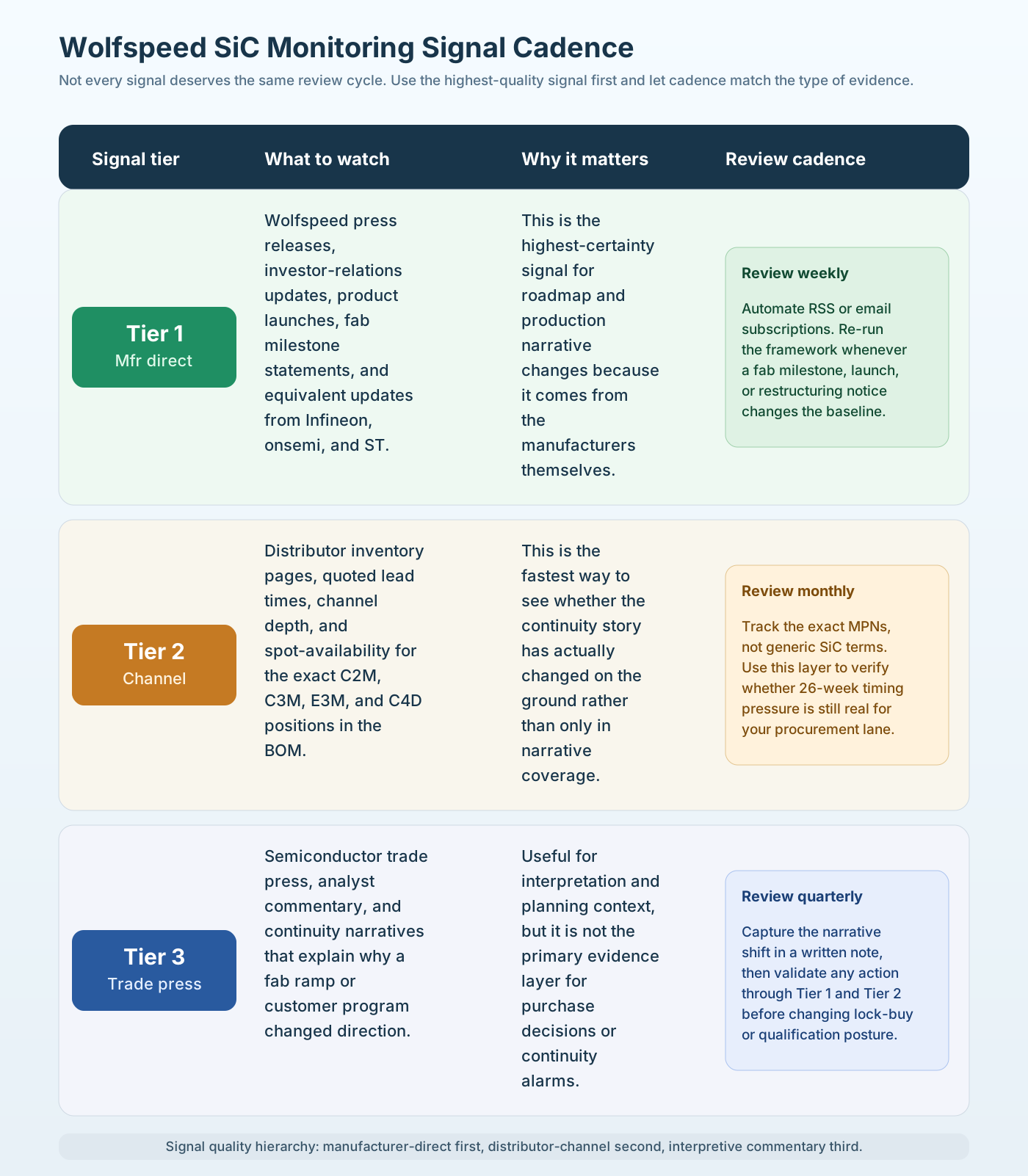
Tier 1 — mfr direct (weekly check). Wolfspeed's investor-relations email and press-release RSS feed are the canonical source for fab milestones, product launches, and customer-program wins/losses. The 5/21/2026 3.3 kV module announcement and the 6/9/2026 Gen 5 announcement both came through this channel. The signal is high-quality (mfr-controlled) but narrow (only covers Wolfspeed's own narrative). Pair it with Infineon's, Onsemi's, and ST's investor-relations channels to catch the second-source side of the story — the IMZA65R040M2H or equivalent CoolSiC M2 H Automotive candidate will get its own press releases as production ramps.
Tier 2 — distribution and channel (monthly check). Distributor inventory and lead-time pages are the single best signal for whether the supply story has actually changed on the ground. DigiKey, Mouser, Octopart, and Richardson RFPD all carry Wolfspeed SiC parts and they all show live inventory and lead times. A buyer who watches one of these pages monthly will catch a 26-week lead-time stretch the same week it appears, not the week after the next quarterly report. inference The C2M0025120D's continued availability across major distributors as of mid-2026 is consistent with our working assumption that the 1200V industrial discrete line remains on standard lead times; a single distributor-page check would surface the live signal directly and is the right verification step before placing a non-urgent PO.
Tier 3 — trade press and analyst commentary (quarterly check). Semiconductor trade press and analyst commentary are useful for the "why" — why a fab ramp slipped, why a customer program shifted, why a mfr's product roadmap changed direction. The signal is interpretive rather than empirical, and it should not be used as the primary input to a continuity decision. The semiconductorx.com Chapter 11 commentary on Wolfspeed's SiC supply chain is the right kind of secondary source for this tier; Reuters or Bloomberg coverage is rarer for this story because SiC power is a B2B story, not a consumer story.
The right cadence for a buyer running this framework is: weekly check on Tier 1, monthly check on Tier 2, quarterly check on Tier 3, with a full framework re-run whenever any tier surfaces a material event. A full re-run takes about two hours with a clean BOM and the SERP-backed evidence pipeline TrustCompo uses; it is worth doing before any PO cycle that exceeds six months of forward demand.
Two practical notes on the cadence. First, the weekly Tier 1 check should be automated where possible — RSS feeds and email subscriptions are good enough for most mfrs, and the actual reading time is small (5–10 minutes per week). Second, the quarterly Tier 3 review should produce a written note that goes into the buyer's continuity file, because the framework re-run trigger ("a material event") is easier to evaluate when the baseline state is documented. A buyer who keeps a quarterly Tier 3 note will catch a slow-moving signal (a fab ramp slipping by one quarter, a mfr quietly retiring an old product line) before it becomes an urgent Tier 1 event.
The tools TrustCompo itself uses to run this framework are: the serper_research.py action in the content-ops module for the SERP-backed evidence pack (used in this article's research phase), the topic_research.py action for re-scoring topics against the SERP, and the admin-api search_products endpoint for verifying whether a specific MPN is currently enumerated in the TrustCompo catalog. That final verification step mattered directly for this article: on June 28, 2026, the cited Wolfspeed, Infineon, onsemi, and ST anchor parts were published into the TrustCompo catalog and backfilled into this draft. None of these tools are required for a buyer to run the framework — the framework is a thinking pattern, not a software stack — but they are the supporting evidence pipeline when a buyer wants a quick re-run rather than a from-scratch analysis.
Conclusion
The 2026 Wolfspeed SiC supply story is real, but it is not a uniform supply story. The exposure is concentrated in automotive 650V SiC MOSFETs that pull from the Mohawk Valley fab ramp; the rest of the portfolio — 1200V industrial discretes, the C4D Schottky line, the XM3 module family — sits on different fab footprints with different lead-time profiles. The buyer's job is to read the part family, not the headline.
Three concrete recommendations close the framework. First, build a per-program continuity map: list every SiC part in your BOM, identify the fab and voltage class for each, and put the 650V automotive positions in the lock-buy or qualify bucket before the next PO cycle. Second, qualify at least one second source for any 650V SiC position where the program has a 12-month production horizon; the IMZA65R040M2H or an equivalent CoolSiC M2 H Automotive candidate is the working anchor, and the qualification cost is recoverable in one avoided expedite cycle. Third, monitor the 1200V industrial and Schottky diode positions on a quarterly cadence rather than a daily one, because the supply story is not concentrated there and over-monitoring is itself a productivity cost.
The framework is intentionally evergreen: the specific part numbers and lead times will move, but the part-family-and-fab pattern will hold through the 2026–2027 restructuring cycle. Re-run this framework when a new fab event (capacity cut, second fab opening, customer-program cancellation, or a successful Chapter 11 exit) shifts the supply story. Until then, the action is in the 650V automotive bucket and the noise is everywhere else.
Need a second source on a SiC BOM? TrustCompo can run a structured RFQ intake and an alternative-sourcing review for any of the part numbers above, and the anchor product pages for the cited Wolfspeed, Infineon, onsemi, and ST parts are now live in the TrustCompo catalog.