- MLCC
- Murata
- TDK
- Samsung Electro-Mechanics
MLCC Supply Continuity 2026: Which AI-Server and High-Capacitance Specs Are Tightening First?
A 2026 buyer framework for MLCC supply continuity across Murata, TDK, and Samsung Electro-Mechanics, focused on high-capacitance, AI-server, automotive, and industrial specs that deserve early sourcing review.
Quick facts
- The useful 2H26 MLCC question is not whether every MLCC is short, but which high-end specs are tightening first.
- TrendForce's July 6, 2026 market note flags elevated 2H26 shortage risk for high-end MLCCs tied to AI demand.
- Murata, TDK, and Samsung Electro-Mechanics all have public 2026 material connecting AI server or AI infrastructure power density to MLCC demand.
- Buyers should segment MLCC risk by capacitance, voltage, case size, dielectric, reliability grade, and end market before escalating RFQs.
Key Takeaways
- Do not treat MLCC as one shortage category. The highest-risk lines are defined by exact capacitance, voltage, package, dielectric, application location, qualification status, and AVL limits.
- AI server demand is pulling on specific power-tree windows first. Watch low-voltage high-capacitance decoupling, PSU / IBC power stages, 100V-class MLCCs, and high-reliability automotive or industrial positions.
- A same-value alternate is not automatically safe. DC bias, ESR / ESL, temperature behavior, mechanical robustness, and customer approval can make two nominally similar MLCCs very different in production.
- The buyer action is continuity review, not panic buying. Score each MLCC line by substitution cost, supplier concentration, demand overlap, and qualification friction before escalating RFQs.
The MLCC story in mid-2026 is easy to overstate. A buyer sees a shortage headline, a price rumor, or an urgent distributor note, and the whole category starts to feel risky. That is understandable, but it is not precise enough for a production BOM. MLCC supply risk is not a single line item called "capacitors." It is a stack of electrical, mechanical, thermal, qualification, and approved-vendor constraints.
The better question is narrower: which MLCC specifications are tightening first, and which ones still behave like normal commodity passives?
This article takes a split-market view. Official 2026 material from Murata, TDK, and Samsung Electro-Mechanics shows that AI server, AI infrastructure, and dense power-delivery designs are pulling more attention toward high-value MLCCs. TrendForce's July 6, 2026 market note adds a stronger market signal: high-end MLCC book-to-bill pressure has risen enough that 2H26 shortage risk deserves buyer review.
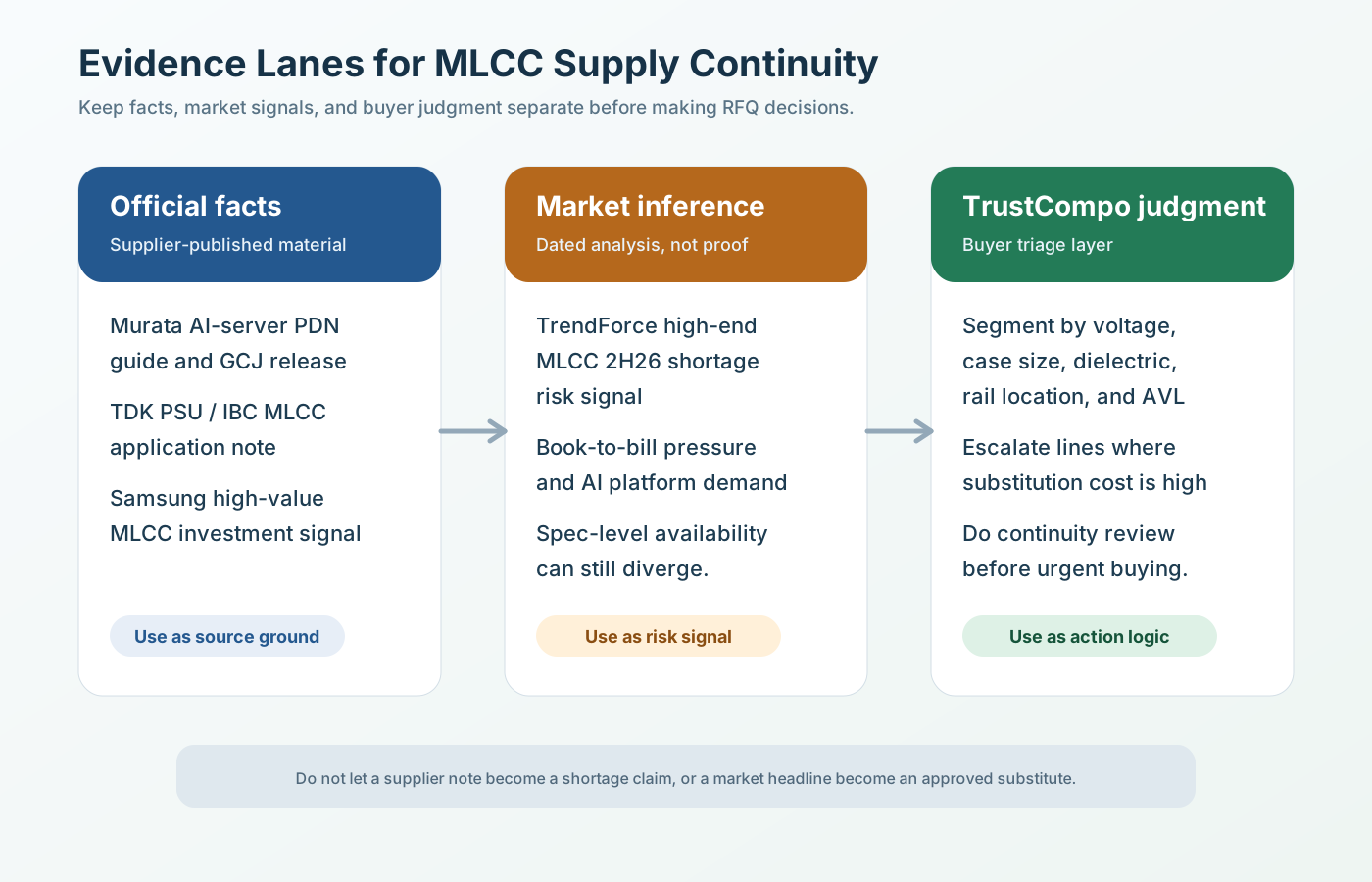
Those two layers should not be blurred. Manufacturer application notes are official facts about demand drivers and product focus. TrendForce is market analysis. TrustCompo's judgment is the buyer triage layer: which specs should move earlier in the RFQ, alternate-source, and redesign-review queue.
The hard part: an MLCC shortage is never only about capacitance
If a BOM line says "47uF 2.5V 0402 X6S," the naive purchasing read is simple: find another 47uF, 2.5V, 0402 part and ask for price. The engineering read is less forgiving.
The effective capacitance may collapse under DC bias. The dielectric may behave differently over temperature. The part may have a different thickness, land-pattern tolerance, ESR/ESL profile, mechanical stress behavior, acoustic-noise tendency, or customer approval status. In a dense AI accelerator, a part near a GPU/ASIC rail is not doing the same job as a general decoupling part on a low-current auxiliary rail.
That is why 2026 MLCC supply continuity should be reviewed by function in the power tree, not by catalog category.
| Power-tree location | Typical MLCC stress | Procurement meaning |
|---|---|---|
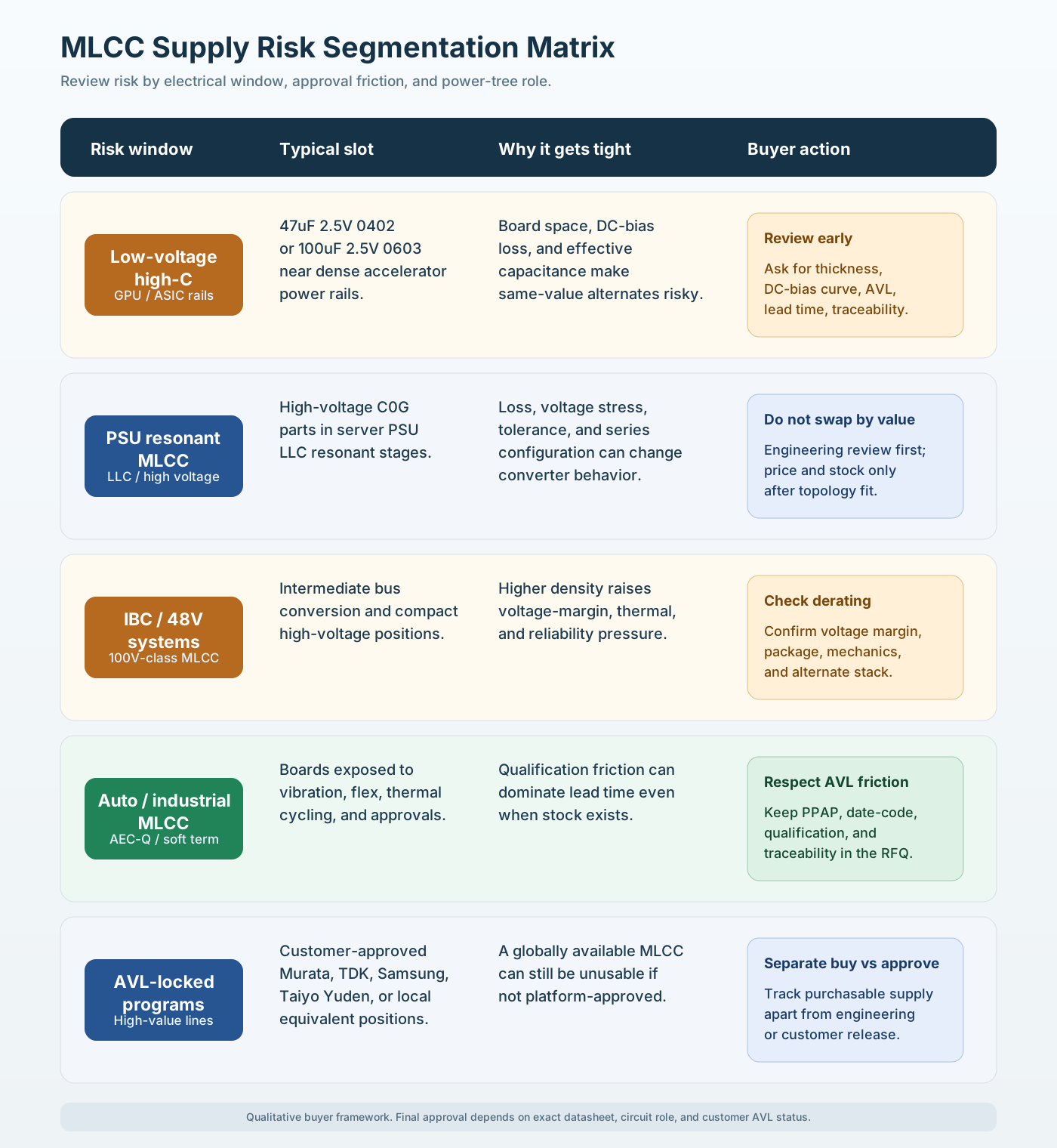
| GPU / ASIC / CPU point-of-load decoupling | Low voltage, very high transient current, extreme board density | Same nominal capacitance may not deliver the same effective capacitance at bias. |
| PMIC / VRM output bank | Ripple, thermal rise, board-space limits, low ESL requirements | Alternate needs electrical and layout review, not only AVL approval. |
| PSU DC/DC resonant stage | High voltage, low loss, topology-specific RMS current | Class 1 / C0G high-voltage parts can be harder to substitute casually. |
| IBC 48V-to-12V stage | 100V-class margin, ripple, heat, reliability | Mid-voltage MLCC availability can become a hidden schedule blocker. |
| Automotive / industrial control boards | AEC-Q200, flex cracking, vibration, temperature cycling | Mechanical and qualification status may dominate price and lead time. |
TrustCompo Judgment
The MLCC parts most worth early review are not the most expensive parts in isolation. They are the parts where substitution cost is high and everyone else is trying to secure the same electrical window.
What is officially confirmed
Murata published a February 4, 2026 guide for optimizing power delivery networks in AI servers and next-generation data centers. The guide positions MLCCs, silicon capacitors, polymer aluminum electrolytic capacitors, inductors, ferrite beads, and thermistors as part of the component stack needed for stable and efficient data-center power delivery.
TDK's July 2026 application note on MLCC solutions for data-center and AI-server power systems makes the same engineering point from another supplier angle: as AI and cloud demand raise rack and server power density, PSU and intermediate bus converter designs need passive components with higher efficiency, reliability, and density. The useful detail is that TDK separates the power chain into PSU, IBC, and VRM stages, and discusses high-voltage C0G resonant capacitors for LLC stages plus 100V-rated MLCC needs around intermediate-bus conversion.
Samsung Electro-Mechanics has two useful official signals. Its July 3, 2026 fair-disclosure filing describes a long-term investment strategy to strengthen package substrate and high-value MLCC competitiveness for AI data-center servers. Separately, its product material highlights ultra-compact, high-capacitance MLCCs for AI-related power stabilization, including AI-server examples such as CL05X476MS6N9W and CL10X107MS8NZW.
Official fact: these suppliers are publicly aligning high-value MLCC development, support, and investment with AI infrastructure and dense power electronics.
What the market signal adds
TrendForce's July 6, 2026 MLCC note is the clearest public market signal reviewed for this article. It reports elevated book-to-bill ratios for leading Japanese and Korean MLCC suppliers and frames 2H26 shortage risk around high-end MLCCs tied to AI server platform upgrades and custom ASIC demand.
That does not mean a buyer should panic-buy every capacitor line. It means the buyer should treat high-end MLCC pressure as spec-specific and time-sensitive. The phrase "high-end MLCC" is still too broad for an RFQ. The practical question is which exact spec windows are being pulled by AI servers, automotive electronics, industrial power, and edge-AI miniaturization at the same time.
The most exposed windows are likely to include the following:
| Watchlist window | Examples in current research | Why buyers should care |
|---|---|---|
| Low-voltage, high-capacitance, miniature MLCCs | CL05X476MS6N9W at 47uF / 2.5V / 0402 / X6S and CL10X107MS8NZW at 100uF / 2.5V / 0603 / X6S | AI accelerator boards need high capacitance near dense low-voltage rails. Board space and effective capacitance matter as much as nominal value. |
| High-voltage C0G resonant MLCCs | TDK examples such as C3225C0G3B223J, C3225C0G3A333J, and related mid/high-voltage C0G families in PSU LLC stages | Resonant capacitors are topology-sensitive. Loss, voltage stress, tolerance, and series/parallel configuration affect converter behavior. |
| 100V-class MLCCs for IBC / 48V systems | TDK's AI-server PSU / IBC framing and Murata's 100V automotive MLCC example GCJ21BD72A225KE02 | 48V and higher-density architectures increase demand for smaller high-voltage parts. Mechanical reliability and derating are part of the sourcing problem. |
| Automotive / industrial high-reliability MLCCs | AEC-Q200 and soft-termination families such as Murata GCJ | Qualification friction makes substitution slower even when open-market inventory exists. |
| AVL-locked high-value positions | Customer-approved Murata, TDK, Samsung, Taiyo Yuden, or local equivalents | A part can be available globally and still unusable if it is not approved for the platform. |
TrustCompo Judgment
MLCC shortage risk is not a category label. It is a map of exact capacitance, voltage, package, dielectric, grade, approved vendor, and application location.
Not all MLCCs are equally constrained
This is the section buyers should keep open during an RFQ review.
An MLCC is not interchangeable just because two lines share the same nominal capacitance. In a real design, the following details decide whether an alternate is practical:
- capacitance under DC bias
- voltage rating and derating rule
- dielectric class and temperature behavior
- case size and board land pattern
- ESR / ESL behavior in the target frequency range
- ripple, surge, and mechanical stress requirements
- AEC-Q200, industrial, or customer-specific approval
- supplier AVL status and traceability needs
That is why a high-capacitance 2.5V part near an AI accelerator rail and a commodity decoupling MLCC in a less critical consumer board should not be treated as the same sourcing problem.
A buyer-grade risk matrix for MLCC lines
For a hard BOM review, do not start with "Murata vs Samsung vs TDK." Start with how difficult it is to approve the next usable lot.
| Risk factor | Low risk | Medium risk | High risk |
|---|---|---|---|
| Electrical uniqueness | Generic decoupling, loose tolerance, multiple approved vendors | Same nominal value exists, but DC-bias / ESR / size needs review | Position depends on effective capacitance, low ESL, C0G behavior, or resonant-tank performance |
| Qualification friction | Commercial product, no customer-specific AVL | Industrial or long-life program with limited alternates | Automotive, medical, defense, aerospace, or customer-locked AVL |
| Package pressure | Larger case size allowed | Layout can absorb one package option with minor review | Board is space-constrained; thickness, land pattern, or height is locked |
| Demand overlap | Consumer-only or low-current auxiliary use | Industrial plus some AI / automotive overlap | AI server, data-center PSU/IBC, automotive 48V, or high-density edge-AI overlap |
| Supplier concentration | Three or more validated suppliers | Two validated suppliers, one preferred | Single approved supplier or exact family locked by validation |
Score each row from 1 to 3. Any MLCC line scoring 11 or higher should move from "normal RFQ" to "continuity review." That does not mean buy immediately. It means someone should confirm lead time, quote validity, alternates, and redesign fallback before the line becomes urgent.
What engineering should verify before approving an alternate
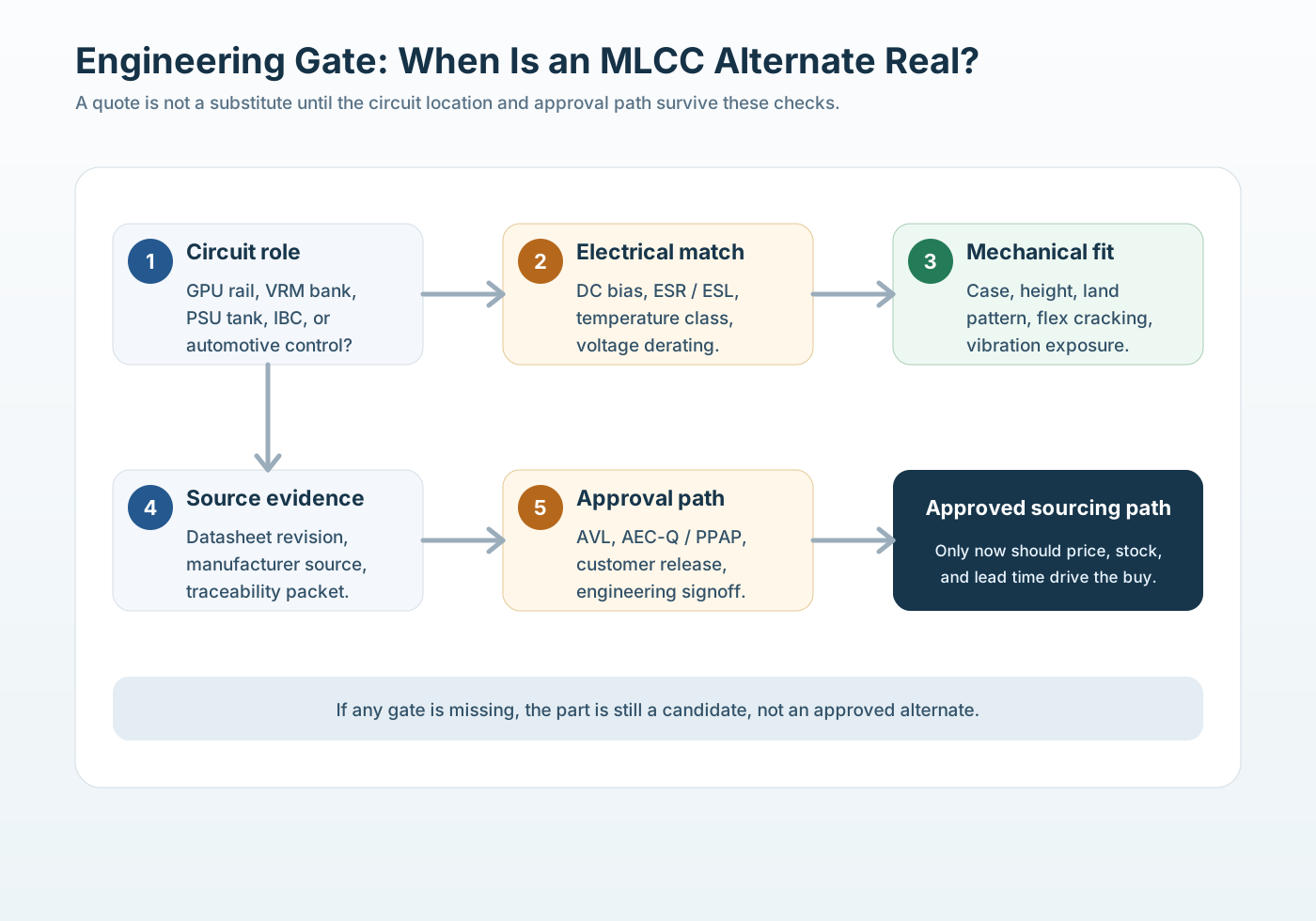
A useful alternate proposal should include more than price and stock. Ask engineering to review:
- Effective capacitance at operating bias
A 47uF nominal MLCC may deliver much less capacitance at the actual DC bias. This is especially important on low-voltage, high-density rails where the design counted on a specific capacitance bank. - Temperature characteristic and operating window
X5R, X6S, X7R, X7T, C0G, and other dielectric classes are not interchangeable labels. They define temperature behavior and application fit. - Voltage derating and surge margin
A replacement with the same rated voltage may still be unacceptable if the customer derating rule, transient environment, or platform margin is different. - ESR / ESL and placement sensitivity
Near a fast rail, physical placement and parasitics can change the result. A substitute that looks fine in a spreadsheet can worsen ripple, transient response, or EMI. - Mechanical robustness
Soft termination, board flex behavior, vibration exposure, and thermal cycling matter for automotive and industrial boards. Murata's GCJ21BD72A225KE02 is useful here as a signal of where high-voltage, high-capacitance, small-case, reliability-oriented MLCC development is going. - Process and compliance status
A substitute must match not only the electrical target but the customer's approval route: RoHS/REACH, AEC-Q200 if needed, PPAP requirements, customer AVL, date-code rules, and traceability.
TrustCompo Judgment
If an alternate does not come with a datasheet, manufacturer source, package confirmation, and the reason it works in that exact circuit location, it is not an alternate yet. It is only a search result.
How to phrase the RFQ so suppliers return useful data
Weak RFQ:
Need 100k pcs MLCC 47uF 2.5V 0402, quote best price.
Better RFQ:
Need approved supply options for Samsung
CL05X476MS6N9Wor equivalent. Application: AI accelerator low-voltage rail decoupling. Required: 47uF nominal, 2.5Vdc, X6S or engineering-approved equivalent, 0402 / 1005 footprint, thickness limit to be confirmed, original manufacturer traceability, datasheet link, lead time, quote validity, COO, date code, packaging, and alternate approval notes.
The second RFQ gives the supplier enough context to avoid useless alternates. It also gives the engineering team a clean review packet instead of a list of random cross-reference candidates.
Buyer checklist for the next 30 days
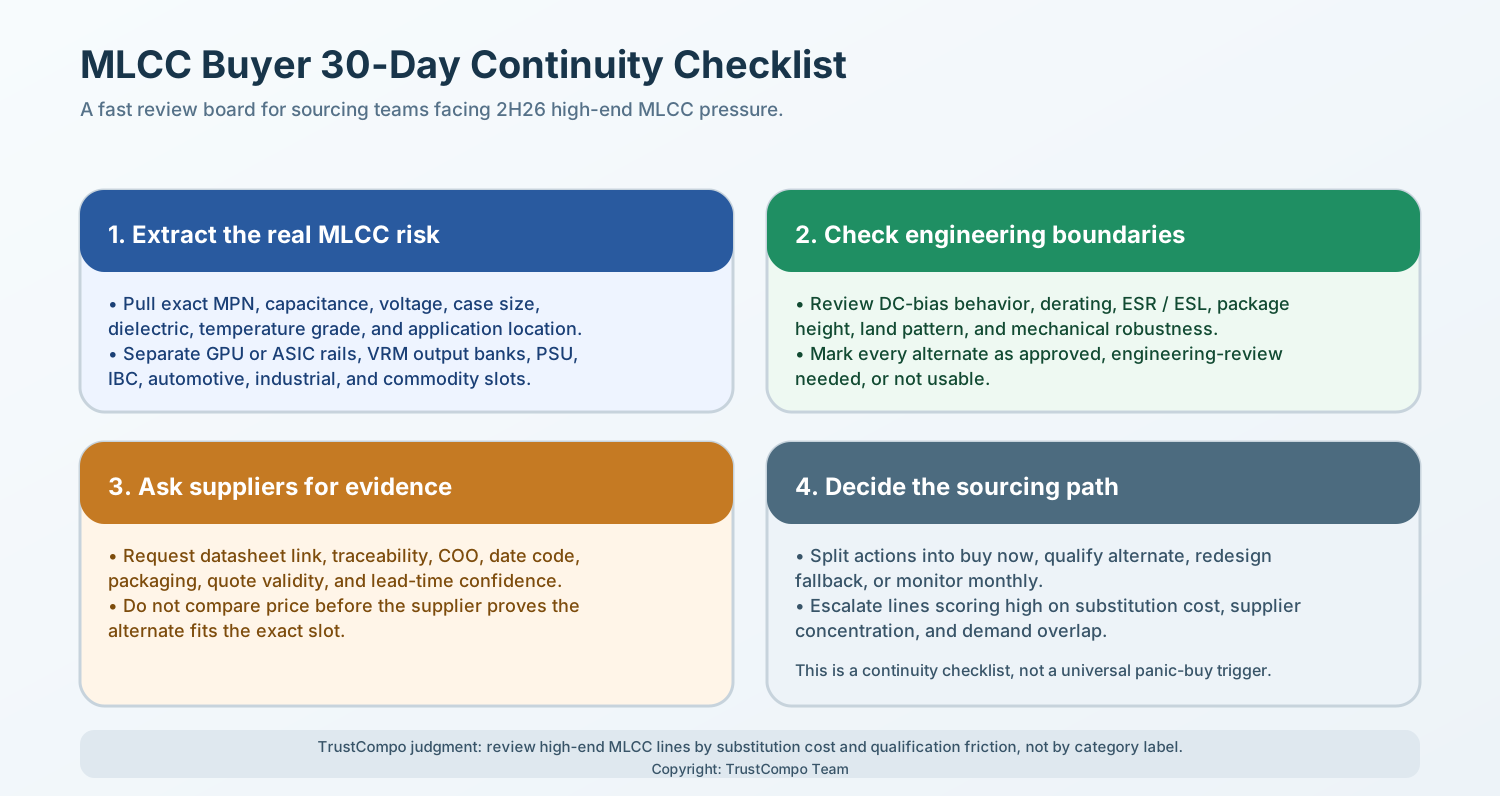
- Pull the exact MLCC lines from the BOM instead of reviewing the category as "capacitors."
- Mark every part by capacitance, voltage, case size, dielectric, temperature grade, reliability grade, and application location.
- Separate AI-server, high-current, automotive, industrial, and commodity positions.
- Ask suppliers for quote validity and lead-time confidence on the high-risk windows first.
- Confirm approved alternates before the market becomes urgent.
- For parts without a qualified second source, ask engineering whether redesign is realistic or whether the program needs buffer stock.
- Keep market reports, manufacturer application notes, distributor quotes, and internal supplier feedback in separate evidence lanes.
- Build a two-column action list: "can buy now from approved sources" vs "needs engineering review before any substitute is safe."
- For every high-risk line, store the datasheet revision, source URL, quote date, lead-time estimate, and traceability requirement in the same RFQ record.
For sourcing teams, the goal is not to predict one universal MLCC shortage. The goal is to avoid discovering too late that the one capacitor class your board cannot easily change is the class everyone else is chasing too.
Sources
- Murata, February 4, 2026: AI-server power delivery network technology guide announcement.
- TDK, July 2026: MLCC solutions for data-center / AI-server PSU and IBC power systems.
- Samsung Electro-Mechanics, July 3, 2026: investment disclosure for package substrate and high-value MLCC for AI data-center servers.
- Samsung Electro-Mechanics, July 2026 component data:
CL05X476MS6N9W, 47uF, 2.5Vdc, X6S, 0402 / 1005. - Murata, June 4, 2026:
GCJ21BD72A225KE02, 2.2uF, 100Vdc, 0805, soft-termination automotive MLCC. - TrendForce, July 6, 2026: market analysis on high-end MLCC book-to-bill pressure and 2H26 shortage risk.