- STMicroelectronics
- ST price adjustment
- STM32
- procurement strategy
STMicroelectronics June 2026 Price Adjustment: Buyer Checklist and BOM Review Steps
A buyer checklist for the STMicroelectronics June 2026 price adjustment, covering confirmed notice facts, BOM exposure review, quote validity, alternate boundaries, and incoming quality checks.
Quick facts
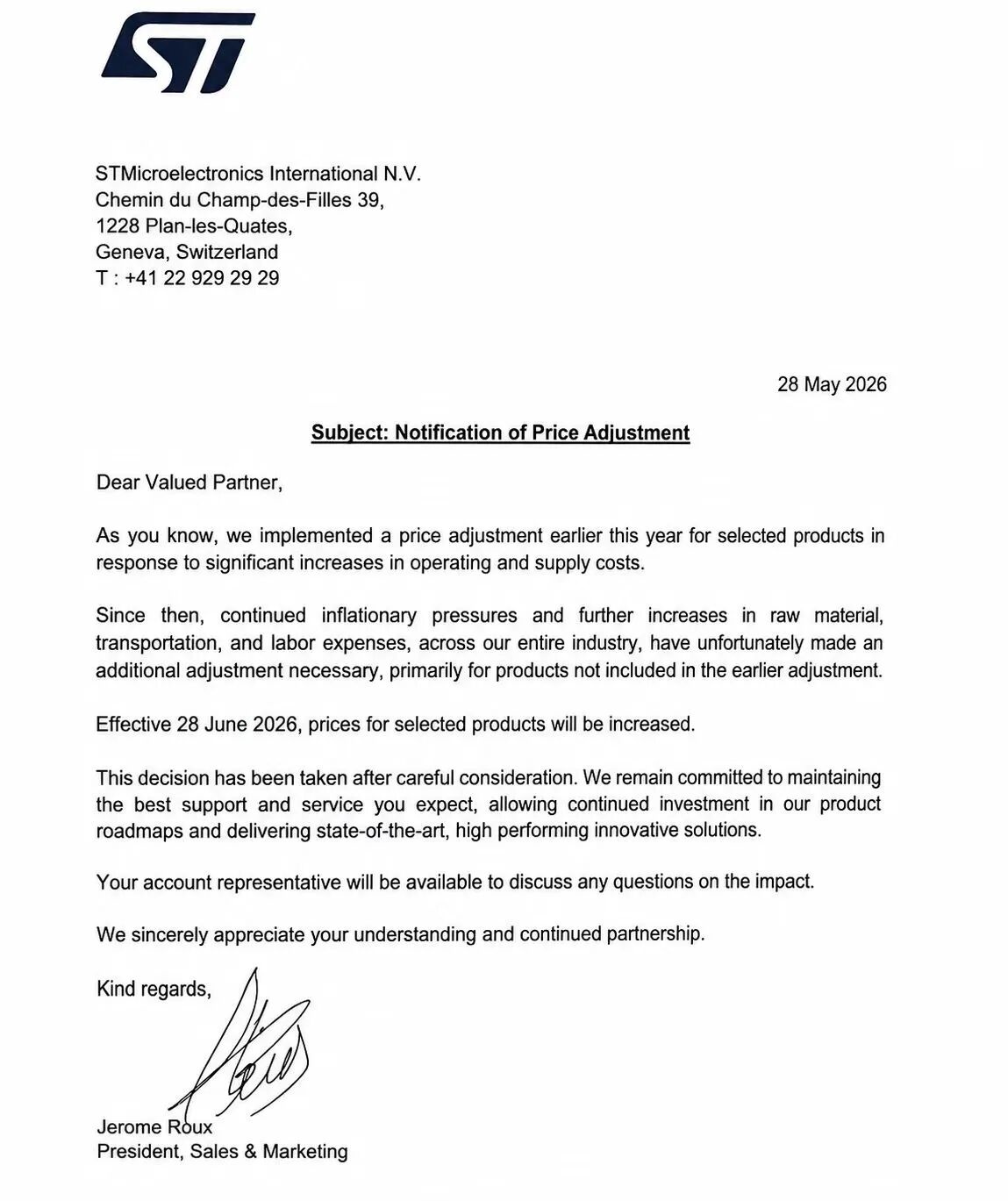
- STMicroelectronics issued a Notification of Price Adjustment dated May 28, 2026.
- The new pricing takes effect on June 28, 2026.
- The notice says the adjustment is primarily for products not included in an earlier adjustment.
- For buyers, the key near-term risk is not only price but also pull-forward demand, mixed-lot offers, and weaker traceability during the transition window.
STMicroelectronics issued a Notification of Price Adjustment dated May 28, 2026, with new pricing effective June 28, 2026. That is the confirmed source basis for this article. The reviewed notice does not provide a public SKU-by-SKU increase table, so the buyer task is narrower and more practical: identify ST exposure in the BOM, confirm quote validity before the effective date, and avoid treating weak-traceability offers as a shortcut around repricing.
This article stays close to what is actually confirmed, then separates that from procurement judgment. The goal is not to inflate a market rumor into a broader claim than the source supports. The goal is to help sourcing teams act before a routine price notice turns into a cost and supply problem.
Source Basis and Review Date
This article was last reviewed on August 5, 2026. Its core date claims are based on the STMicroelectronics price adjustment notice dated May 28, 2026, with new pricing effective June 28, 2026.
For broader business context, it also references STMicroelectronics official Q1 2026 financial results source, STMicroelectronics official June 2, 2026 data-center revenue-ambition source, and the official STMicroelectronics investor quarterly-results source archive.
Where the article discusses likely exposure areas or channel behavior, those sections are presented as TrustCompo procurement judgment, not as a direct quotation from ST.
What Changed Since Prior Review
- The page title and visible framing now use price adjustment rather than a broad price-increase alert.
- The opening states the confirmed notice date, effective date, and source boundary within the first screen.
- Product examples are limited to published TrustCompo anchors and are framed as representative BOM-review checks, not as a confirmed affected-SKU list.
- Buyer actions now focus on quote validity, traceability, alternate boundaries, and incoming quality controls before purchase approval.
What Is Confirmed as of June 3, 2026
The following points are supported by the primary material reviewed for this draft:
- STMicroelectronics issued a price adjustment notice dated May 28, 2026.
- The notice says the new prices take effect on June 28, 2026.
- The communication is signed by Jerome Roux.
- The notice says the adjustment is primarily for products not included in the earlier adjustment.
- ST cites inflationary pressures on raw materials, logistics, and labor expenses, along with continued investment in product roadmaps.
Those are the hard facts. What the notice does not give buyers is a public SKU-by-SKU impact list, a universal percentage increase table, or a promise that channel behavior will stay calm during the 30-day transition period.
Confirmed vs Assumed for BOM Review
Use this distinction before forwarding the notice internally. It keeps the commercial response fast without turning an incomplete source into a broader claim than it can support.
| Item | Status | How Buyers Should Use It |
|---|---|---|
| Notice date: May 28, 2026 | Confirmed from the reviewed notice image. | Use it as the starting date for quote-age and approval-window checks. |
| Effective date: June 28, 2026 | Confirmed from the reviewed notice image. | Ask suppliers whether quoted pricing is valid before, on, and after this date. |
| "Primarily for products not included in the earlier adjustment" | Confirmed wording in the reviewed notice. | Treat it as a reason to review broad ST exposure, not as proof that every family is affected. |
| Exact affected SKU list | Not available in the reviewed material. | Do not assume inclusion; verify line by line with the authorized channel, supplier quote, or ST account contact. |
| MCU, power, analog, interface review priority | TrustCompo procurement judgment. | Use these as triage buckets for BOM review, then validate against actual part numbers and quote history. |
| Pull-forward demand and traceability noise | Market-behavior risk, not a direct ST claim. | Add documentation and incoming-inspection requirements to urgent or open-market buys. |
What the Notice Likely Means for Buyers
From a procurement perspective, the most important sentence is the one about products not included in the earlier adjustment. That usually signals a portfolio clean-up rather than a single-category event. In other words, the purpose is not only to react to one hot product line. It is to rebalance pricing across portions of the catalog that were left behind in previous rounds.
TrustCompo assessment: buyers should treat this as a pricing window event, not only a cost headline.
That distinction matters:
- If you focus only on the percentage increase, you may miss the shorter-term risk of pull-forward orders before June 28.
- If you focus only on lead time, you may miss the margin impact on mature ST parts that appear in many low-cost designs.
- If you focus only on official channel stock, you may end up buying from the open market after repricing, when traceability quality is often weaker.
The broader public context also supports a more disciplined reading. In the official Q1 2026 financial-results source cited above, ST described improving demand, strong booking, normalized distribution inventory, and continued investment. In the official June 2, 2026 data-center update cited above, ST raised its revenue ambition for data-center activity. Those sources do not prove which exact MCU or power device will move first, but they support reading price management as part of wider portfolio and investment discipline rather than a one-off temporary reaction.
Which ST Product Buckets Deserve Review First
The article should stay careful here: the reviewed notice does not publish a detailed affected-product list. So the table below is not a claim of confirmed inclusion. It is a buyer-priority framework for where to check exposure first.
| Product Bucket | Why Review It First | Evidence Needed Before PO |
|---|---|---|
| Mature STM32 MCU lines | These parts often sit in long-life industrial and embedded BOMs where even a modest increase can spread across large volumes. | Current quote, prior approved price, lead time, date code, package condition, and whether alternates are already released in the AVL. |
| Standard power discretes | Mature MOSFET, rectifier, and driver families are common cost-sensitive BOM items. | Electrical and thermal limits, package and pinout match, supplier traceability, lot uniformity, and price validity across June 28. |
| Offline power and support ICs | Small-value PMIC or switcher lines can create hidden cost creep when bought in volume. | Line-item annual usage, approved lifecycle status, production criticality, and whether a different source changes test coverage. |
| Gate drivers and isolation-adjacent ICs | Qualification can depend on isolation rating, propagation delay, UVLO behavior, and package creepage or clearance. | Datasheet comparison, application review, lot traceability, and engineering sign-off before substitution. |
| Mature analog and interface devices | These often escape attention because they are not the most expensive part on the board. | Parametric limits, package code, temperature grade, firmware or timing dependency, and approved second-source status. |
If you want to move from category review to part-level verification, these representative detail pages are the most practical starting points for this article:
- review current STM32F103C8T6 availability for legacy control designs
- compare STM32F030C6T6 pricing before the June 28 deadline
- verify STM32F407VGT6 sourcing for higher-performance STM32F4 programs
- check STL60N10F7 MOSFET stock for cost-sensitive power stages
Representative broader searches that match this article's sourcing intent:
- Search STM32-related inventory
- Search ST power devices and related families
- Browse the STMicroelectronics manufacturer page
If your production depends on very specific part numbers, the next step should be a BOM-level check rather than broad category guessing.
For teams reviewing smaller power and driver lines before repricing, two useful anchor parts are VIPER12A for offline auxiliary power-supply sourcing and STGAP1AS for isolated gate-driver cost and qualification review. These are representative checks, not a claim that those exact SKUs are named in the notice.
SKU-Level Review Examples
Use examples only where a real part number, datasheet path, or product anchor exists. The point is to turn the price notice into a controlled BOM exercise.
| Example Line | Review Question | Buyer Control |
|---|---|---|
| STM32F103C8T6 | Is this legacy control MCU still bought as an original ST part, or has the program approved a second source or redesign path? | Compare current quotes with the last approved buy, require label and lot photos, and confirm firmware/package assumptions before accepting any alternate. |
| STM32F030C6T6 | Does the part sit in high-volume low-cost equipment where a small unit increase affects margin? | Check annual usage and price validity first; do not substitute based only on core family name. |
| STM32F407VGT6 | Would a quote delay or repricing event affect higher-performance controller builds? | Ask for shipment date, date code, and traceability path before approving urgent coverage. |
| STL60N10F7 | Is any proposed MOSFET alternate actually compatible with the power-stage thermal and switching limits? | Validate VDS, RDS(on), gate charge, package, thermal resistance, and avalanche requirements before PO. |
| VIPER12A | Is an offline auxiliary supply line being ignored because the unit price is low? | Review line-item spend, lifecycle exposure, and incoming inspection coverage. |
| STGAP1AS | Does the application depend on isolation, drive strength, timing, or UVLO behavior? | Keep any substitute in engineering review until datasheet and application constraints are checked. |
The Real 30-Day Risk: Market Behavior Before the Deadline
For many teams, the highest risk between May 28, 2026 and June 28, 2026 is not the notice itself. It is how the channel behaves after the notice circulates.
Common market patterns in this kind of window include:
- distributors asking buyers to lock decisions faster
- shorter quote-validity periods
- customers pulling orders forward to beat the effective date
- higher open-market activity on mature and familiar ST part numbers
- more offers with mixed date codes, partial packaging, or incomplete traceability
That last point deserves attention. Mature ST parts are exactly the kind of components that can appear safe at first glance because everyone recognizes the family name. In practice, the stressful period is when a sourcing team is most likely to approve an offer with:
- mixed lots presented as one clean batch
- inconsistent label history
- partial reel or repacked tray conditions
- unclear country-of-origin or distributor path
- "same family" replacement logic that has not actually been approved by engineering
This is where a routine price event becomes a quality-control event.
For example, if your team is buying familiar MCU lines such as STM32F103C8T6 for long-life industrial control builds, STM32F030C6T6 for high-volume low-cost controller programs, or STM32F407VGT6 for higher-performance STM32F4 designs, the recognition factor itself can become a risk. Buyers may assume every offer is equivalent even when packaging condition, lot uniformity, or traceability quality is clearly different.
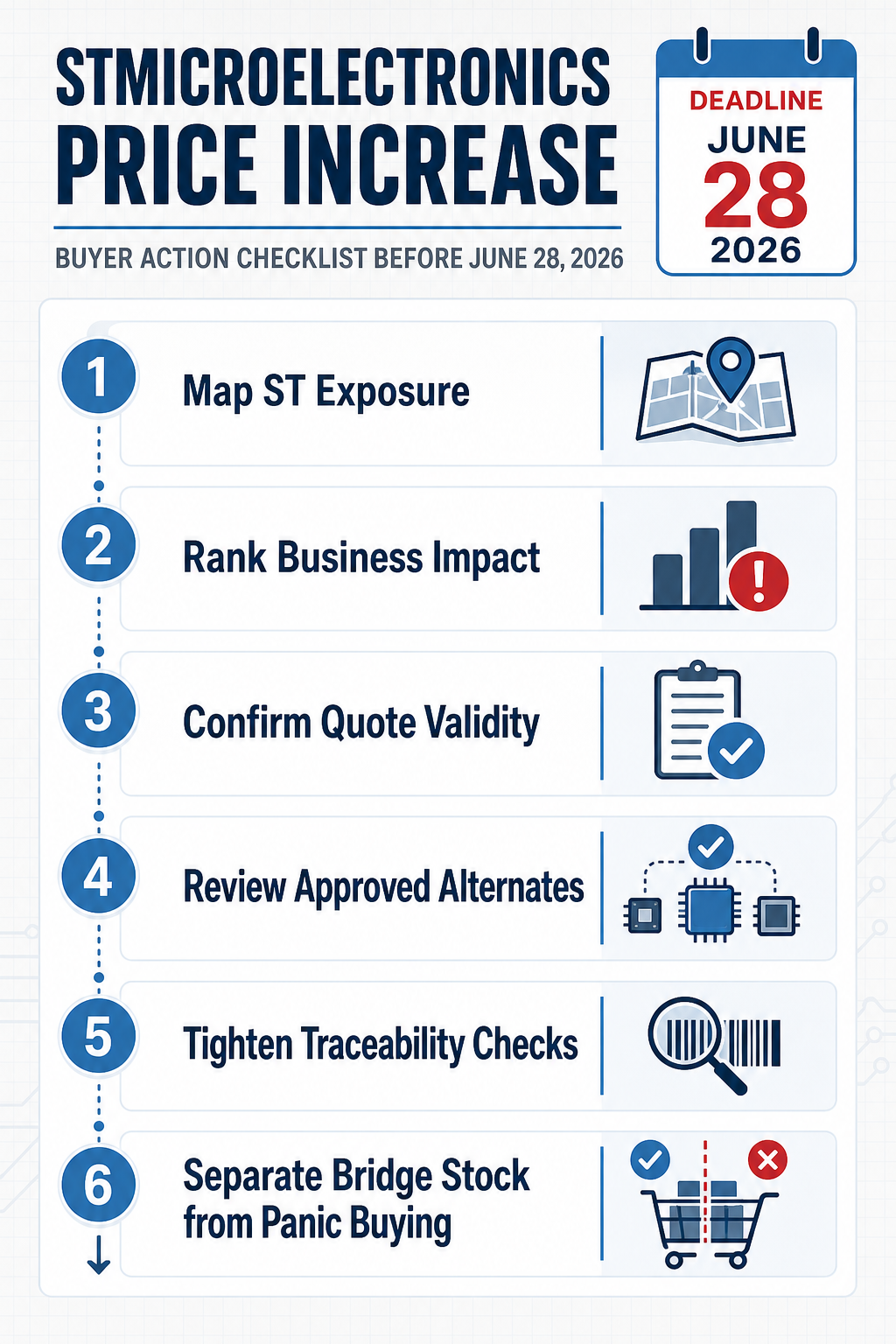
A Practical Buyer Checklist Before June 28, 2026
Use the deadline as a workflow trigger, not just a calendar note.
| Step | What to Do | Why It Matters |
|---|---|---|
| 1. Map ST exposure | Pull every active ST line item from the current production BOM and open RFQs. | You need to know which parts are truly margin-sensitive before rushing orders. |
| 2. Rank by business impact | Sort by usage volume, supply sensitivity, single-source dependency, and end-product margin impact. | Not every ST line justifies the same pre-buy strategy. |
| 3. Ask for written validity | Require suppliers to confirm price validity, shipment timing, and whether the quote remains valid across the June 28 boundary. | This reduces ambiguity when approvals take several days. |
| 4. Review alternate boundaries | For mature MCU and power parts, confirm which alternates are already approved and which still require engineering review. | A price adjustment is a bad time to discover that a "substitute" is only commercially similar. |
| 5. Tighten incoming quality checks | Add date code, label photo, packaging, and traceability checks to any urgent ST buy. | The open market usually gets noisier as repricing begins. |
| 6. Separate bridge stock from undocumented pre-buying | Buy what protects production and qualification schedules, not whatever looks available. | Excess or unverified inventory creates a different cost problem later. |
How to Talk About Alternatives Without Creating New Risk
A price notice often pushes teams to ask for replacements immediately. That is reasonable, but the review standard should stay high.
For ST parts, "alternative" can mean very different things:
- an exact manufacturer-original part sourced through a different channel
- an approved second-source component already released in the BOM
- a functionally similar part that still needs engineering review
- a redesign path for future cost control
Those are not interchangeable options. A sourcing team should not let a June deadline blur them together.
If the goal is short-term cost control, the safest path is usually:
- secure pricing on truly critical original parts
- review approved alternates for non-core lines
- send engineering the parts that still need validation
- keep quality and traceability requirements attached to every urgent quote
The same logic applies to mature power devices. A line item like STL60N10F7 for motor-control or DC-DC power-stage coverage should be checked against approved thermal and package boundaries before a buyer treats an open-market offer as a harmless substitution.
For support ICs, buyers should be equally careful not to dismiss "small" line items. VIPER12A for offline auxiliary power designs can affect cost across large production runs, while STGAP1AS for isolated gate-drive stages often sits inside applications where qualification boundaries are tighter than the unit price suggests.
For broader support, the most relevant internal next steps are:
- Request global sourcing support
- Start an alternative solutions review
- Upload a BOM for risk screening
- Send a quick quote request
Bottom Line
As of June 3, 2026, the key fact is straightforward: STMicroelectronics has announced a price adjustment dated May 28, 2026, effective June 28, 2026. The harder part is not reading the notice. It is deciding which ST-dependent BOM lines need action before the market reprices around them.
If your team uses ST extensively in mature MCU, power, or standard analog designs, the right move is not undocumented pre-buying. It is a fast, documented review of exposure, quote validity, alternate boundaries, and incoming inspection requirements.
Approval rule: do not release an urgent ST buy or a proposed alternate based only on a familiar part number and a lower pre-deadline price. Release it only after the supplier has confirmed price validity, shipment timing, lot/date-code condition, traceability path, and any engineering limits that affect the BOM position.