- Texas Instruments
- analog IC
- power management IC
- lead time
Texas Instruments Lead Time and Price Pressure in 2026: What Analog and Power Buyers Should Do Now
A buyer-facing framework for Texas Instruments analog and power IC exposure in 2026, covering what is confirmed, where price and lead-time pressure is most likely to show up, and which actions sourcing teams should take first.
Quick facts
- As of July 8, 2026, TI's April 22, 2026 Q1 results showed revenue of $4.83 billion, up 19% year over year, with Q2 guidance centered at $5.2 billion.
- That business update is evidence of demand recovery, not proof that every TI analog and power device is in shortage.
- Representative TI orderable MPN anchors used in this article remain active on TI product pages, including LM358DR, INA219BIDR, TPS7A4700RGWR, LM5117PMH/NOPB, and UCC28C42DR.
- For buyers, the practical risk is a combination of longer quotes, selective lead-time stretch, and noisier open-market offers on familiar mature parts.
Texas Instruments is not a rumor-driven story in 2026. It is a signal-driven one. On April 22, 2026, TI reported $4.83 billion in first-quarter revenue, up 19% year over year, and guided second-quarter revenue to a midpoint of $5.2 billion. Public coverage of the release also highlighted stronger industrial and data-center demand. For buyers of analog and power ICs, that matters because mature supply chains usually get harder before they get cleaner: quotes tighten, distributors prioritize known customers, and familiar part numbers start attracting weaker traceability offers.
This article stays disciplined about what is confirmed, what is inference, and what is TrustCompo judgment. The goal is not to claim that every TI analog device is suddenly impossible to buy. The goal is to help buyers decide where to look first, which part families deserve early RFQ coverage, and when price pressure should be treated as a quality-control problem rather than only a sourcing problem.
What Is Confirmed as of July 8, 2026
The following points are supported by the sources captured in this draft's research brief:
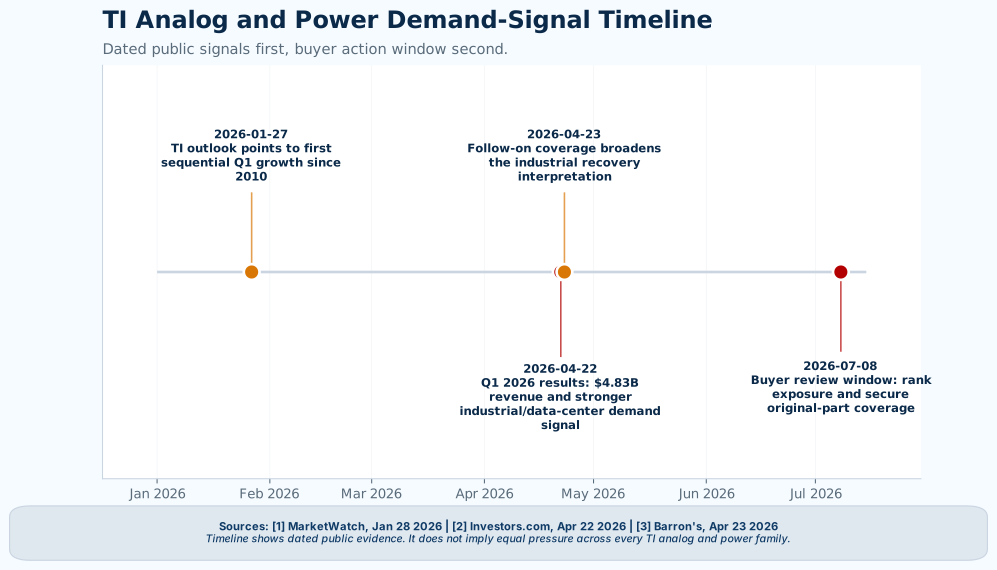
- On January 27, 2026, market coverage of TI's outlook said the company was forecasting sequential first-quarter revenue growth for the first time since 2010.
- On April 22, 2026, TI reported Q1 2026 revenue of $4.83 billion and EPS above consensus expectations, while guiding Q2 revenue to roughly $5.0 billion to $5.4 billion, with a midpoint of $5.2 billion.
- Public reporting tied that strength to industrial and data-center demand rather than to one isolated product niche.
- TI product pages still show the representative orderable MPN anchors in this article as ACTIVE:
LM358DR: LM358-family dual, 30-V, 700-kHz operational amplifier in SOIC-8 tape-and-reelINA219BIDR: INA219B-family 26-V, 12-bit I2C digital power monitor in SOIC-8 tape-and-reelTPS7A4700RGWR: TPS7A4700 1-A, 36-V low-noise LDO in VQFN-20 large tape-and-reelLM5117PMH/NOPB: LM5117 5.5-V to 65-V synchronous buck controller in HTSSOP-20 tubeUCC28C42DR: UCC28C42 industrial current-mode PWM controller in SOIC-8 tape-and-reel
The shorter names LM358, INA219, TPS7A47, LM5117, and UCC28C42 are family names. They are useful for product-page research, but they are not precise enough for a BOM line, RFQ, PO, or catalog product title.
Those facts do not prove a universal shortage across the whole TI analog and power catalog. They do support a more practical conclusion: buyers should expect selective tightness, especially where mature analog and power parts are both commercially familiar and hard to replace cleanly.
What Buyers Should Infer, and What They Should Not
The safest interpretation is this:
- Fact: TI's business signal improved materially in early 2026.
- Inference: improving analog and industrial demand usually increases pressure on mature, high-volume line items before it reaches every family equally.
- TrustCompo judgment: buyers should treat 2026 as a coverage-and-discipline year for TI analog and power ICs, not as a blind panic-buy year.
That distinction matters. If you overreact, you create excess inventory and second-source mistakes. If you underreact, you discover too late that your most stable-looking op amp, power monitor, or controller has become the hardest thing to quote with confidence inside a compressed schedule.
Three claims should be avoided unless you have newer primary evidence:
- "All TI analog parts are on allocation."
- "Every TI power device is seeing a formal price increase."
- "One market report proves a BOM-wide shortage event."
None of those claims is supported by the current evidence set in this draft.
Which TI Analog and Power Buckets Deserve Review First
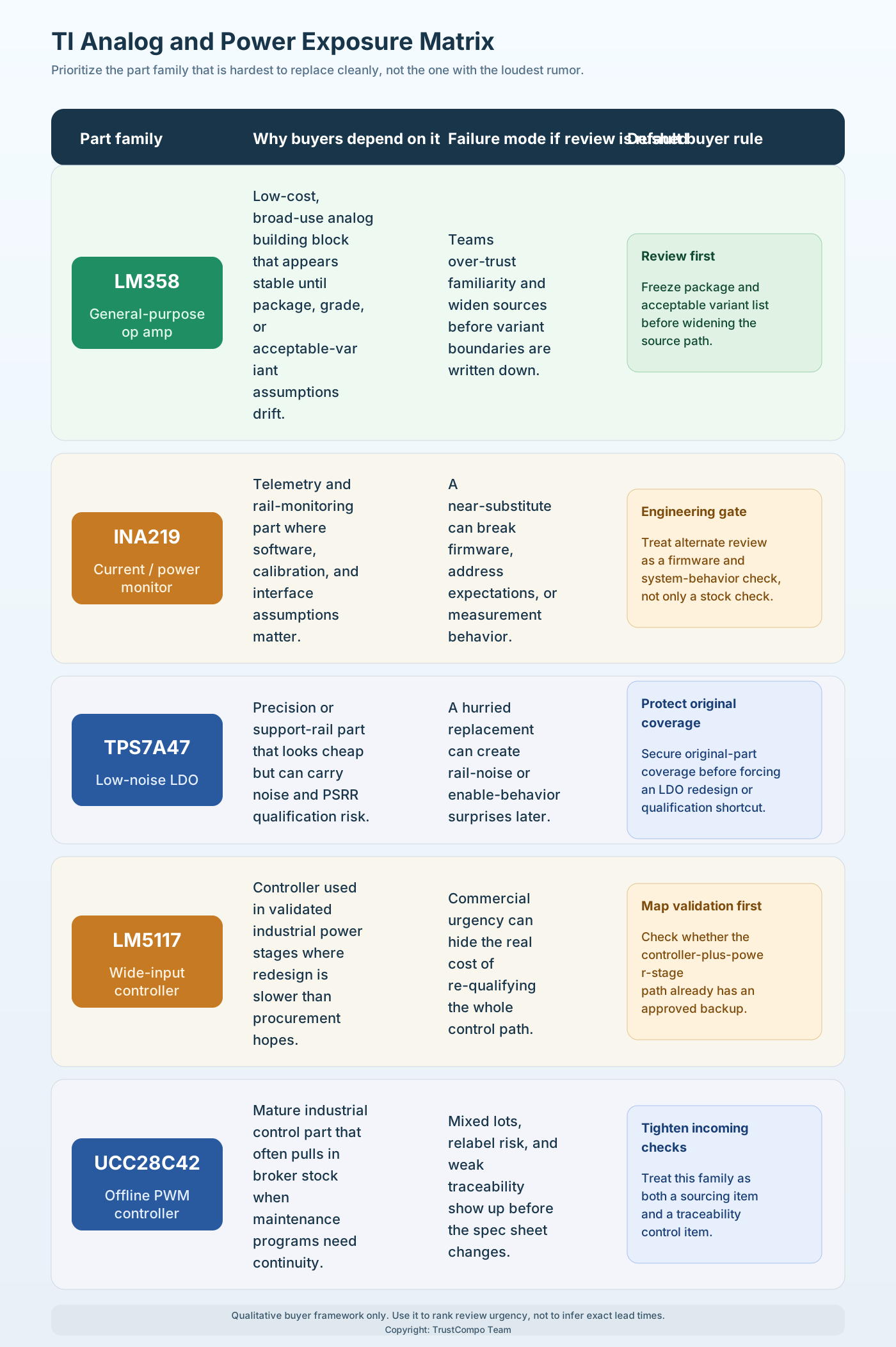
Buyers should start with parts that combine four traits: high volume, broad reuse, design lock-in, and easy confusion in the open market. The table below shows a practical first-pass framework.
| Representative family | Why it deserves review first | Typical sourcing risk | Article anchor |
|---|---|---|---|
| General-purpose op amps | Mature analog parts often look interchangeable until offset, temperature, or package details matter. | Quote compression, mixed lots, "same family" substitution shortcuts | LM358DR |
| Current and power monitors | These parts sit close to battery, rail, and telemetry decisions, so substitutes can break firmware or calibration assumptions. | Narrow approved-vendor list, counterfeit-risk uplift on familiar parts | INA219BIDR |
| Low-noise LDO regulators | LDOs often look like low-cost line items, but qualification boundaries around noise, PSRR, and enable behavior can be tight. | Price creep across volume builds, limited approved alternates | TPS7A4700RGWR |
| Wide-input power controllers | Controller families get sticky once the power stage is validated. | Engineering reluctance to re-qualify, longer quote cycles | LM5117PMH/NOPB |
| Offline PWM controllers | Mature PWM devices are common in industrial and power-supply maintenance programs. | Open-market relabel risk, lifecycle confusion, broker noise | UCC28C42DR |
This is why the first procurement question should not be "What is TI's average lead time?" The real question is "Which of our TI-dependent line items would hurt us most if quote validity shrinks, substitutes are not really approved, or open-market quality gets noisy?"
Why These Five TI Parts Matter in a Real Buyer Workflow
The representative anchors in this article are not random examples. Each one stands for a common buyer failure mode.
LM358DR: mature, familiar, and easy to underestimate
TI lists LM358DR as an ACTIVE dual op amp, with a product-page headline of 30-V operation and 700-kHz bandwidth. That is exactly the kind of mature analog part buyers sometimes treat as "always available somewhere." The risk is not only stock. The risk is commercial complacency. Once a part is seen as universal, teams get less disciplined about package verification, version boundaries, and alternate approval.
If your BOM depends on LM358DR, treat that detail page as a checkpoint for:
- package-specific approval
- industrial-temperature coverage vs catalog-grade assumptions
- whether
LM358Bor another newer variant is acceptable without engineering re-check
INA219BIDR: common part, less-common tolerance for substitution mistakes
TI's product page marks INA219BIDR as ACTIVE and describes it as a 26-V, 12-bit I2C output digital power monitor. The buyer trap here is software and system expectation. An offer that sounds "close enough" may still break address assumptions, calibration flow, or telemetry behavior.
If your team is sourcing INA219BIDR, do not let the discussion stop at availability. Confirm:
- firmware expectations
- shunt-value assumptions
- package and pinout equivalence
- whether the proposed alternate is pin-compatible or only functionally similar
TPS7A4700RGWR: small line item, outsized validation risk
TI lists TPS7A4700RGWR as ACTIVE and positions it as a 1-A, 36-V low-noise high-PSRR LDO. LDO parts like this are easy to misclassify as routine replenishment. In practice, noise floor, dropout behavior, and enable behavior can make them qualification-sensitive in instrumentation, RF-support, and precision-rail designs.
That makes TPS7A4700RGWR a priority not because it is the biggest spend item, but because a rushed substitute can create a hidden rework bill later.
LM5117PMH/NOPB: validated power paths tend to stay sticky
TI describes LM5117PMH/NOPB as an ACTIVE wide-input synchronous buck controller covering 5.5 V to 65 V. Parts like this often survive in long-life industrial power designs long after the original project is considered stable. Buyers know that the controller can be bought. The harder question is whether the full validated power path can be changed cheaply if quotes deteriorate.
For controller families, the buyer-risk discussion is not mainly about transistor-style parameters such as MOSFET Rds(on). It is about whether the validated input-voltage window, control topology, compensation approach, and attached power stage can stay intact if sourcing pressure pushes the team toward a new path.
For LM5117PMH/NOPB, the first sourcing action should be to map:
- current approved source path
- available safety stock window
- whether any proposed alternate is already validated at the controller-plus-power-stage level
UCC28C42DR: where mature power control meets open-market risk
TI's UCC28C42DR page marks the part ACTIVE and describes it as an industrial current-mode PWM controller with 100% duty cycle support. This is the kind of long-running controller family that can trigger an ugly combination of issues when the market tightens: authentic but mixed-condition lots, relabel risk, and "drop-in" claims that skip real review.
Here again, the buyer-risk issue is not a missing MOSFET datasheet number. It is whether the control-mode behavior, duty-cycle assumptions, startup behavior, and downstream validation documents still match the exact controller family being quoted.
If UCC28C42DR matters to your maintenance, industrial, or auxiliary power programs, treat it as both a sourcing line and a traceability line.
What the 2026 Risk Looks Like in Practice
For most buyers, the near-term risk is not a dramatic "cannot buy TI" event. It is a layered deterioration in buying conditions:
- shorter quote-validity windows
- more selective distributor allocation of attention
- heavier dependence on broker or independent-stock offers for familiar mature parts
- more internal pressure to accept near-substitutes without finishing validation
- more confusion between original-part coverage and redesign-driven alternative sourcing
This is where analog and power IC articles often get too vague. So here is the practical TrustCompo view:
| Risk pattern | What it looks like in the field | Why it matters |
|---|---|---|
| Quote compression | A supplier offers a good price but only for a very short approval window. | Slow internal approval becomes a sourcing failure, not just a process annoyance. |
| Mixed-lot exposure | The offered stock is real but assembled from multiple date codes, packaging states, or traceability paths. | Incoming inspection and customer audit risk increase immediately. |
| Alternate drift | Commercial teams call something "equivalent" before engineering checks system-level boundaries. | You save days on the PO and lose weeks in validation or field risk. |
| Visibility gap | Buyers know TI is stronger this quarter but cannot say which of their own BOM lines are most exposed. | Teams end up reacting to noise instead of ranked exposure. |
A Buyer Action Framework for the Next 7 to 14 Days
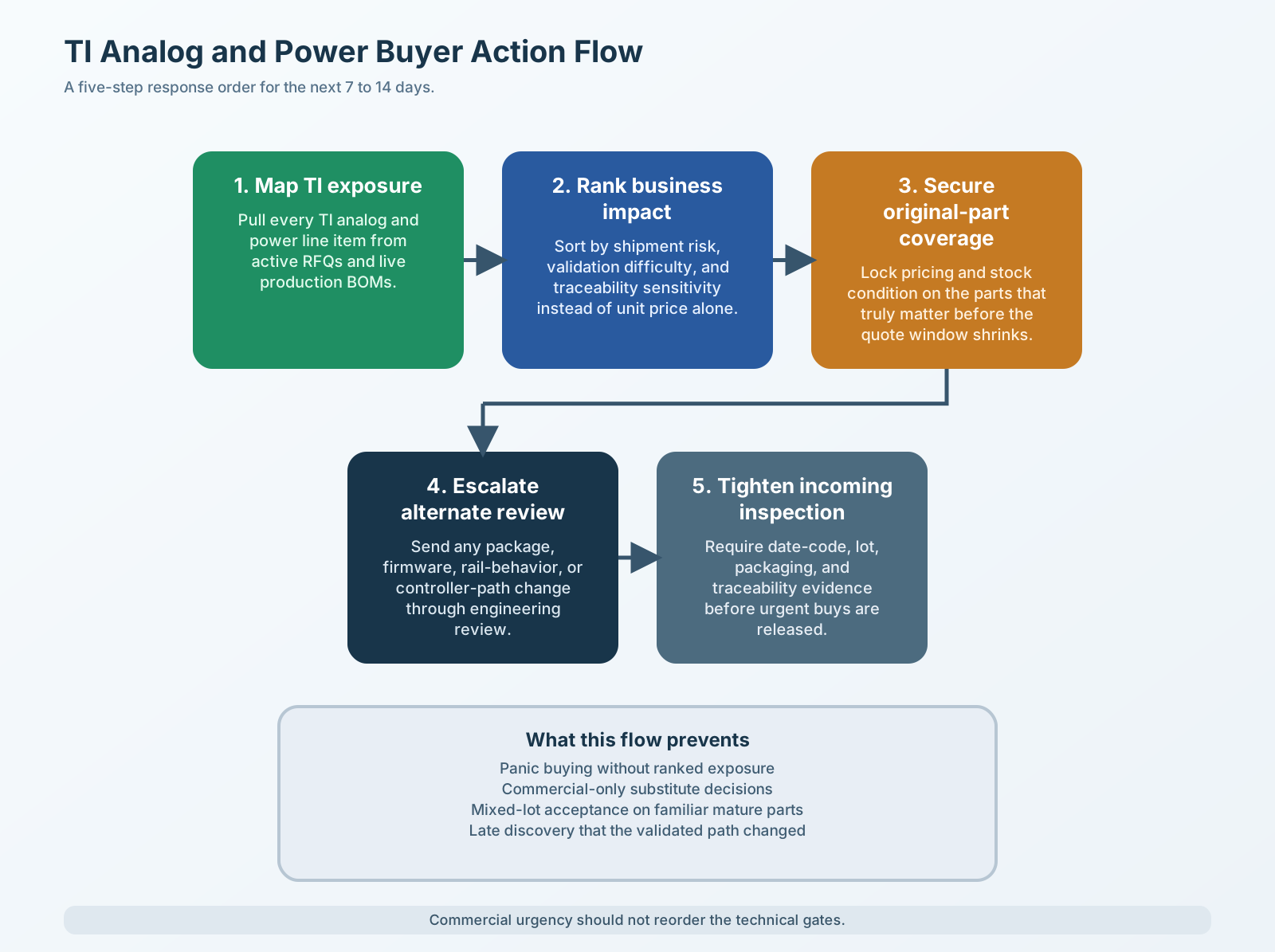
If your team has meaningful TI analog or power exposure, this is the right short-cycle workflow:
- Build a TI-only exposure list from active RFQs and live production BOMs.
- Rank line items by business impact, not by unit price.
- Separate "must buy original" from "candidate for approved alternate review."
- Ask suppliers to document price validity, stock condition, date code, and traceability before PO approval.
- Escalate any near-substitute offer that changes package, firmware behavior, monitoring interface, noise profile, or controller topology.
The ranking step is where many teams lose time. A useful sequence is:
- first rank by shipment risk
- then by validation difficulty
- then by counterfeit or relabel exposure
- only then by pure price sensitivity
For this article's anchor families, the first-pass posture should look like this:
| Part | First buyer question | Default posture |
|---|---|---|
LM358DR | Is this a replenishment part or a hidden variant-control problem? | Verify package and acceptable variant list before widening sources. |
INA219BIDR | Can we substitute without changing firmware or calibration assumptions? | Treat substitutes as engineering items first, commercial items second. |
TPS7A4700RGWR | Is this rail qualification-sensitive in our design? | Protect original-part coverage before forcing an LDO redesign decision. |
LM5117PMH/NOPB | Do we have a validated alternate controller path? | Assume controller changes are slower than the sales team hopes. |
UCC28C42DR | Is this a traceability-sensitive mature power-control buy? | Tighten incoming checks and reject vague "drop-in" language. |
What Buyers Should Not Do
Three bad responses show up repeatedly in this kind of market:
- buying broad TI inventory without ranking real exposure
- treating every alternative as an availability problem instead of a validation problem
- relaxing incoming inspection because the part family is familiar
That last mistake is especially expensive. Mature analog and power devices are exactly where familiarity can hide weak paperwork, mixed reels, inconsistent labels, or unrealistic "same function" claims.
If your team is already seeing slower approvals, noisier offers, or growing pressure on a few repeated TI line items, the next step is not guesswork. It is a documented exposure review anchored to the real parts that drive your shipment schedule.
Conclusion
As of July 8, 2026, the evidence supports a careful buyer message: TI's analog and power business signal is stronger than it was at the start of the year, and that is enough reason to tighten coverage on mature, high-volume line items. It is not enough reason to claim a blanket TI shortage across every analog and power part number.
For sourcing teams, that means acting with precision:
- protect the original parts that truly matter
- review second-source boundaries before commercial urgency rewrites engineering logic
- tighten traceability controls where familiar mature parts attract noisy market offers
If you need to move quickly on TI analog or power exposure, start with RFQ coverage and part-level review for LM358DR, INA219BIDR, TPS7A4700RGWR, LM5117PMH/NOPB, and UCC28C42DR, then expand from there only after your ranked exposure list is clear.
Review Scope
This article was reviewed on July 8, 2026. It uses:
- TI product pages for
LM358DR,INA219BIDR,TPS7A4700RGWR,LM5117PMH/NOPB, andUCC28C42DR - public market coverage of TI's January 27, 2026 outlook and April 22, 2026 first-quarter results
The business-update figures are treated as market context rather than SKU-level Texas Instruments guidance. That is why the article keeps the financial framing conservative and avoids unsupported part-number claims.
Where this article discusses likely buyer risk patterns such as quote compression, mixed lots, and alternate-review discipline, those sections are presented as TrustCompo procurement judgment, not as direct statements from Texas Instruments.