- Murata
- MLCC
- AI servers
- passive components
Murata MLCC and AI Server Demand: Buyer Checks for High-Capacitance Ceramic Capacitors
A 2026 buyer and engineering guide to Murata MLCC exposure in AI-server and high-reliability designs, covering high-capacitance ceramic capacitor demand, source boundaries, DC-bias checks, dielectric limits, and substitution risk.
Quick facts
- Murata's April 30, 2026 forecast points to increased capacitors and power supply modules for servers and planned capacity investment for products with expected server-driven demand growth.
- Murata's FY2026 segment data says capacitor revenue increased for servers, while its forecast projects capacitor segment sales growth for FY2027.
- Price-increase discussion should be treated as a secondary market signal unless a buyer has a primary Murata notice, distributor circular, or SKU-level quote change.
- AI servers consume MLCCs unevenly: high-capacitance, high-reliability, compact-case, and power-delivery-adjacent part families deserve review first.
The useful 2026 question for Murata MLCC buyers is not whether every ceramic capacitor is suddenly short. It is whether AI server demand is pulling hardest on specific high-capacitance, compact-case, high-reliability MLCC families used around GPU, CPU, VRM, accelerator, and auxiliary power rails. That narrower framing matters because a price headline can be noisy, while a specification-level MLCC review can prevent a real build interruption.
As of August 5, 2026, this article treats Murata server demand as a confirmed directional signal, but treats any broad Murata MLCC price increase claim as a secondary market signal unless a buyer has a primary Murata notice, distributor circular, or SKU-level quote change. The practical buyer task is to verify capacitance, voltage, case size, dielectric, DC-bias behavior, temperature range, reliability grade, approved alternates, and traceability before escalating a purchase order.
Evidence Boundary and Source Basis
This article was last reviewed on August 5, 2026 and reflects public sources reviewed through that date. It uses Murata official material as the source basis for server-related capacitor demand, then separates market reporting and TrustCompo procurement judgment from confirmed manufacturer statements.
| Dated source basis | What it supports | Buyer use |
|---|---|---|
| Official Murata earnings forecast, April 30, 2026 | Murata forecast FY2027 revenue growth and said it expected increased capacitors and power supply modules for servers, with capital spending directed partly toward products whose demand is expected to grow from servers. | Treat server-related capacitor demand as a confirmed Murata demand driver, not as proof that every MLCC line is constrained. |
| Official Murata operating segment sales | Murata's FY2026 segment discussion says capacitor revenue increased for servers, and the capacitor segment accounted for a larger share of revenue than in FY2025. | Prioritize exact capacitor families used in server power delivery before making broad category assumptions. |
| Official Murata MLCC technology overview | Murata describes MLCC coverage across capacitance, voltage, case size, X5R / X7R / X6S dielectrics, high-reliability options, low-ESR / low-inductance types, and server / FPGA peripheral applications. | Use capacitance, voltage, case size, dielectric, ESR / ESL, and reliability grade as approval boundaries, not only nominal value. |
| Bloomberg report, February 17, 2026 | Bloomberg reported that Murata was exploring price changes for high-performance MLCCs used in AI servers. | Treat price discussion as secondary market reporting unless your supplier provides a primary notice or revised quote. |
| TrendForce market note, July 6, 2026 | TrendForce flagged elevated 2H26 shortage risk for high-end MLCCs tied to AI server and custom ASIC demand. | Use as a market-risk signal for RFQ timing, not as a substitute for MPN-level availability and qualification review. |
| TrustCompo engineering and sourcing interpretation | As of the August 5, 2026 review, the highest-risk MLCC lines are defined by exact capacitance, voltage, case size, dielectric, DC-bias behavior, reliability grade, application location, and AVL status. | Escalate by specification and application role, not by the generic label "Murata MLCC." |
What This Article Does Not Claim
To keep the source boundary clear, this article does not claim that:
- Murata has issued a public, universal MLCC shortage notice.
- Every MLCC package, capacitance value, or voltage rating is constrained.
- A Bloomberg or TrendForce market signal is the same thing as a primary Murata circular.
- A same-value MLCC from another supplier is automatically a drop-in replacement.
- Domestic or second-tier MLCC alternatives can replace qualification-locked server positions without validation.
The defensible conclusion is narrower: AI-server growth is a credible demand driver for selected high-value MLCC windows, and buyers should review exact Murata and alternate-source positions before treating the topic as a blanket shortage.
What MLCCs Do in a Server, and Why They Are Not Just Commodity Capacitors
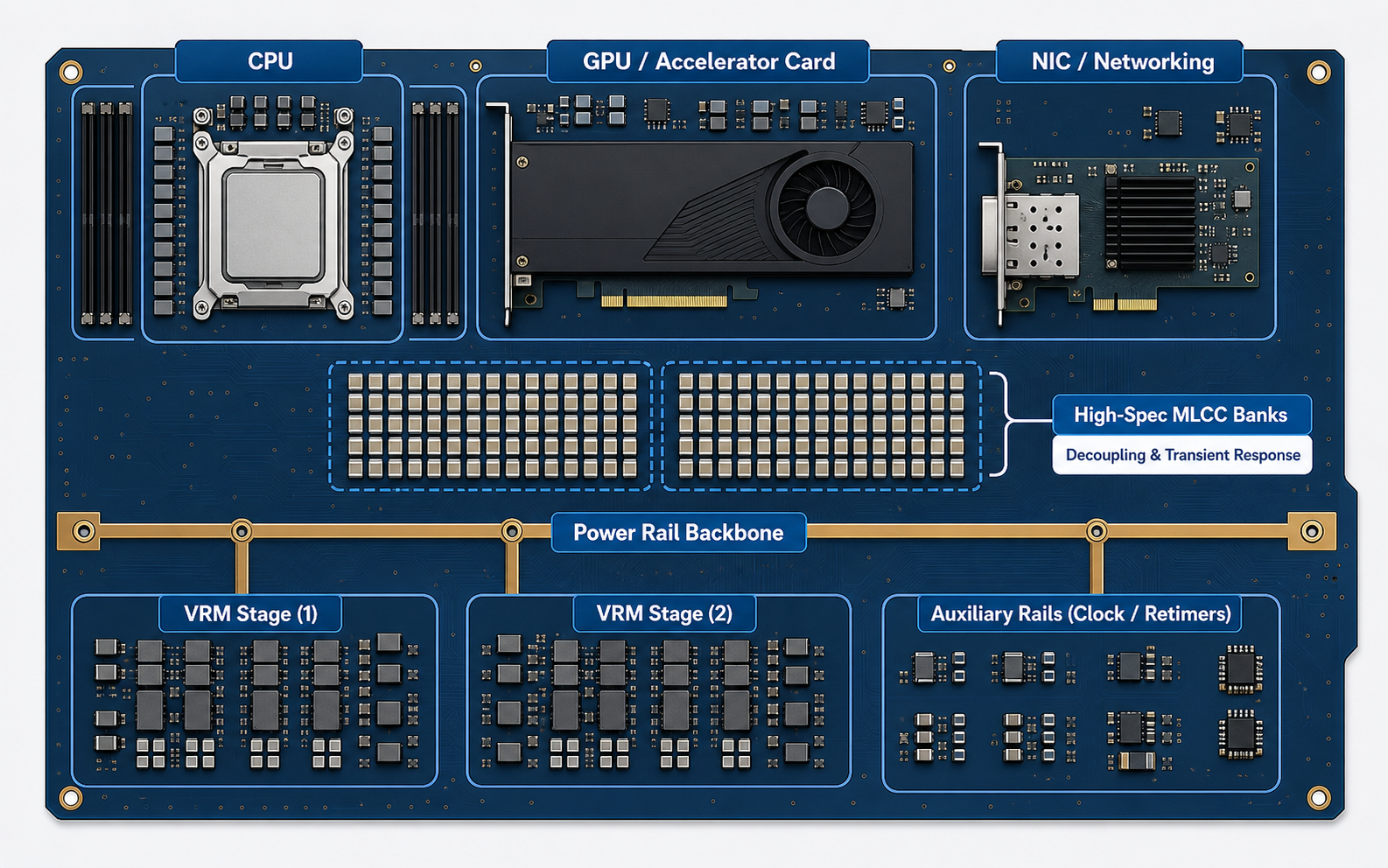
An MLCC is easy to underestimate because it is small, cheap on a unit basis, and everywhere. But in servers, that is exactly why it matters. These capacitors sit around CPU rails, GPU rails, VRM stages, networking sections, retimers, clocking circuits, and auxiliary power paths to suppress noise, stabilize voltage, and improve transient response.
The problem is that "MLCC" is not a single product category in any practical sourcing sense. A server designer does not ask for "some capacitors." They ask for a specific electrical and mechanical envelope:
- a given capacitance at operating bias
- a package size that fits dense layouts
- a voltage rating with margin
- a dielectric and temperature behavior that match the design target
- a reliability profile acceptable for long-life or mission-critical hardware
That is why a surge in AI-server builds does not translate into even demand across the whole passive-component market. It tightens the parts that fit dense, high-current, high-reliability designs first.
For a buyer, the minimum engineering vocabulary is:
| MLCC parameter | Why it matters in AI-server or high-reliability designs | Procurement check |
|---|---|---|
| Capacitance | Nominal capacitance does not equal delivered capacitance on the board. | Confirm effective capacitance at working voltage, temperature, and aging condition. |
| Voltage rating | Low-voltage rails can still need margin; 48V and PSU / IBC positions need larger derating discipline. | Check rated voltage, derating rule, and surge or ripple exposure. |
| Case size and thickness | Dense GPU / ASIC layouts may lock package, height, and land pattern. | Do not approve alternates by capacitance alone if package or thickness changes. |
| Dielectric | X5R, X6S, X7R, C0G / NP0, and other dielectrics behave differently over temperature and bias. | Match dielectric behavior to the application, not only capacitance code. |
| DC-bias behavior | High-K MLCCs can lose substantial effective capacitance under DC bias. | Require bias curves or engineering review before accepting a same-value substitute. |
| ESR / ESL | Power-delivery and high-frequency filtering positions can be sensitive to impedance profile. | Review ESR / ESL, low-inductance structure, and placement near the load. |
| Reliability grade | Automotive, industrial, telecom, and server programs may have different approval gates. | Confirm AEC-Q200 or customer qualification where required. |
| Traceability | Tight markets can increase mixed-lot and weak-documentation offers. | Require date code, packaging condition, CoC where available, and supplier chain clarity. |
Why Murata Becomes the Reference Point So Quickly
When the market talks about a Murata capacitor move, it is often using Murata as a signal for the upper end of the MLCC stack. That does not mean Murata is the only important supplier. It means Murata is often treated as a benchmark when buyers think about higher-consistency, higher-reliability, and harder-to-replace MLCC families.
Three reasons explain the attention:
| Why Murata Is Watched Closely | What It Means for Buyers |
|---|---|
| Murata has strong influence in higher-spec MLCC segments. | Server-demand, pricing, or capacity signals from Murata are often interpreted as an early read on tight product classes. |
| Server and infrastructure buyers care about validated performance, not just nominal capacitance. | A second source may exist on paper but still fail internal approval for bias behavior, footprint limits, or long-cycle reliability. |
| Murata moves are easy for the channel to amplify. | Even limited firmness in a selected family can create broader market noise and more aggressive quoting behavior. |
This is also why the phrase "Murata MLCC price increase" travels faster than the more precise reality behind it. The market likes simple claims. Procurement teams need the harder, narrower question: which MLCC families, in which sizes and specifications, for which applications?
Why AI Servers Pull Harder on High-End MLCC Demand
The AI-server demand signal is not just about more boards shipped. It is about the kind of boards being shipped.
A modern AI server typically combines:
- power-hungry GPUs or accelerators
- complex VRM networks
- fast memory and interconnect fabrics
- dense routing with strict power-integrity requirements
- tighter thermal and mechanical constraints than many standard enterprise platforms
Each of those pushes designers toward MLCC positions where electrical stability and size efficiency matter at the same time.
Two concrete examples make this less abstract:
- Around a GPU power-delivery network, designers often place large banks of MLCCs close to the load to support transient response and suppress switching noise. Even when no single capacitor is remarkable, the aggregate requirement for validated high-performance MLCCs rises quickly.
- On server motherboards and accelerator cards, auxiliary rails for controllers, retimers, NICs, and clocking sections can consume many smaller MLCC placements. These may not be the most expensive BOM lines, but they still compete for capacity in specific case sizes and performance windows.
This is why the phrase "AI servers are driving MLCC demand" needs refinement. AI servers are not lifting every MLCC SKU the same way. They are pulling harder on the parts that combine compact size, useful capacitance under bias, high reliability, and proven use in advanced power-delivery designs.
That pressure is not limited to standard-purpose 0201 or 0402 capacitor demand. Buyers may also compete for lower-ESL structures, multi-terminal parts, automotive or high-reliability families, and high-capacitance X5R / X6S / X7R options placed close to hot GPU and VRM zones. In practical terms, AI servers are not just consuming "more capacitors." They are pulling on MLCCs built for lower parasitics, compact layout, transient response, and validated reliability.
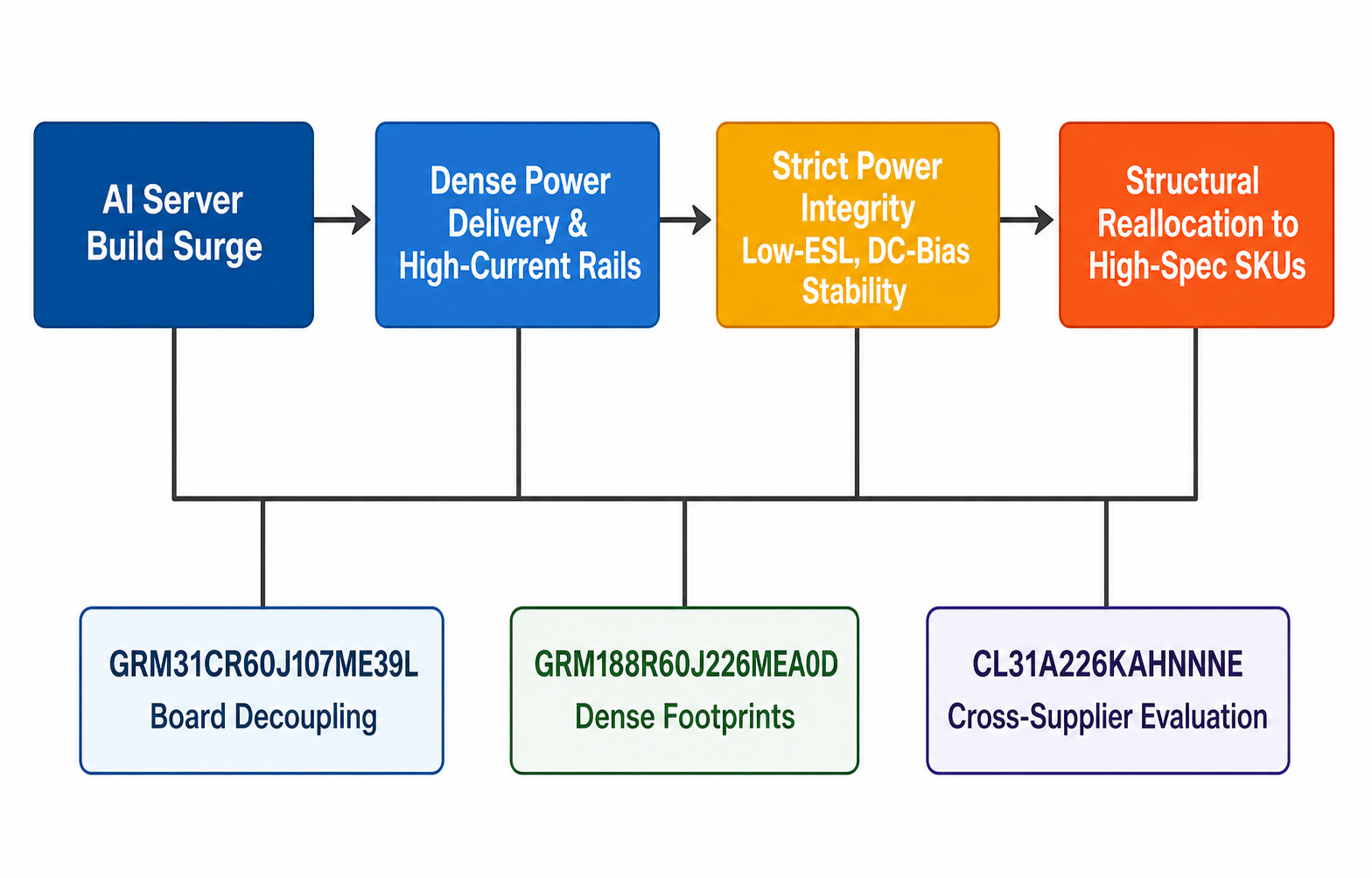
To keep the discussion concrete, this article tracks a small set of representative MLCC anchors. These are article context parts, not drop-in recommendations.
| Representative MPN | Supplier | Nominal context | Why it matters | Approval caveat |
|---|---|---|---|---|
| GRM31CR60J107ME39L | Murata | 100uF, 6.3V, X5R, 1206-class MLCC | Large high-capacitance example for board-level decoupling and power-rail stability discussions. | Effective capacitance under DC bias and temperature must be checked before using it as a substitute reference. |
| GRM188R60J226MEA0D | Murata | 22uF, 6.3V, X5R, 0603-class MLCC | Compact high-capacitance example for dense rails where capacitance and footprint compete for space. | Case size, thickness, bias behavior, and placement near hot components decide fit. |
| GCM1885C1H102JA16D | Murata | 1000pF, 50V, C0G / NP0, 0603-class automotive MLCC | Qualification-bound example for reliability-sensitive comparisons. | Do not compare it to high-capacitance X5R / X6S positions; it illustrates reliability and dielectric stability boundaries. |
| CL31A226KAHNNNE | Samsung Electro-Mechanics | 22uF, higher-voltage 1206-class MLCC | Cross-supplier anchor for substitution-boundary discussion. | A commercial match still needs dielectric, voltage, thickness, bias, and customer approval checks. |
The Core Logic of This Round: Structural Reallocation, Not Blanket Shortage
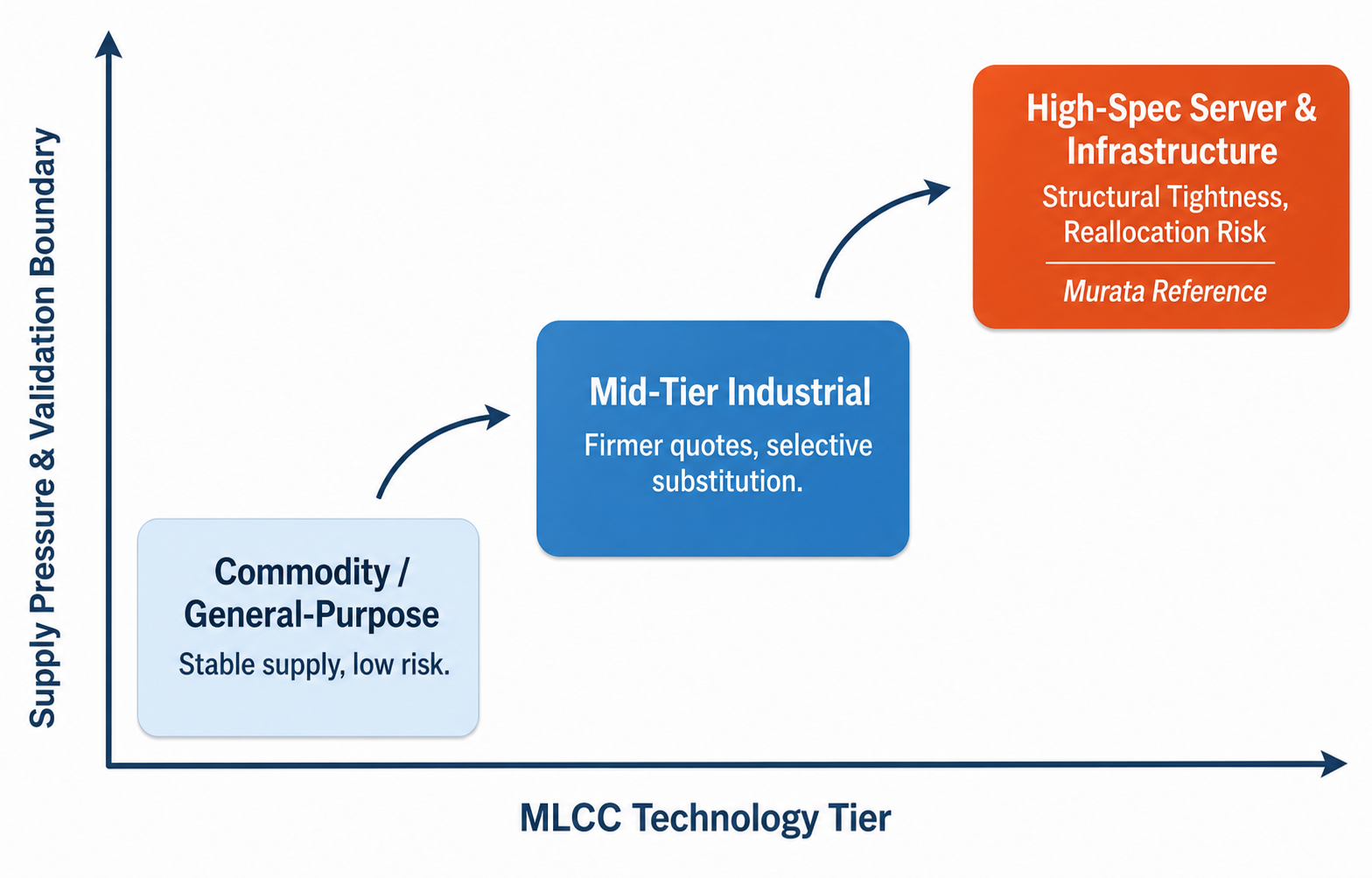
The cleanest way to explain this market is supply reallocation.
If AI infrastructure programs are growing faster than many traditional electronics categories, MLCC manufacturers and distributors naturally prioritize where capacity creates the most predictable return. That does not require a factory shutdown or a full-industry shortage. It only requires a shift in which SKUs, case sizes, dielectrics, and customers receive the cleanest capacity and quote coverage.
Here is the practical framework:
| Market Layer | What Is Happening | Buyer Risk |
|---|---|---|
| Commodity or broad general-purpose MLCCs | Conditions may stay relatively stable. | Buyers may overreact and assume all categories will tighten. |
| Mid-tier industrial MLCCs | Some programs may see firmer quoting if overlap with infrastructure demand increases. | Quote validity can shorten and substitute reviews become more frequent. |
| High-spec server, telecom, and reliability-sensitive MLCCs | These families are most exposed to structural prioritization. | Lead times, price firmness, and approved-source pressure can worsen first here. |
That is why this article argues against the loose claim that "MLCCs are all going up." The better interpretation is narrower: selected higher-end MLCC families may tighten first because AI-server demand changes the priority map of available capacity.
In practice, sourcing teams should review exact candidate MPNs rather than broad family labels. For this article, that means verifying whether GRM31CR60J107ME39L, GRM188R60J226MEA0D, or similar validated Murata lines appear in GPU, VRM, or auxiliary-rail positions, then checking whether a comparison part such as CL31A226KAHNNNE is truly approved or only commercially similar.
Which Applications Deserve Review First
If that structural reading is correct, the first impact is not always seen in retail-like spot shortages. It often appears in buyer behavior, quote quality, and substitution friction.
The most exposed applications are likely to include:
- AI servers and accelerator hardware, where dense power delivery can concentrate MLCC demand
- telecom and networking equipment, where reliability and layout constraints limit substitution freedom
- industrial power systems, especially when validated BOMs depend on specific MLCC behavior
- smaller OEMs or brokers sourcing niche high-spec lines, who may feel availability pressure before large strategic accounts do
The cost effect can still look modest on a single line item. The risk becomes larger when one validated capacitor family blocks a board build, forces a redesign review, or opens the door to mixed-lot supply with weaker traceability.
That is also the point where a price topic becomes a quality topic. In tight passive markets, buyers are more likely to see:
- mixed date-code offers presented as one batch
- substitute suggestions based on nominal value rather than validated performance
- partial packaging or relabeled reels
- spot inventory with unclear storage or handling history
Do Domestic Chinese MLCC Suppliers Have a Real Window
There is a real opportunity here, but it should be described carefully.
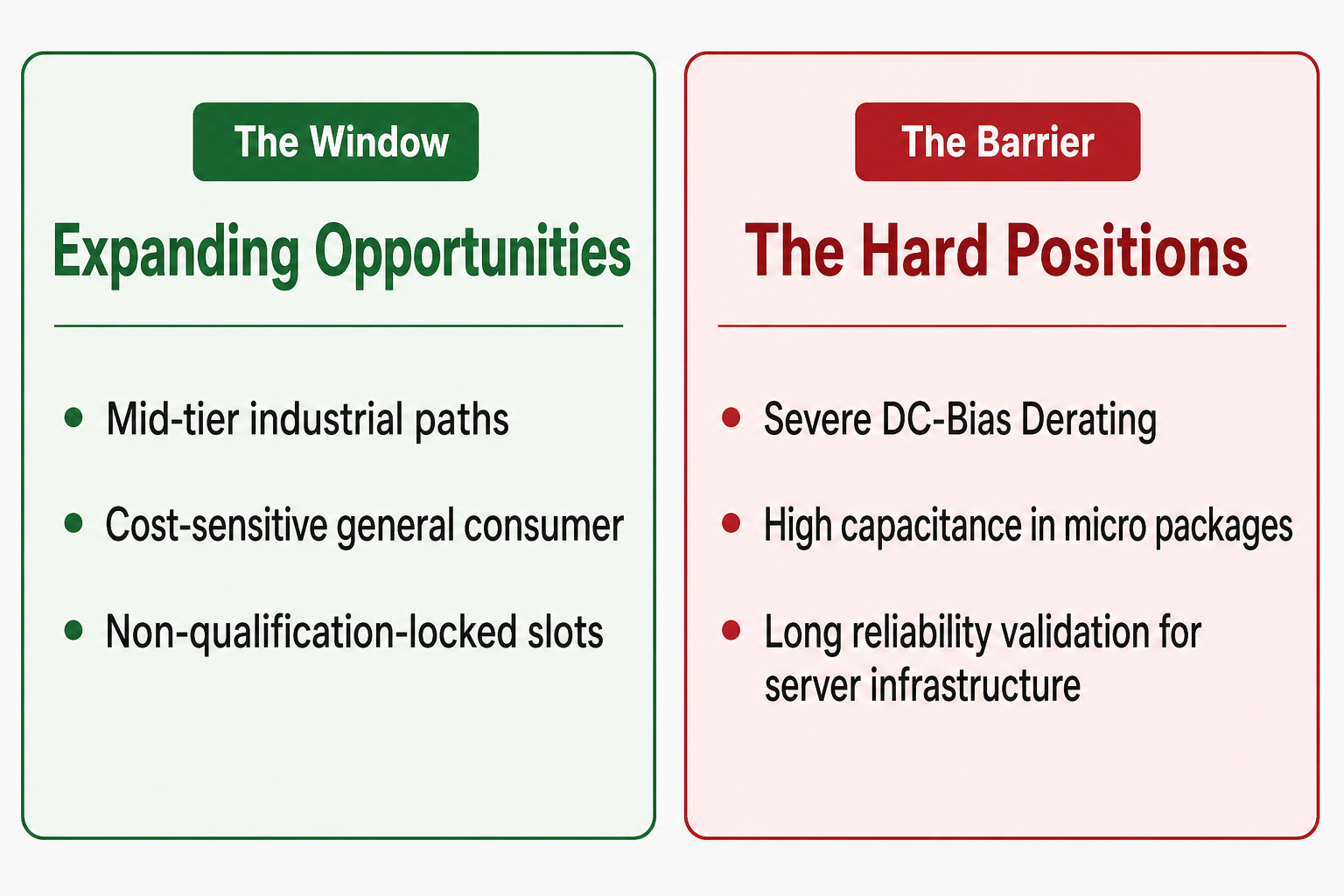
The strongest near-term opening for domestic or second-tier vendors is not "replacing Murata everywhere." It is expanding acceptance in mid-tier industrial, cost-sensitive, or less qualification-locked positions where buyers want supply-chain diversity and where engineering teams have room to validate alternatives.
The harder positions remain hard:
- high-capacitance parts in very small packages
- applications sensitive to DC-bias derating behavior
- long-life infrastructure or server programs with strict validation history
- customer environments where even a small reliability change can trigger requalification
So the balanced conclusion is this: the substitution window is widening, but the top end is still selective.
One of the clearest engineering pain points is DC bias derating. A domestic or second-tier alternative may match a nominal 100uF value on the datasheet, but under real operating bias and elevated temperature, its effective capacitance can fall differently from the incumbent part. That gap is exactly why substitution reviews cannot stop at nameplate capacitance. Material system behavior, dielectric stability, and effective capacitance under load are often where the real qualification risk appears.
A practical way to frame that boundary is:
- If your design already qualifies a Murata line such as GCM1885C1H102JA16D, a second source cannot be treated as interchangeable until bias behavior, reliability expectation, and customer approval are checked together.
- If your team is reviewing cost or availability around GRM188R60J226MEA0D or CL31A226KAHNNNE, the right question is not only nominal capacitance match but whether the alternative still fits the validated electrical window once DC bias, temperature drift, ESR, and manufacturing consistency are considered together.
A Practical Buyer Checklist Before Calling This a Shortage
If your team is exposed to Murata MLCCs or similar high-spec passive parts, use a specification-first review instead of reacting to broad market claims.
| Checkpoint | What to Verify | Why It Matters |
|---|---|---|
| BOM exposure | Which exact Murata families, case sizes, voltage ratings, capacitance values, and dielectrics sit in AI, telecom, or power-delivery designs? | "MLCC" is too broad to manage risk effectively. |
| Electrical boundary | What is the effective capacitance under DC bias, temperature, aging, ripple, and operating voltage? | A nominal 22uF or 100uF value may not behave the same in the target circuit. |
| Mechanical boundary | Is the case size, height, land pattern, and board position locked? | A commercially available alternate may still require layout review. |
| Approval boundary | Which alternates are truly approved, and which are only commercially similar? | A nominally close part may fail bias, ESR / ESL, or reliability expectations. |
| Quote quality | Are suppliers committing to date code, packaging condition, and traceability? | Tight markets increase the chance of mixed lots and weak documentation. |
| Time horizon | Is the risk short-term price firmness or a longer qualification delay? | The right response differs for bridge stock, redesign, and strategic sourcing. |
| Segment reality | Are you exposed to server-grade or general-purpose MLCCs? | Overreacting to the wrong segment can create unnecessary inventory decisions. |
The review should happen against concrete candidate parts such as GRM31CR60J107ME39L, GRM188R60J226MEA0D, and GCM1885C1H102JA16D, not against a generic "Murata MLCC" label.
For teams that need direct support, the most useful next actions are usually:
- request shortage sourcing support
- start an alternative-parts review
- send a quick RFQ for exposed MLCC lines
Bottom Line
The most important takeaway is not that one more component category may be getting expensive. It is that AI infrastructure is pulling on the supporting power-delivery stack, including selected high-capacitance and high-reliability MLCC families. That makes this a specification review first and a price discussion second.
If Murata MLCC pricing is getting firmer in a specific line, the smarter interpretation is not blanket panic. It is a warning that the market may be repricing validated high-spec passive capacity before the broader capacitor universe feels the same pressure.
For procurement teams, the approval rule is simple: do not treat a Murata MLCC line as safe or replaceable until the exact capacitance, voltage, case size, dielectric, DC-bias behavior, temperature behavior, ESR / ESL profile, reliability grade, AVL status, and supplier traceability have been checked against the real board position.
When an exposed MLCC line sits near GPU, VRM, accelerator, telecom, or high-reliability power rails, move it from normal RFQ handling into continuity review. Confirm current quote validity, bridge-stock need, approved alternates, and redesign fallback before the line becomes urgent.
For teams that need help turning this review into action, the next step is to submit the exposed MPN list through quick quote, request shortage sourcing support, or start an alternative-parts review before approving substitute lots.