- supplier intelligence
- PCN
- PDN
- EOL
How to Build a First-Hand Supplier Intelligence Workflow for Electronic Component Sourcing
Learn how to build a first-hand supplier intelligence workflow for electronic component sourcing using manufacturer PCN, PDN, EOL notices, watchlists, structured extraction, and human review.
Quick facts
- Supplier intelligence should be maintained as a workflow, not collected only when a quote becomes urgent.
- The first version should focus on non-inventory signals such as PCN, PDN, EOL, NRND, last-time-buy, quality notices, datasheet updates, product announcements, and supplier notes.
- TrustCompo keeps real-time price, inventory, and lead-time aggregation out of the initial MVP unless the data source is authorized or covered by a commercial agreement.
- Software can help summarize, classify, and extract candidate dates or affected part numbers, but customer-facing alerts require human review against the original source.
- A practical supplier-intel system can start with a shared inbox, source catalog, watchlist, structured event table, SQLite or spreadsheet storage, and a weekly Markdown digest.
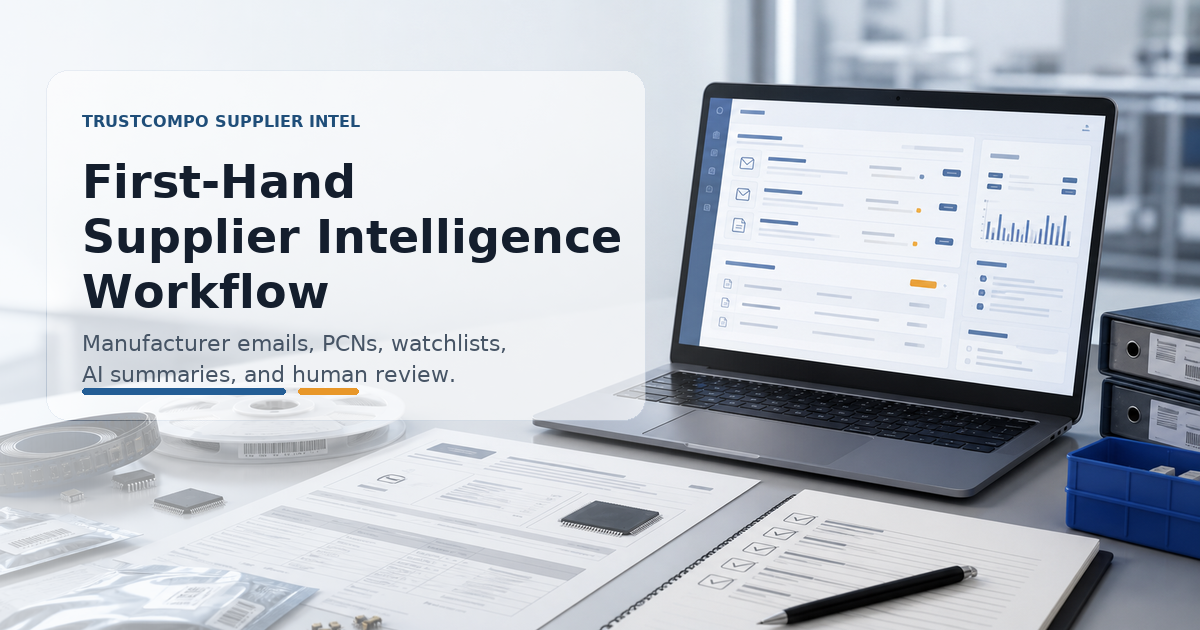
To build a first-hand supplier intelligence workflow for electronic component sourcing, start with official manufacturer PCN / PDN / EOL sources, route them into a shared intake point, normalize each notice into structured event fields, match those events against priority BOM parts, and require human review before any customer-facing sourcing action.
In electronic component sourcing, the first public price shock is rarely the first signal. Before the market starts talking about shortages, allocation, or panic buying, quieter signals often appear in manufacturer PCNs, PDNs, EOL notices, datasheet revisions, quality alerts, authorized-distributor updates, and conversations with supplier sales or FAE teams.
That is why TrustCompo treats first-hand supplier intelligence as a workflow, not a habit of "checking the market." A useful sourcing team needs a maintained system that collects source material, normalizes it, checks it against priority suppliers and part numbers, and separates official facts from early warnings and unverified market talk. For teams still handling supplier notices one PDF at a time, this operating model pairs naturally with a controlled PCN review workflow.
This article explains the operating model behind that workflow. It is not a promise of real-time stock, price, or lead-time visibility. The first version is more conservative and more useful for early risk detection: it focuses on non-inventory supplier intelligence that can be reviewed, stored, and routed into procurement action.
This workflow is based on TrustCompo's internal supplier-notice review process and public manufacturer PCN / lifecycle sources reviewed on July 30, 2026. The examples below are used to show operating discipline, not to imply that every notice has the same commercial urgency.
Key Takeaways
- A supplier-intelligence workflow should capture official PCN, PDN, EOL, lifecycle, datasheet, quality, distributor, and supplier-conversation signals before a quote becomes urgent.
- The minimum useful system is a shared alert inbox, source catalog, part-number watchlist, structured event table, extraction step, and human review gate.
- Automated extraction can prepare candidate fields, but the original source must be checked before BOM alerts, last-time-buy decisions, or customer communication.
- The first MVP should focus on non-inventory risk signals; live price, stock, and lead-time aggregation need separate authorization and validation rules.
Why Supplier Intelligence Cannot Start at the Quote Stage
By the time a buyer sees a harsh quote, the upstream signal may already be old. A PCN may have changed marking, packaging, assembly site, wafer source, test flow, or firmware behavior. A PDN or EOL notice may have started the last-time-buy clock. A distributor alert may show lifecycle pressure before the open market agrees on a price story.
The operational mistake is treating these signals as scattered emails or web pages. A sourcing team can read the same notice in three very different ways:
| Reader | What they may notice first | What they may miss |
|---|---|---|
| Buyer | price, stock, MOQ, lead time | technical change boundary |
| SQE / IQC | package, label, date code, traceability | supplier roadmap pressure |
| Engineer | fit, form, function, datasheet impact | purchasing deadline or LTB window |
| Sales / account owner | customer urgency | evidence level behind the alert |
The workflow has to connect those views before a supplier change becomes a late-stage production problem.
The Source Stack: Not Every Signal Has the Same Weight
TrustCompo separates sources by confidence level because a sourcing decision should not treat an official PCN and a chat-room rumor as equivalent evidence.
| Confidence | Source Type | How It Should Be Used |
|---|---|---|
| High | Manufacturer PCN / PDN / EOL notice, quality notification, official datasheet revision, authorized-distributor system record | Can anchor a formal review, but the original source still needs to be retained |
| Medium | Manufacturer sales, authorized agent sales, FAE, product manager, project-support communication | Useful as an early warning or context, ideally cross-checked against a public or formal source |
| Low | Market rumors, peer chat, broker quote sheets, unsourced shortage claims | Useful as a lead, not as a customer promise |
The point is not to ignore lower-confidence signals. Sometimes they arrive earlier. The point is to label them honestly so they do not accidentally become facts in a customer alert.
This is not just a TrustCompo preference. Public manufacturer quality and lifecycle pages show why a structured source layer matters. TI's PCN policy lists fields such as the change description, reason, tracking number, affected products, fit / form / function / quality / reliability impact, qualification plan, sample availability, and projected shipment timing. NXP, ADI, and Infineon describe formal PCN processes tied to fit, form, function, quality, or reliability impact and JEDEC change-notification practices. onsemi, Microchip, ADI, and Vishay also expose notification, search, or subscription surfaces for product changes, discontinuance, lifecycle, or errata information.
For this article, TrustCompo reviewed public manufacturer source surfaces on July 30, 2026. The table below is not a live event feed; it shows why the workflow starts with official source capture before it adds structured summaries or procurement interpretation.
| Public Source Surface | What It Supports in the Workflow | Buyer Takeaway |
|---|---|---|
| TI product change notification policy | PCN fields such as change reason, affected products, impact, qualification plan, sample availability, and shipment timing | Capture enough fields to review the notice later, not just the PDF title |
| NXP change-management communication | Formal review and ePCN communication for changes affecting fit, form, function, quality, or reliability | Treat PCNs as cross-functional events, not buyer-only messages |
| ADI PCN / PDN and lifecycle pages | PCN / PDN policy, lifecycle status, LTB / LTS fields, replacement-part context, and email notification options | Store lifecycle and replacement context beside the event record |
| Infineon product-change pages | PCN / PD communication, JEDEC-aligned timing, manufacturing / test / label / package change examples, qualification, PPAP, and date-code planning | Route site, material, labeling, and date-code changes to SQE or engineering when needed |
| onsemi PCN surfaces | Public notification tables and customized notification options with affected orderable part numbers | Match notices against OPN-level watchlists instead of relying only on supplier-level alerts |
| Microchip PCN service | Notifications for changes, updates, revisions, and errata by product family or development tool | Include errata and revision signals when they affect customer documentation or validation |
| Vishay PCN search | Searchable and subscription-based PCN access for registered customers | Keep source subscriptions owned and documented so coverage does not depend on one person's inbox |
The operational lesson is simple: manufacturers already publish structured change signals. The buyer-side problem is whether those signals are captured, matched to the right BOM exposure, and reviewed before they turn into sourcing surprises.
The Operating Loop We Use
The internal model is simple enough to start small and structured enough to scale.
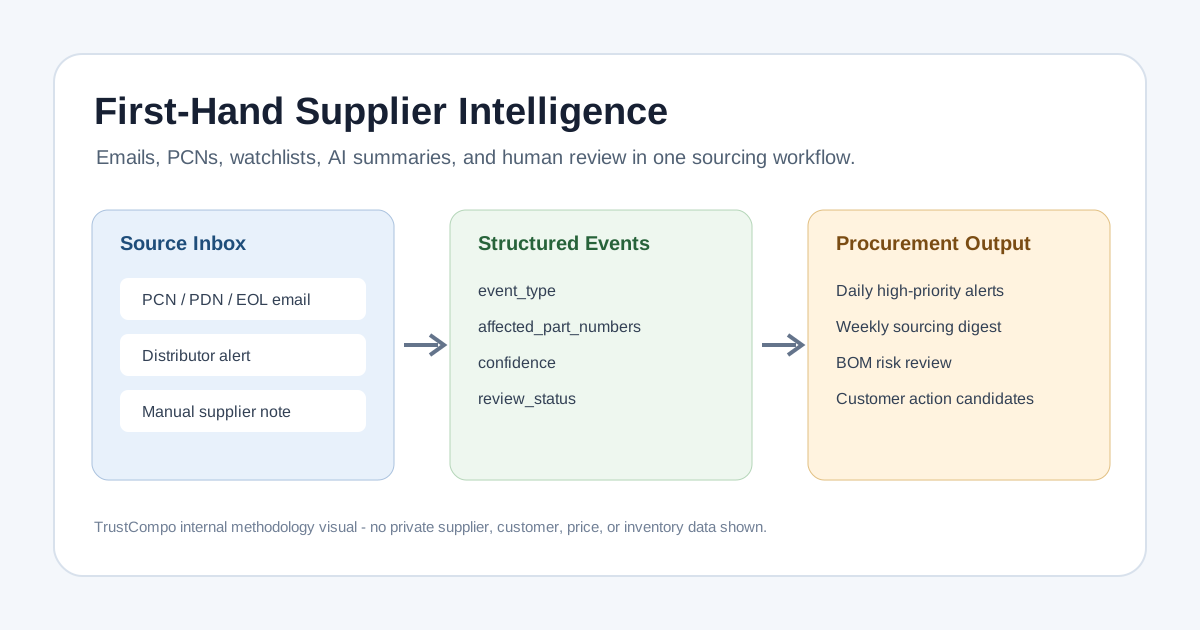
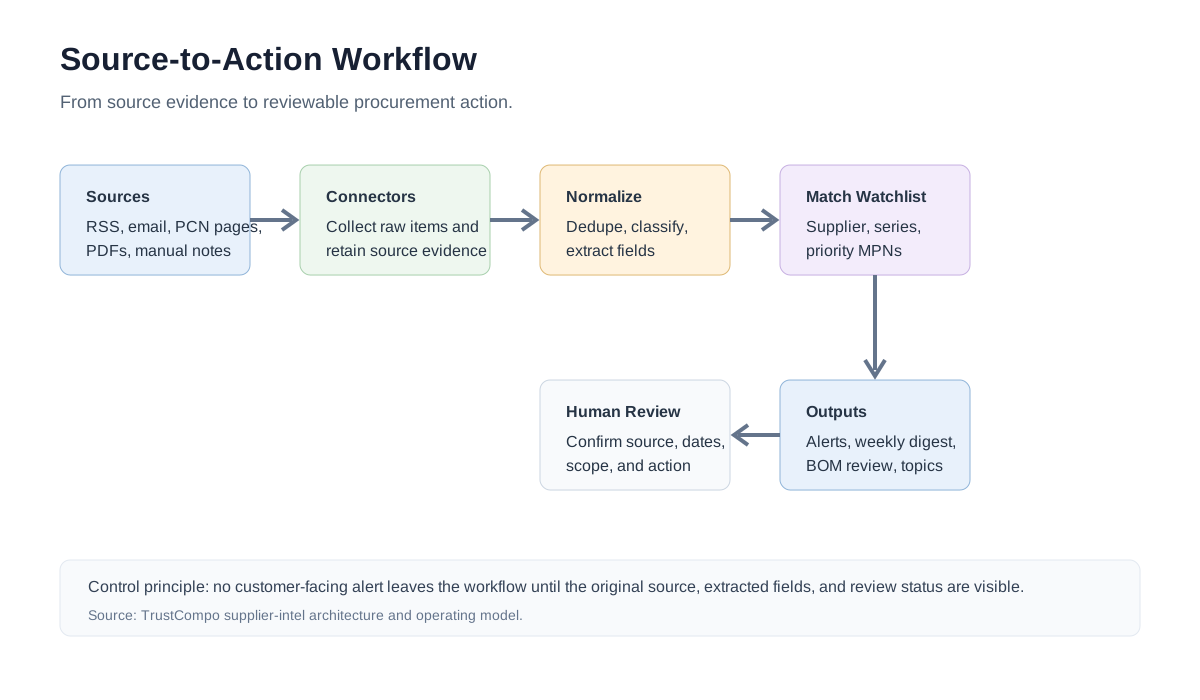
Sources
  -> connectors
  -> raw source item
  -> dedupe and classification
  -> structured extraction
  -> supplier / part-number watchlist match
  -> structured supplier event
  -> human review
  -> daily alerts, weekly digest, customer BOM review, purchasing follow-up, blog topics
The first working version can be built from six pieces:
- A shared supplier-alert inbox for PCN, PDN, EOL, NRND, LTB, quality, datasheet, and newsletter emails.
- A source catalog that records manufacturer, distributor, RSS, PCN page, document index, and manual-note sources.
- A watchlist for priority suppliers, series, and part numbers.
- A structured event table for normalized supplier events.
- Structured extraction for summaries, dates, affected parts, and event classification.
- Human review before any customer-facing alert or sourcing commitment.
What a Real Digest Looks Like
In one internal run generated on July 30, 2026 at 08:15 UTC, the supplier-intel workflow produced a compact digest rather than a loose reading list.
| Digest Signal | Count |
|---|---|
| High-priority events | 19 |
| Medium-priority events | 5 |
| PCN events | 17 |
| PDN events | 1 |
| EOL events | 1 |
| New-product signals | 2 |
| M&A / portfolio signals | 3 |
The important part is not the count alone. The workflow separated a product discontinuance from a product-change notice, separated manufacturing changes from portfolio news, and promoted items only when affected parts were detected. That gives procurement a review queue instead of a pile of supplier links.
Representative high-priority candidates in that run show the practical effect of the workflow:
| Notice | Supplier | Event Type | What the Workflow Extracted | Affected Scope | Review Action |
|---|---|---|---|---|---|
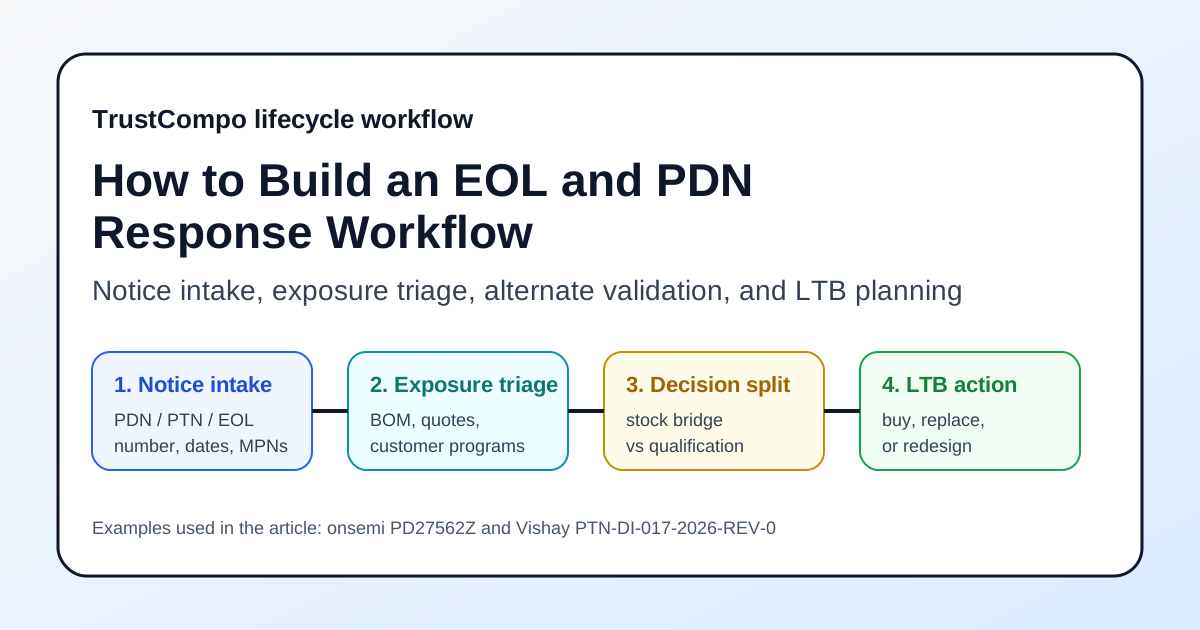
PD27562Z | onsemi | PDN / product discontinuance | Product discontinuance for NSVF4015SG4T1G | One affected OPN was detected | Open the source and confirm LTB / LTS dates before customer action |
PTN-DI-017-2026-REV-0 | Vishay | EOL / product obsolescence | Product termination notice for ILSB0603ERR33JA1 | RF inductor, surface-mount product scope | Confirm termination status and replacement path |
CBOL-21ZKND337 | Microchip | PCN / manufacturing change | Qualification of MMT as an additional assembly site | ATTINY45 TSSOP catalog part candidates were detected | Check effective date, qualification data, and customer BOM exposure |
PCN-2840 | Diodes Incorporated | PCN / material change | Mold compound, die attach epoxy, and bond wire type change | Select automotive discrete semiconductor products, large affected list | Route to SQE / engineering review instead of treating it as a purchasing-only alert |
IPCN26978XA1 | onsemi | PCN / wafer and test site change | Wafer fab and test site transition for ST3 products | Multiple affected OPNs were detected | Review traceability, transition timing, and incoming-inspection impact |
This is the real effect of the workflow: it does not merely say "there are new supplier notices." It separates discontinuance, obsolescence, manufacturing change, material change, and site-transition signals, then gives procurement a source-backed review action.
Those outputs were still not treated as customer-facing facts automatically. In the digest, these were extraction candidates waiting for review. TrustCompo still requires human review against the original manufacturer source before turning them into BOM alerts, sourcing actions, or customer communication.
The Event Model: Turning Noise into Reviewable Records
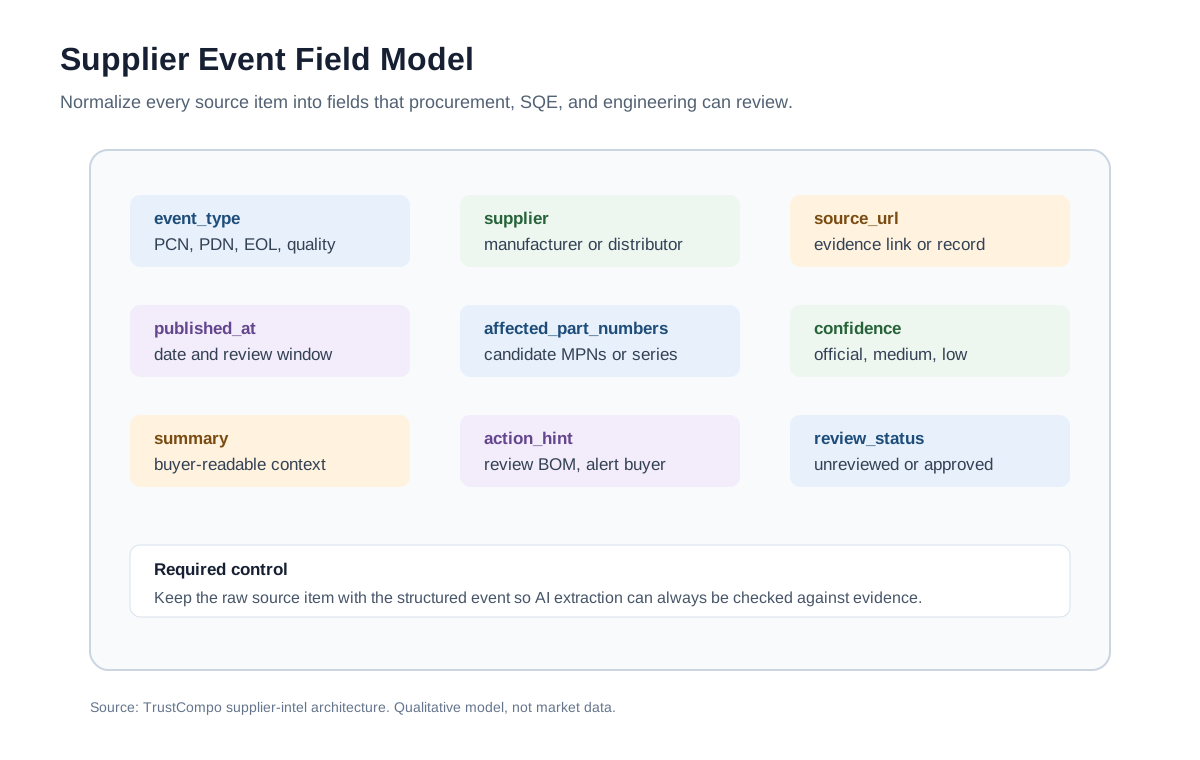
A supplier alert becomes useful only when it can be searched, compared, and reviewed. That is why every item should be normalized into a common event model.
| Field | Why It Matters |
|---|---|
event_type | Separates PCN, PDN, EOL, NRND, LTB, quality notice, datasheet update, new product, and market signal |
supplier | Identifies the manufacturer, distributor, or source owner |
title | Preserves the original signal in a short readable form |
source_url | Keeps the evidence path available for review |
published_at | Helps buyers understand timing and urgency |
affected_part_numbers | Supports BOM and watchlist matching |
confidence | Prevents rumors from being handled like official notices |
action_hint | Converts the event into a next step |
review_status | Makes clear whether a human has checked the extraction |
This structure can live in SQLite, a spreadsheet, Notion, or an internal system. The storage choice matters less than the discipline of keeping raw evidence, extracted fields, and review state together.
Where Automation Helps, and Where Review Must Hold
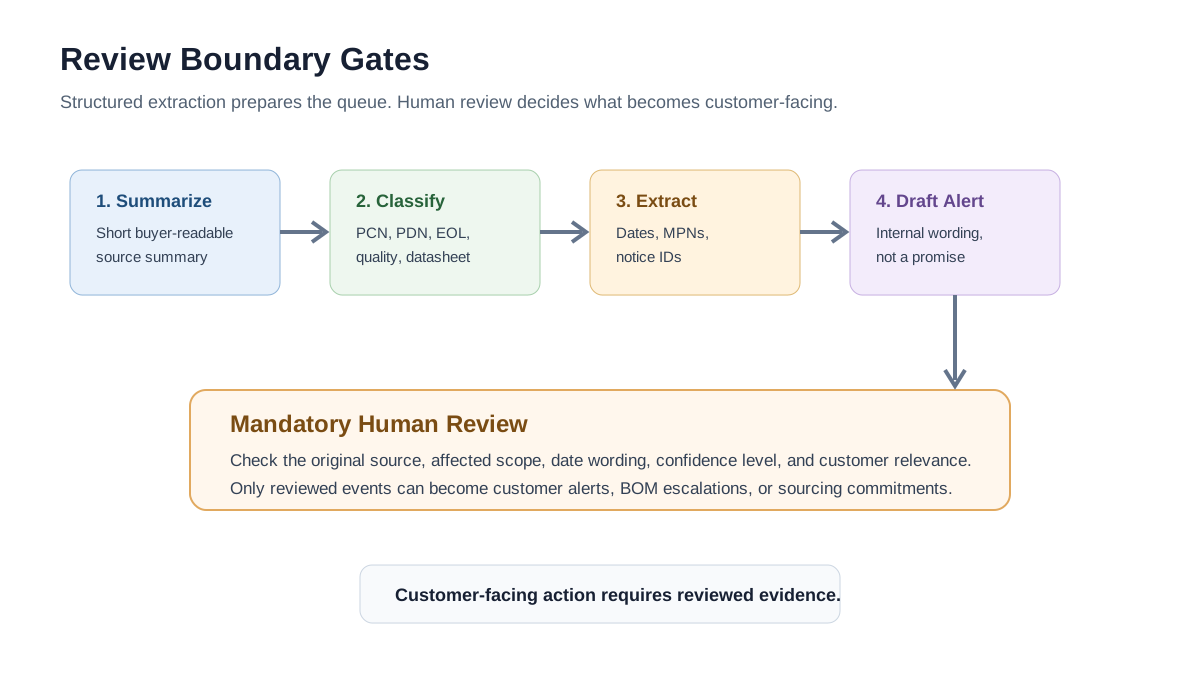
Automation is useful in this workflow because supplier notices are repetitive, long, and easy to miss when they arrive as PDFs, emails, or document-index entries. The system can prepare a short notice summary, classify the event type, extract candidate dates, identify affected part numbers, and draft an internal note.
But extraction output should not become the final source of truth. For supplier intelligence, TrustCompo treats automation as a review accelerator, not a decision authority.
| System Task | Allowed Use | Review Rule |
|---|---|---|
| Summarize source text | Create a short buyer-readable summary | Compare against the original notice before customer use |
| Classify event type | Suggest PCN, PDN, EOL, NRND, LTB, datasheet update, or quality notice | Human reviewer confirms the label |
| Extract dates | Identify published date, effective date, last order date, or last ship date | Human reviewer checks date wording and timezone / format |
| Extract affected parts | Pull candidate MPNs or product families | Human reviewer confirms exact part-number scope |
| Draft alert copy | Prepare internal or customer-facing wording | Human reviewer approves before sending |
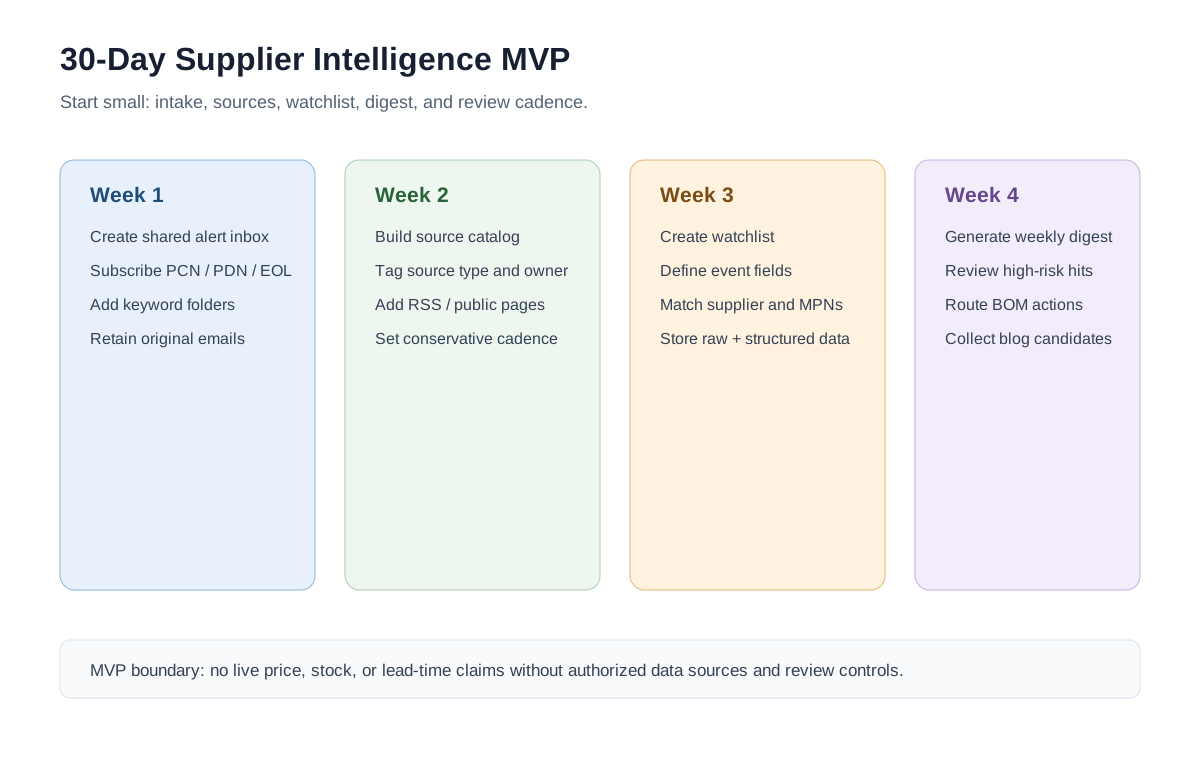
A 30-Day MVP for a Sourcing Team
This system does not need to start as a heavy platform. A small team can build a useful version in one month.
| Week | Build Step | Practical Output |
|---|---|---|
| 1 | Create a shared supplier-alert inbox and subscribe to manufacturer and distributor notices | One controlled intake point instead of scattered personal inboxes |
| 2 | Build the source catalog and keyword rules | Sources are owned, typed, and searchable |
| 3 | Create the supplier / part-number watchlist and event fields | Priority signals can be matched against live sourcing exposure |
| 4 | Generate a weekly digest and review high-risk matches | Procurement gets a repeatable review rhythm |
A workable MVP also needs plain field discipline. For a source catalog, start with source_owner, supplier, source_type, access_method, url_or_mailbox, login_required, refresh_cadence, and last_checked_at. For a watchlist, keep mpn, manufacturer, customer_or_project, annual_usage, approved_alternates, lifecycle_status, risk_owner, and review_priority. These fields are simple enough for a spreadsheet, but they prevent a common failure: the team sees a supplier notice and still cannot tell whether it touches an active BOM.
For review status, avoid vague labels such as "done" or "checked." Use a small controlled set:
| Status | Meaning | Customer-Facing Use |
|---|---|---|
new | Source captured but not reviewed | Do not use |
extraction_candidate | The system extracted a summary, dates, parts, or event type | Internal queue only |
source_checked | Human reviewer opened the original notice and checked the extraction | Can support internal sourcing action |
bom_matched | Affected parts were matched against a live BOM, AVL, or watchlist | Can support customer-specific review |
approved_alert | Evidence, affected scope, dates, and action wording were approved | Ready for customer communication |
closed_no_action | Reviewed and found irrelevant, duplicated, expired, or not applicable | Keep for audit trail |
What We Intentionally Keep Out of the First Version
The first version should not promise live price, stock, or lead-time aggregation unless the data source is authorized and operationally reliable.
Those data categories are valuable, but they carry different risks:
- many platforms require API keys, commercial agreements, or authenticated access
- page scraping may violate terms or trigger access controls
- price and inventory change quickly and require frequent validation
- customer-facing commitments need stronger evidence than a stale screen capture
That boundary is part of the trust model. Non-inventory supplier intelligence gives the team an early-warning layer without turning the MVP into a brittle data-scraping system.
How the Output Becomes Procurement Action
The weekly digest should not be a content artifact only. It should route into real decisions:
| Output | Owner | Action |
|---|---|---|
| High-confidence PCN match | Procurement + SQE | Check live BOM exposure and decide whether incoming inspection rules need updates |
| PDN / EOL / LTB event | Buyer + customer owner | Review bridge stock, redesign timing, and last-time-buy options |
| Datasheet or quality notice | Engineering + SQE | Confirm whether validation or documentation updates are needed |
| Medium-confidence supplier conversation | Procurement | Look for official confirmation before customer communication |
| Repeated category signal | Content owner | Turn the pattern into a buyer education article or market alert |
For customer-facing work, the next step is usually not a dramatic warning. It is a controlled review: which BOM lines are affected, what source evidence exists, what dates matter, and which actions are reasonable now.
In practice, the hard part is not finding one supplier notice. It is keeping the source file, affected scope, review owner, and customer relevance together after the first alert has been read.
Conclusion
First-hand supplier intelligence is not about having more tabs open than everyone else. It is about turning supplier information into a maintained operating loop: source catalog, alert inbox, watchlist, structured events, confidence grading, extraction, human review, and repeatable procurement output.
For a sourcing team, the practical next steps are straightforward:
- move PCN, PDN, EOL, quality, and datasheet-update subscriptions into a shared supplier-alert inbox
- build a priority watchlist before the next shortage, not after it
- require source evidence and
review_statusbefore sending customer-facing supplier alerts
That is the difference between reacting to market chatter and building sourcing judgment from evidence.
Work with TrustCompo
If your team wants to monitor priority parts before a PCN, EOL, or allocation signal becomes urgent, TrustCompo can help build a practical review path around your BOM. Start with BOM Tools, route uncertain lots through Quality Assurance, or use Obsolete / EOL Continuity when supplier intelligence shows lifecycle exposure.