- PCN
- product change notification
- electronics procurement
- TI
Product Change Notification (PCN) Checklist for Electronic Components: TI and Renesas Examples
Use this electronic component PCN checklist to review Product Change Notifications, separate PCN vs PDN vs EOL, and decide when supplier changes need tracking, validation, or engineering escalation.
Quick facts
- A Product Change Notification checklist should capture the PCN number, affected products, change description, reason, effective date, and fit-form-function statement before any release decision.
- In electronic component sourcing, a PCN can cover marking, site qualification, firmware, package material, test flow, and datasheet changes.
- The TI and Renesas examples show why marking, site, and firmware PCNs can affect receiving rules, traceability, and engineering validation even when the ordering code stays familiar.
Product Change Notification (PCN) Checklist for Electronic Components
For electronic component buyers, a Product Change Notification is not just a supplier PDF to archive. It is a release-control signal. A good PCN checklist helps procurement, SQE, IQC, NPI, and engineering teams decide whether a supplier change is safe to track, needs cross-functional review, or must be validated before changed material reaches the production line.
Use this first-pass checklist before releasing a changed lot:
| PCN checklist item | What to verify | Escalate when |
|---|---|---|
| PCN number and issue date | The notice has a traceable supplier reference and a review record | The notice is missing, mirrored only, or not tied to a manufacturer source |
| Affected products | MPNs, package codes, date codes, lots, or product families match active BOM lines | A live BOM, AVL, customer-approved part, or safety stock item is affected |
| Change description | The change is marking, site, package, test, firmware, material, datasheet, or lifecycle related | The title sounds minor but the detail changes identity, traceability, firmware, or materials |
| Reason for change | Standardization, capacity transfer, corrective action, supply continuity, or feature update | The reason implies process migration, quality correction, or behavior change |
| Effective date or first ship date | The team knows when changed material can enter inventory | Old and new lots may overlap without clear receiving rules |
| Fit-form-function statement | Supplier impact claims are recorded but not treated as the whole review | Application behavior, customer approval, IQC evidence, or validation assumptions may change |
Related TrustCompo paths for PCN-driven sourcing work: use BOM exposure triage tools to match affected products against active assemblies, Lifecycle Risk Center to screen non-active and EOL exposure, and change-window traceability review when lot history or change-window control is weak.
Many teams still treat a PCN as supplier-side housekeeping. That is usually the first mistake. The manufacturer may say the part number is unchanged. The package outline may still fit the PCB. The fit-form-function statement may even say "none." Then two months later, IQC rejects a new lot as suspicious, a high-reliability customer asks for updated manufacturing-path evidence, or engineering discovers that the firmware build inside the same ordering code no longer behaves the same way.
This guide is written for the teams who actually need to absorb that risk. If your current workflow still treats supplier notices as email attachments rather than controlled review events, it helps to pair this article with a clear TrustCompo quality assurance intake path and a shared BOM triage route. The article stays grounded in three PCN case studies reviewed from manufacturer source materials:
- Texas Instruments
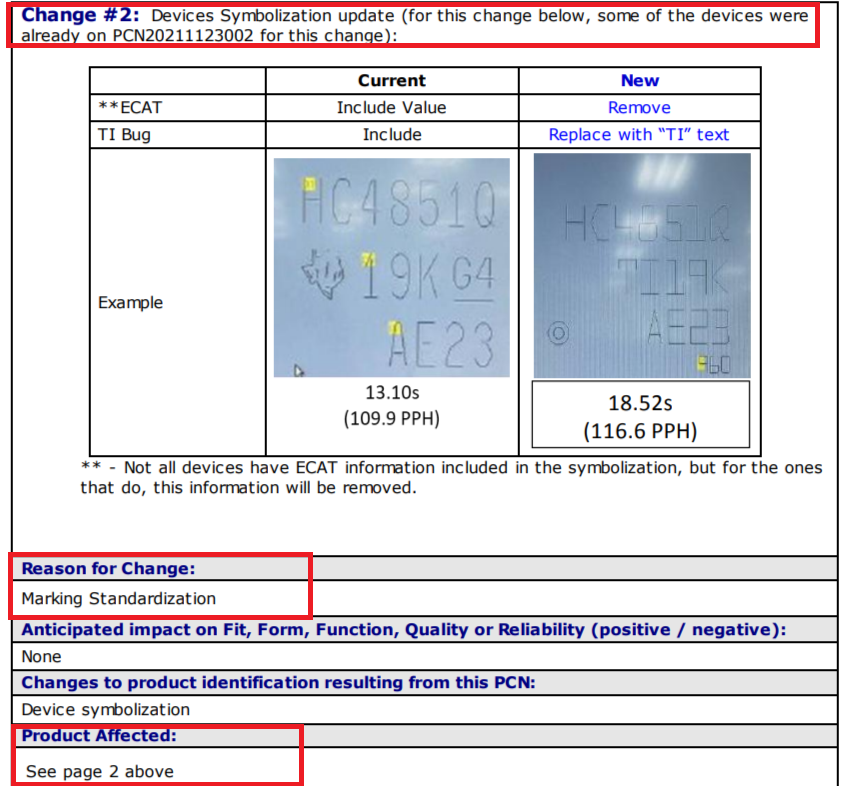
PCN#20230306005.0, issued on March 16, 2023, covering marking standardization for select devices. This is a TI PCN PDF mirror hosted by DigiKey. - Texas Instruments
PCN 20200901001.1, issued on September 18, 2020, covering qualification of additional fab and assembly site options for select LBC7 devices. This PDF is hosted on TI's E2E file service. - Renesas
PCN230005, issued on April 13, 2023, covering a firmware update for8A34004E-000NBGwith an effective date of July 13, 2023.
Source basis: the factual claims in the case-study sections are limited to the linked PCN materials and the primary-source screenshots reviewed for this article. The operational risk comments are TrustCompo sourcing and quality-review judgment, not supplier failure claims.
The point is not to define the acronym and stop. The point is to show how to use a practical electronic component PCN checklist to tell the difference between a notice that only needs process tracking and a notice that deserves real validation work before it reaches the line.
1. What is a PCN? PCN vs PDN vs EOL
In electronics supply chains, these abbreviations often get mixed together because they all arrive through a similar notification channel. Operationally, they mean different things.
| Notice type | What it signals | Main question for the buyer |
|---|---|---|
| PCN | Something about the product, process, package, marking, test flow, software, or manufacturing path is changing | Does this change affect inspection, qualification, validation, traceability, or release rules? |
| PDN | The supplier is moving toward discontinuation or formal product withdrawal activity | How much time is left, and what continuity action is needed? |
| EOL | The lifecycle is ending or the product is already in an end-of-life stage | What are the last-time-buy, last-time-ship, and replacement paths? |
| ECN | An engineering change process, often internal or customer-specific rather than a broad supplier notice | Who must approve the technical change and where is the formal impact boundary? |
This distinction matters because a dangerous PCN does not need to look dramatic. It can arrive without the obvious urgency of a discontinuation notice and still create more operational disruption than a clean EOL. A site-qualification change, a top-mark rewrite, or a firmware revision inside the same part number can create immediate workflow risk long before lifecycle risk becomes the main issue.
2. How to read a Product Change Notification: the six fields every team should check first
The fastest way to misread a PCN is to rely on the title alone. A safer method is to strip the notice down to six fields before the discussion starts.
| First-look field | Why it matters | Typical owner |
|---|---|---|
| PCN number and issue date | Gives you the traceability key for later audits and customer communication | Procurement or document control |
| Affected product list | Tells you whether the notice touches a live BOM or only a dormant family | Procurement |
| Description of change | Reveals whether the change is marking, site, package, test, firmware, material, or datasheet driven | SQE and engineering |
| Reason for change | Helps separate standardization, capacity transfer, corrective action, and feature update logic | Procurement and SQE |
| First ship, effective date, or implementation date | Defines the real window for inventory planning and mixed-lot control | Procurement and warehouse planning |
| Fit, form, function, quality, or reliability statement | Shows the supplier's declared impact boundary, which is useful but should never replace your own review | SQE and engineering |
If your organization has no standard PCN worksheet yet, start there. The goal is not bureaucracy. The goal is to force the first-pass review into a comparable format before anyone decides that the notice is "probably nothing."
3. TI PCN example: marking standardization and the IQC trap
Texas Instruments issued PCN#20230306005.0 on March 16, 2023 under the title Marking Standardization for Select Devices. At first glance, many teams would downgrade it immediately. The title sounds administrative. The notice is presented as information-focused. The supplier states no expected impact to fit, form, function, quality, or reliability.
That is exactly why this is a useful teaching case.
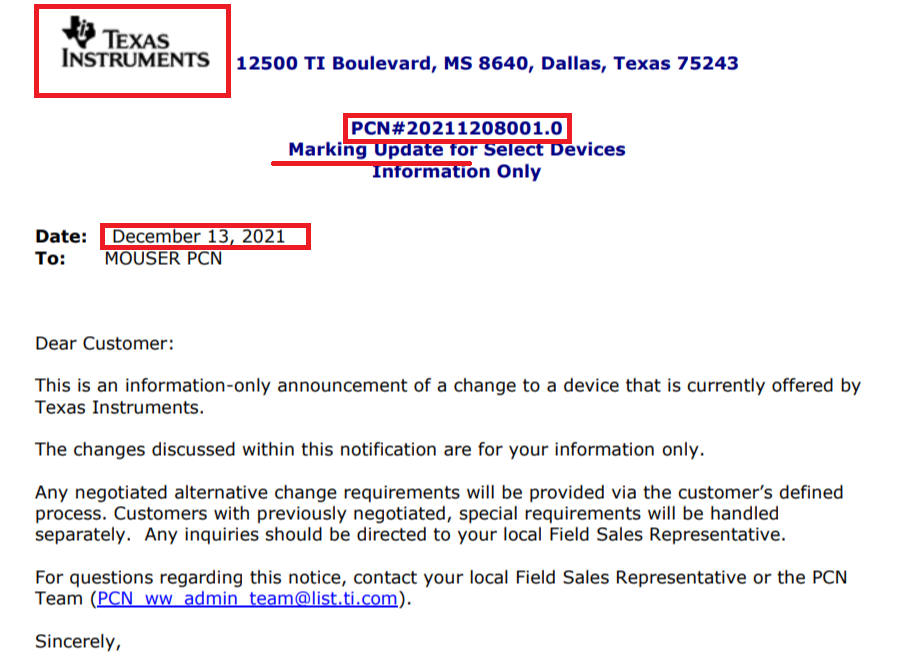
The notice content shown in the draft screenshots describes several concrete marking changes:
- device symbolization format updates
- addition of a
mold cavity idto strengthen device-level traceability - removal of some
ECATinformation on selected devices - replacement of the historical
TI Bugmark with theTItext treatment
There is an easy but dangerous conclusion here: if there is no electrical change, then the notice is low risk. That conclusion is incomplete.
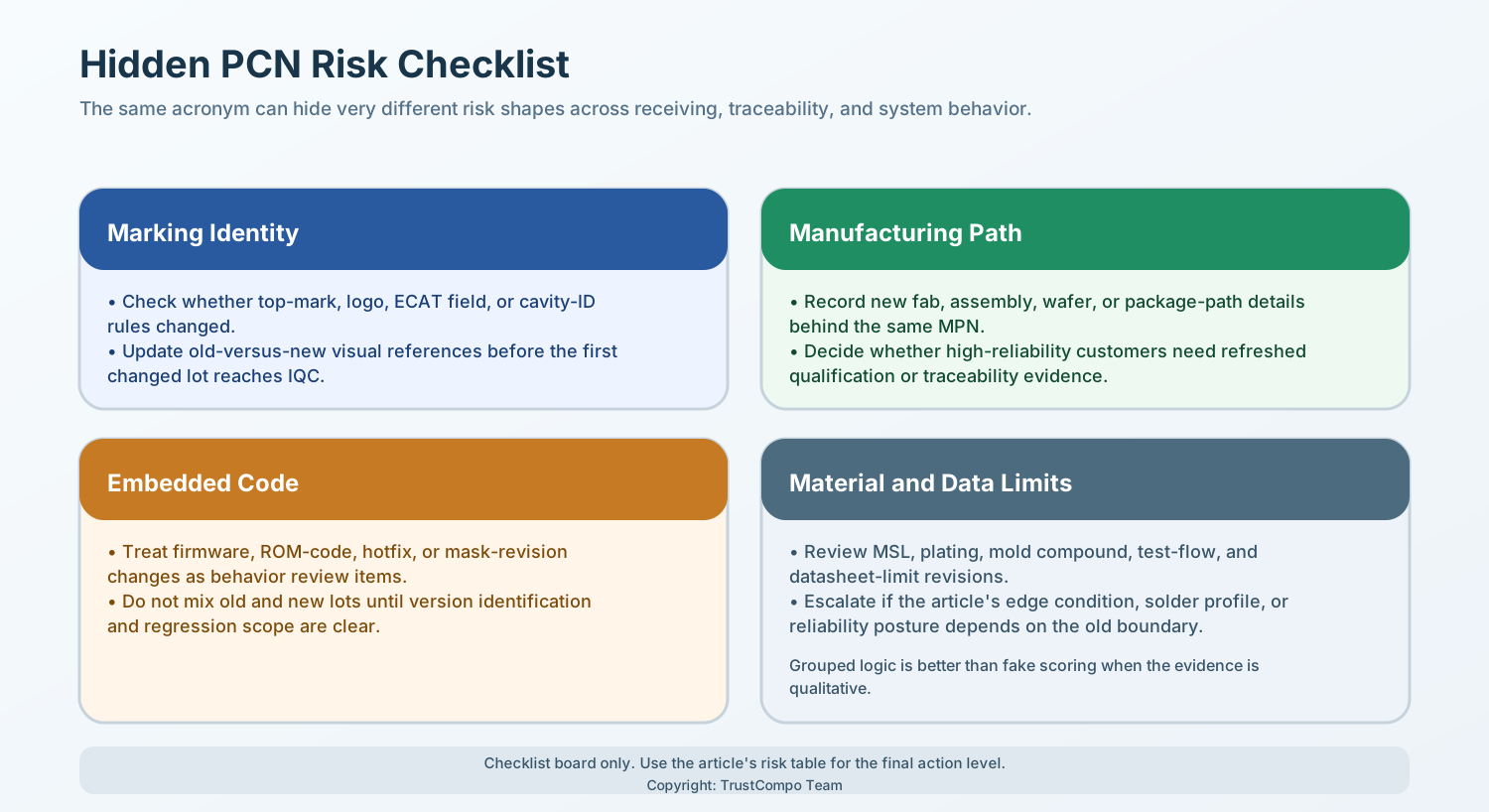
TrustCompo judgment: a marking-only PCN is often low electrical risk and medium operational risk.
Why? Because incoming teams do not inspect only function. They inspect identity. If the warehouse, IQC checklist, or customer golden sample is based on the old top-mark style, a legitimate lot can suddenly look like mixed stock, gray-market stock, or re-marked stock.
The first department affected is usually not design engineering. It is one of these:
- IQC, because the top-mark no longer matches the retained sample
- warehouse or traceability control, because mixed old and new marking can appear inside the change window
- customer quality, because field teams may ask why the same MPN now carries a different visual identity
That is why the right response to a marking PCN is rarely full regression testing. The usual response is process hardening:
- update incoming visual references
- keep an old-versus-new top-mark record
- ask the supplier to separate batches where possible during the transition window
- notify IQC, warehouse, and any customer-facing quality owner before the first changed lot arrives
The lesson is simple: not every PCN creates a technical failure mode, but some "non-technical" notices break technical operations anyway.
4. TI site-change PCN example: additional fab and assembly site qualification
Texas Instruments issued PCN 20200901001.1 on September 18, 2020 with the title Qualification of additional Fab site (RFAB) and Assembly site (CARZ) options for select LBC7 devices.
This is the kind of notice that procurement teams often summarize as "same part, more supply options." In some cases that is partly true. In many cases it is also incomplete.
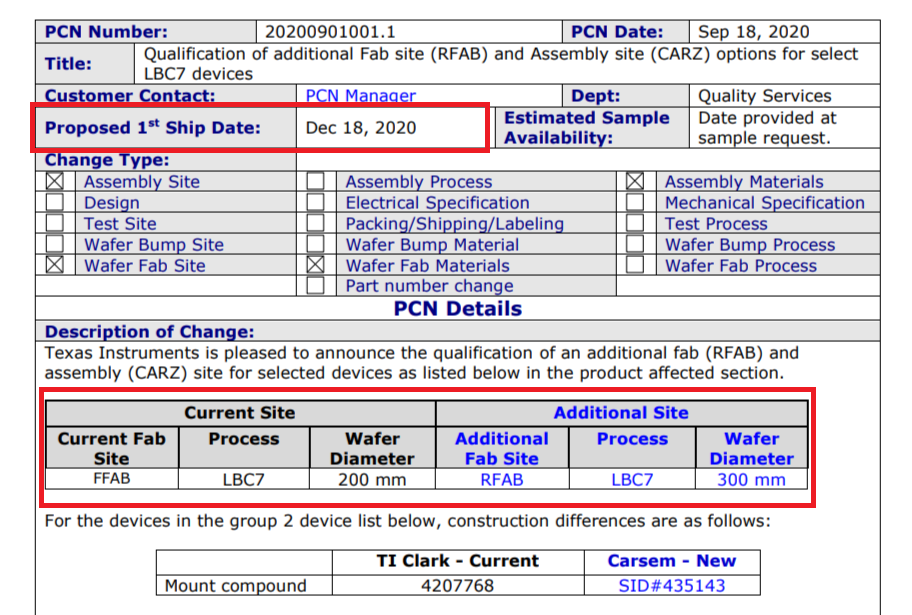
The supplied screenshots highlight several points worth separating:
- the proposed first-ship date is December 18, 2020
- the current fab site is listed as
FFAB - an additional fab site
RFABis being qualified - the wafer diameter changes from
200 mmto300 mm - the notice also describes assembly-side and material-path details for the affected group
The key risk here is not that the MPN suddenly stops working. The key risk is that the manufacturing identity behind that MPN becomes more complex.
That affects four practical areas.
First, traceability gets harder. The same ordered device may now come from a broader combination of fab, assembly, and material paths. If your internal records do not tie site, date code, and lot history together, later root-cause work becomes slower and less defensible.
Second, qualification sensitivity can rise in regulated or high-reliability sectors, depending on the customer approval flow and application class. Industrial, automotive-adjacent, energy, and medical programs may need updated documentation, re-approval logic, or customer acknowledgement even when the supplier calls the change qualified.
Third, the manufacturing-platform context changes. A wafer shift from 200 mm to 300 mm is not just a map-pin change on a slide. It signals a process-path difference that may matter to customer auditors or to your own risk posture, especially when the affected program already has site, process, or traceability controls.
Fourth, mixed-path management becomes a real receiving problem. The uncomfortable period is not the announcement day. It is the overlap period where old and new sources can both appear in inventory or in distributor stock.
TrustCompo judgment: site-qualification PCNs usually sit in the middle band between pure process tracking and full functional revalidation. They deserve a cross-functional review, especially when the notice includes platform-level clues such as wafer-size changes, material updates, or more complex assembly-path details. Full requalification is application-dependent, not automatic.
5. Renesas firmware update PCN example and the hidden behavior risk
Renesas issued PCN230005 on April 13, 2023 for 8A34004E-000NBG, with an effective date of July 13, 2023. This is the most important example in the set because it shows how a notice can remain visually quiet while becoming behaviorally significant.
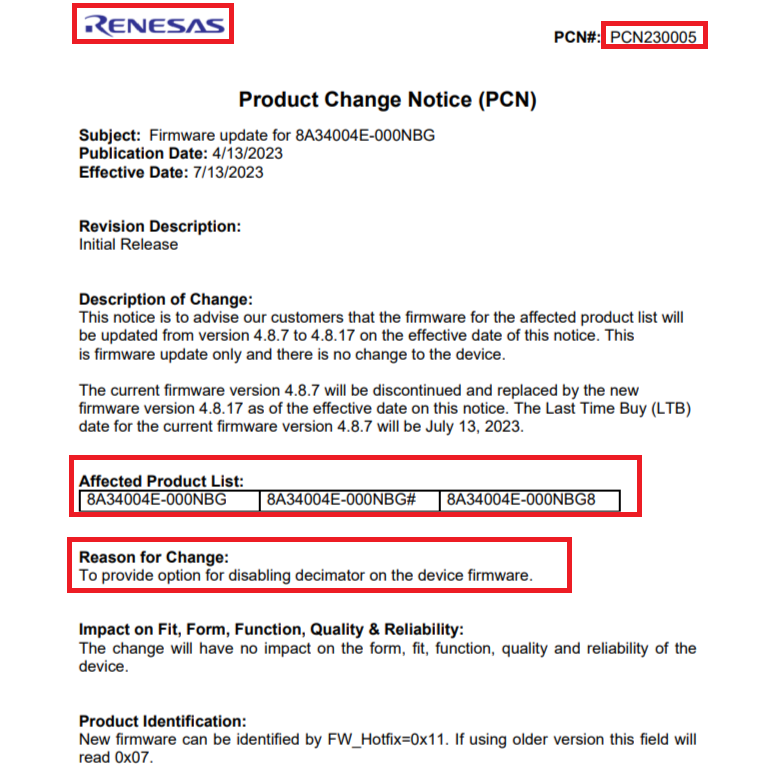
The Renesas PCN source materials show the following facts:
- the affected device is
8A34004E-000NBG - firmware version changes from
4.8.7to4.8.17 - the earlier firmware version is being discontinued
- the last-time-buy date for the older firmware is July 13, 2023
- the reason for change is to provide the option for disabling the decimator in device firmware
- the new firmware can be identified through
FW_Hotfix=0x11, while the previous version is0x07
This is why firmware and ROM-code PCNs deserve special treatment. The supplier may still state that there is no impact to form, fit, function, quality, or reliability in the broad product sense. That statement is important, but the customer still has to verify whether its own initialization scripts, register assumptions, and version controls depend on the previous behavior.
The risk questions shift immediately:
- does initialization logic depend on the old firmware behavior?
- do scripts, registers, or hotfix checks need revision?
- is the validation plan still aligned with the new version boundary?
- can old and new firmware-bearing lots be mixed inside the same program without explicit version control?
TrustCompo judgment: firmware, ROM-code, and mask-revision PCNs should default to engineering review even when the ordering code and package stay unchanged.
That does not mean every case needs a full redesign. It does mean the receiving rule should never be "same MPN, release automatically."
6. Common PCN types that teams underestimate
Most people remember the obvious PCNs: discontinuation-driven notices, package swaps, or manufacturing-site changes. Experienced buyers know that the harder problems are often less visible. The same review logic used in the three case studies applies to several other change families:
- datasheet-limit revisions that narrow a design margin without changing the shipped silicon immediately
- moisture-sensitivity, plating, mold compound, or mount-compound changes that affect assembly or long-term reliability
- reel, label, tape, barcode, or packing-rule changes that can break SMT and incoming flow even when the die is unchanged
- test-flow or screening updates that alter outgoing quality assumptions
- brand-standardization or symbolization rewrites that force traceability references and golden-sample photos to be updated
The common pattern is this: the supplier describes the change by what it is doing internally, while the customer feels the change through receiving, qualification, documentation, or system behavior.
7. Which PCNs need tracking, cross-functional review, or validation?
The goal is not to overreact to every notice. The goal is to use a repeatable grading model.
| Change type | Hidden-risk level | Core failure mode | Highest recommended action |
|---|---|---|---|
| Marking or symbolization standardization | Low to medium | IQC or customer quality treats a valid lot as suspicious because visual identity changed | Process tracking: update incoming references and keep old/new comparison records |
| Packing, reel, label, or tape change | Medium | SPQ mismatch, feeder behavior change, barcode or warehouse confusion | Cross-functional review with warehouse, SMT, and IQC |
| Additional fab or assembly site qualification | Medium to high | Traceability path becomes more complex, and some customers may require refreshed qualification logic | Cross-functional review with procurement, SQE, and engineering |
| Firmware or ROM-code update | High | Same ordered device behaves differently at initialization, script, or protocol level | Engineering review with explicit version-control handling |
| Material, plating, compound, or MSL change | High | Assembly window, solderability, or reliability assumptions move | Validation planning with manufacturing and reliability owners |
| Datasheet critical-parameter revision | High | A legacy design loses hidden margin under edge conditions | Engineering design review and boundary recheck |
That table is intentionally practical rather than academic. Teams do not need a perfect risk taxonomy to improve. They need a rule that helps them decide whether the notice is archive-only, operations-sensitive, or validation-critical.
8. A simple PCN review workflow that actually works
The worst PCN outcome is not "we received too many notices." The worst outcome is "everyone saw the notice and nobody owned the next action." A lightweight internal model is usually enough if the ownership split is clear. When the supplier documentation is incomplete, mixed-lot exposure is unclear, or traceability records are weak, it is usually worth escalating early through a formal quality and traceability review instead of debating the notice by email for a week.
| Function | Minimum PCN responsibility |
|---|---|
| Procurement | Match the affected-product list against live BOMs, note the first-ship or effective-date window, and confirm supplier lot-transition strategy |
| SQE or quality engineering | Classify the change type, maintain the review record, and decide whether customer or internal quality flow needs updates |
| IQC or warehouse quality | Update visual references, label checks, and lot-handling rules when marking, label, or packaging behavior changes |
| Engineering or validation | Review firmware, site, material, datasheet, and behavior-related changes for regression or qualification impact |
| Sales or customer-quality window | Communicate the change early to sensitive customers when documentation or approval posture is likely to shift |
The operating sequence can stay short:
- receive the notice
- extract the six key fields
- classify the change family
- match it to active BOM exposure
- decide whether the action is tracking, cross-functional review, or validation
- update inspection, traceability, and customer records before the first changed lot lands
Conclusion: how to review a PCN before it reaches production
A PCN is not just a notification. It is the start of a change-management decision.
The three case studies reviewed here show why:
- TI marking standardization shows that a low electrical-risk notice can still disrupt IQC and warehouse release
- TI additional site qualification shows that the same MPN can carry a more complicated manufacturing identity after the notice
- Renesas firmware update shows that the most dangerous change can be the one hidden inside a familiar ordering code
For most teams, the best first improvement is not a heavyweight workflow tool. It is a shared first-pass discipline:
- read the same six fields every time
- separate process risk from behavior risk
- do not let "same part number" end the conversation too early
Need an internal escalation path after the first read?
- Route traceability, inspection, or suspect-lot questions to Quality Assurance.
- Use Quality and Traceability Review when a supplier offer is real but the lot history or change-window control is weak.
- Send multi-line exposure checks through BOM Tools when one PCN touches several active assemblies at once.
The best PCN process is not the one with the most meetings. It is the one that catches a changed part before the line, the customer, or the firmware log catches it for you.