- TE Connectivity
- AMP connectors
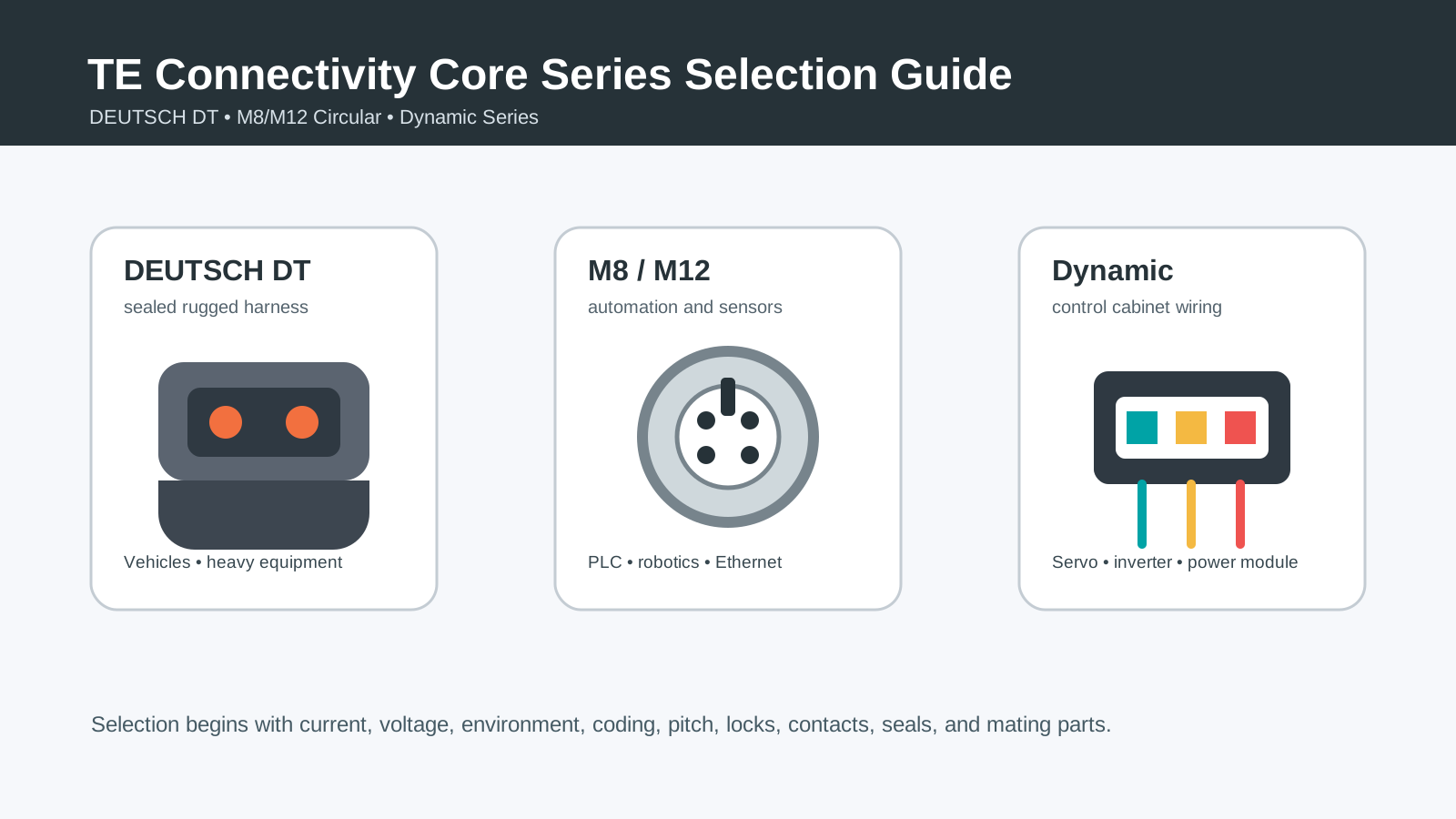
- DEUTSCH DT
- part number decoding
Decoding TE Connectivity Part Numbers: A Practical Guide for Sourcing and Engineering
TE Connectivity part number decoding guide for AMP legacy, Dynamic, and DEUTSCH connectors, including dash codes and contact-gender pitfalls.
Quick facts
- TE numeric connector part numbers often hide a base-number family plus prefix and suffix dash numbers, but the dash logic changes by product type.
- For many housings, a dash number may point to positions, keying, or mechanical variants; for terminals, it often points to plating, wire range, or packaging.
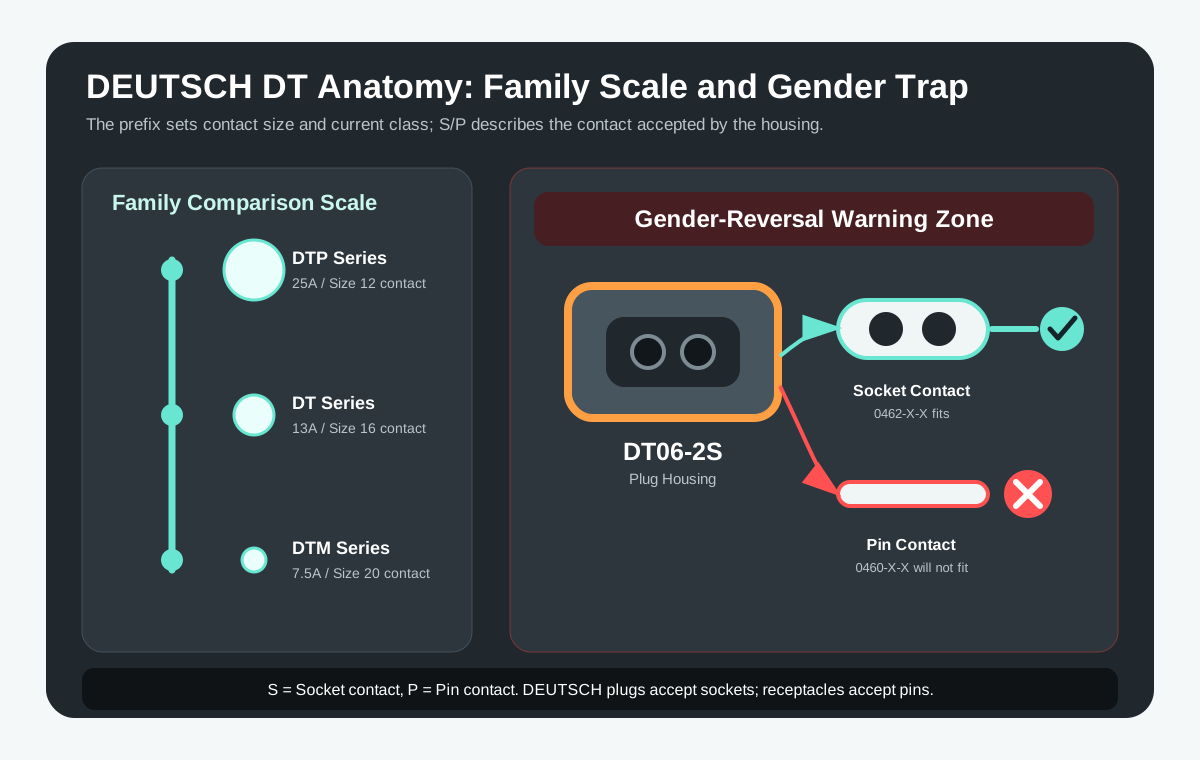
- DEUTSCH DT plugs accept socket contacts, while DEUTSCH DT receptacles accept pin contacts. This is one of the most common BOM mistakes.
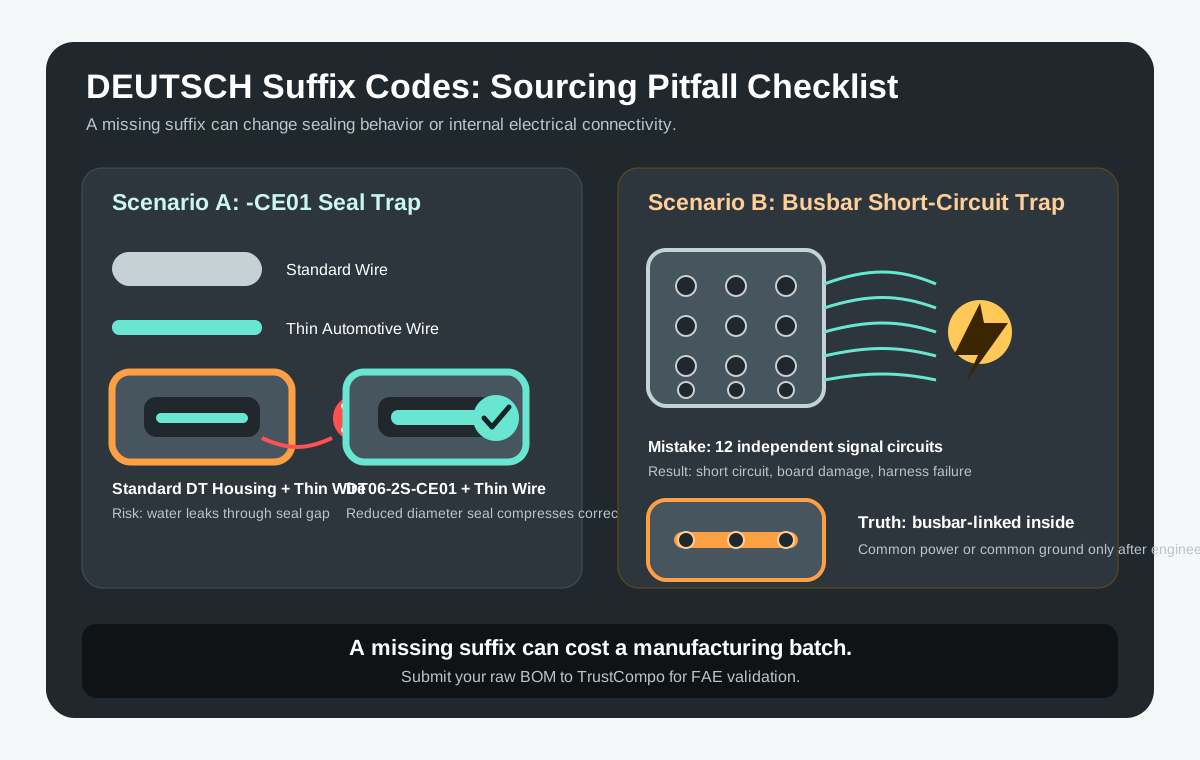
- Modification suffixes such as -CE01 and busbar variants can change sealing behavior or internal electrical connectivity.
TE Connectivity part numbers look simple until a buyer orders the wrong dash number and the production line discovers that the housing fits, the terminal does not, or the connector has an internal busbar that was never shown on the customer BOM. The problem is not that TE part numbers are random. The problem is that TE inherited several naming systems from AMP, DEUTSCH, and other product families, and each system encodes different engineering information.
This guide explains two high-risk decoding zones: standard TE/AMP numeric part numbers and DEUTSCH alphanumeric part numbers. It is written for sourcing teams, FAE engineers, harness builders, EMS buyers, and repair teams who need a practical way to read the number before committing a purchase order.
Important boundary: TE product pages and drawings remain the source of truth. The patterns below are procurement heuristics, not a substitute for a current TE drawing, datasheet, PCN, or customer AVL approval.
Part 1: The Logic Behind Standard TE and AMP Numeric Part Numbers
Many TE commercial connector numbers follow a visible pattern:
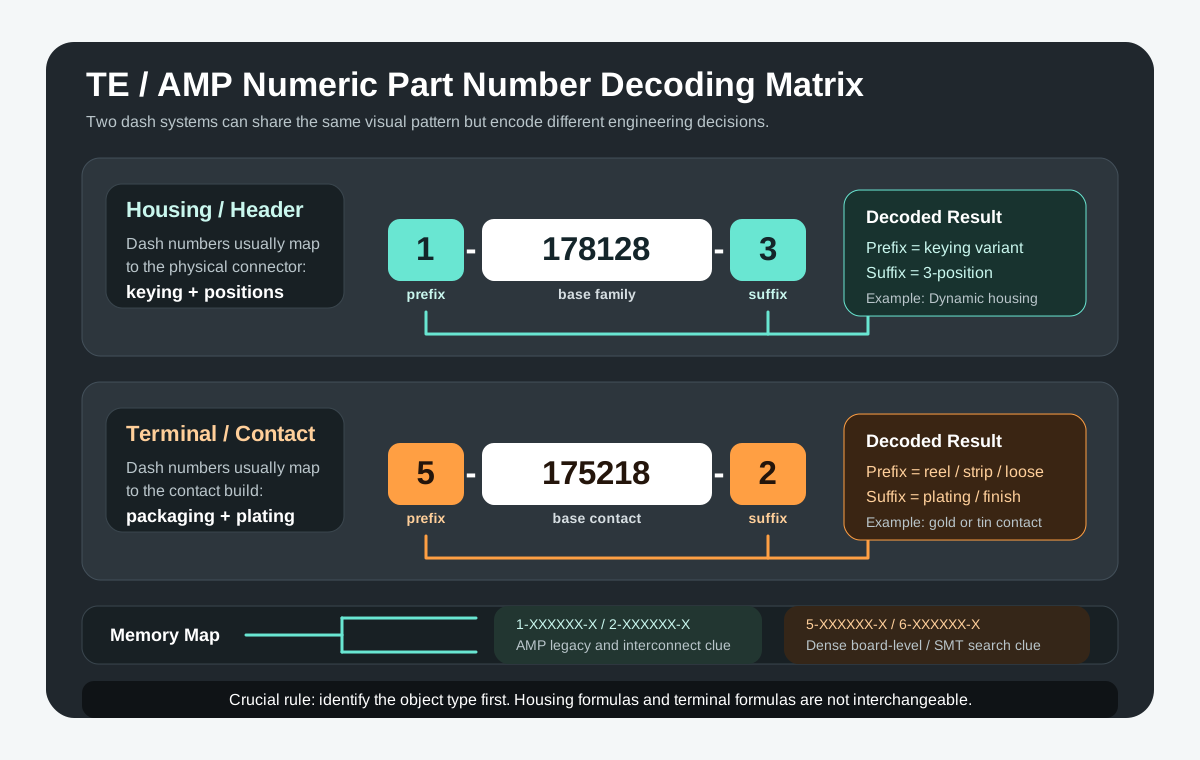
prefix - base part number - suffix
1      - 178128           - 3
That pattern looks easy, but it can be dangerous. A dash number that describes a 3-position housing in one family may describe selective gold plating or reel packaging in a contact family. The first sourcing question should therefore be: what is the object? Housing, header, receptacle, plug, tab, socket, pin, crimp terminal, cable assembly, or accessory.
Base Part Number: The Six-Digit Universe and AMP Heritage
The base number is the design family anchor. In many classic TE commercial connector lines, the base is a six-digit number such as 178128, 175218, 640509, or 206434. Newer, acquired, or expanded product lines may use longer numeric structures, including seven-digit bases.
For sourcing work, the base number is useful because it often groups a drawing family. For example, TE's public pages for 1-178128-3, 2-178128-3, and 3-178128-3 all point into the Dynamic D-3200 / Dynamic 3000 receptacle housing family with the same 178128 drawing base, while the prefix changes the exact variant. That is the mental model buyers should use: the base number is the engineering neighborhood; the prefix and suffix are the exact address.
AMP heritage matters because many older commercial connector families still carry AMP-style numeric DNA. Six-digit bases beginning with 1xx, 2xx, 3xx, 5xx, 6xx, and 9xx frequently appear in legacy interconnect catalogs, appliance connectors, circular plastic connectors, AMPMODU-style systems, Dynamic connectors, and board-level connector families. Do not treat the first digit as a universal category code, but do use it as a reverse-lookup clue.
Practical reverse lookup:
| Base Number Clue | What It Often Means in Sourcing | Buyer Action |
|---|---|---|
178128 in 1-178128-3 | Dynamic D-3200 / Dynamic 3000 housing family | Compare positions, keying, and mating connector from the same drawing family. |
175218 in 1-175218-2 | Dynamic terminal/contact family | Check plating, wire range, contact gender, and applicator tooling. |
5xxxxx or 6xxxxx bases | Often found in dense board-level, SMT, memory, or high-pin-count connector searches | Use TE search filters and drawing family, not the first digit alone. |
Legacy 2xxxxx, 3xxxxx, 7xxxxx, 9xxxxx bases | Common in AMP circular, rectangular, appliance, and interconnect catalogs | Review old catalog notes because prefixes and suffixes may be family-specific. |
The RoHS-era complication is also real. In older AMP and TE commercial families, RoHS-compliant equivalents were sometimes introduced through material, plating, resin, or finish changes. Some catalogs mark all listed numbers as RoHS compliant; other product lines use successor numbers, product change notices, or compliance attributes on the TE page. From a sourcing perspective, never assume that a lead-free, tin-finished, gold-flash, or resin-changed variant is mechanically and electrically identical just because the visible base number looks familiar.
Dash-System Rule: Housings and Terminals Use Different Algorithms
The most expensive mistake is applying one dash formula to every part.
Housing and Header Logic: Dash Numbers Often Track Positions, Keying, or Mechanical Variants
For a housing, header, or receptacle, the suffix frequently maps to a physical configuration such as position count, row count, polarization, keying, color, or mounting style. In the Dynamic example, TE pages identify 1-178128-3 as a 3-position receptacle housing in the Dynamic family. The base 178128 is the design skeleton; the dash numbers select the exact purchasable version.
Buyers often summarize this as:
1-178128-3 = Dynamic family + specific key/variant + 3-position housing
That shorthand is useful, but it is not enough for release. Adjacent prefixes such as 1-, 2-, and 3- can represent different keying or variant details inside the same family. If a design relies on physical keying to prevent a harness from being plugged into the wrong header, a "close" prefix is not a close substitute.
Contact and Terminal Logic: Dash Numbers Often Track Chemistry, Wire Range, and Packaging
For a crimp terminal or contact, the suffix usually does not mean position count. It can indicate contact plating, wire size, strip form, loose-piece form, reel packaging, applicator compatibility, or a finish variant.
A practical example is the Dynamic terminal area. A buyer comparing 1-175218-2 should not read the final -2 as "two pins." It is a terminal/contact part number, so the suffix must be checked against the contact drawing and TE attributes such as contact type, wire range, plating material, and packaging method.
Common sourcing shorthand:
| Contact Variant Signal | Typical Procurement Meaning | Risk If Misread |
|---|---|---|
| Tin or pre-tin finish | Cost-controlled industrial wiring, lower mating-cycle requirements | May not fit signal integrity, oxidation, or low-level circuit needs. |
| Selective gold finish | Gold at mating area, often used for higher reliability signal paths | More expensive; wrong finish can fail customer AVL or environmental expectation. |
| Reel / strip packaging | Used for applicators and automated or semi-automated crimping | Hand repair teams may need loose-piece contacts instead. |
| Loose piece | Used for manual crimp tools, service, prototype, or repair | Production applicators may not accept it. |
The rule is simple: for housings, dash numbers often describe physical shape; for terminals, dash numbers often describe metallurgical and packaging details. Mixing those formulas is how a BOM becomes unbuildable.
Why RoHS and Physical Revisions Matter
RoHS compliance is not just a checkbox on a commercial invoice. Connector compliance may involve plating, solderability, resin, flame rating, or process changes. In old AMP-derived families, a RoHS-compliant version may be listed as a direct compliant listing, a successor variant, or a similar-looking number with a different dash structure.
Before approving a substitute, check:
- TE product compliance status for the exact part number.
- Current product drawing revision.
- Contact plating and finish.
- Mating part compatibility.
- Customer AVL approval and any PCN history.
For open-market buying, this is also a counterfeit and mixed-lot risk. A bag marked with a familiar AMP base number may still contain a different finish, old date code, obsolete resin, or non-approved plating version.
Part 2: DEUTSCH Alphanumeric Part Numbers and Their Hidden Rules
DEUTSCH part numbers come from a different world. They read more like military, vehicle, and heavy-equipment engineering codes than commercial PCB connector numbers. Letters define the connector family, shell role, contact system, seal behavior, and modification code.
DT06 - 2S - CE01
family shell positions/contact code modification code
Prefix and Family Letters: Current, Contact Size, and Housing Class
The family prefix tells you the physical class before you ever inspect the drawing.
| Family | Practical Meaning | Contact System | Typical Current Class | Common Use |
|---|---|---|---|---|
| DTM | Micro-size DEUTSCH connector | Size 20 contacts | 7.5 A class | Sensors, dense body electronics, compact harness branches. |
| DT | Standard sealed rectangular DEUTSCH connector | Size 16 contacts | 13 A class | Vehicle harnesses, industrial equipment, actuators, lamps, machine wiring. |
| DTP | Power-size DEUTSCH connector | Size 12 contacts | 25 A class | Power input, battery management, pumps, heavier loads. |
| DTHD | Single-way heavy-duty connector | Size depends on exact part | High-current single-circuit use | Single power or ground lines in harsh environments. |
| HD / HDP | Heavy-duty circular systems | Multiple contact sizes | Mixed 7.5 A to high-current layouts | Truck, bus, off-highway, firewall, chassis, and bulkhead harnesses. |
TE's public product pages support this family split: DTM uses size 20 contacts at 7.5 A, DT uses size 16 contacts at 13 A, and DTP uses size 12 contacts at 25 A. HDP20 and HD30 move into multi-pin circular heavy-duty systems with mixed contact sizes and bayonet-style rugged interfaces.
The Gender-Reversal Trap: Plug Housing Accepts Socket Contacts
This is the DEUTSCH rule that catches new buyers.
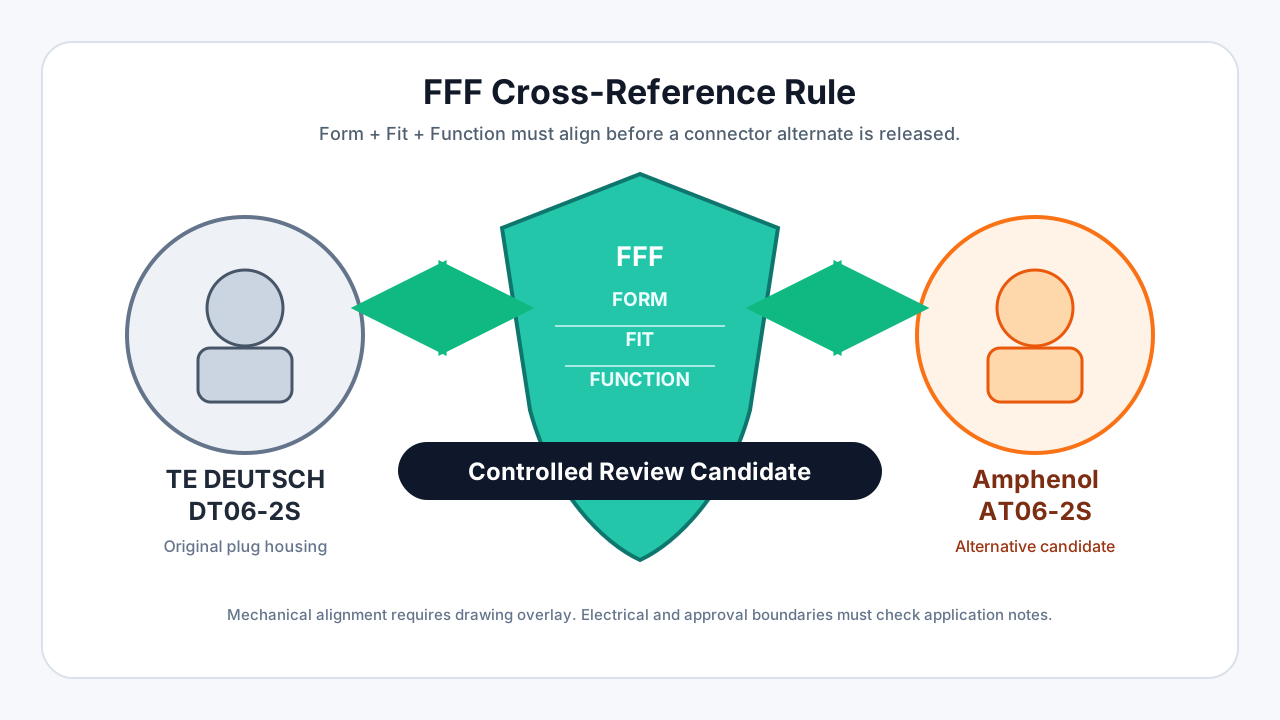
DT06-2S is called a plug housing, but the S means it accepts socket contacts. It is not asking you to buy pin contacts. In TE's own product language, DT06 plug variants are housings for female terminals. The matching contact example is a socket contact such as 0462-201-16141.
The opposite side is DT04-2P, a receptacle housing that accepts pin contacts, such as 0460-202-16141.
The confusing part is mechanical: the plug housing may look like the "male" moving half of the connection, while the internal contact cavity is built for a female socket. The receptacle housing may look like a receiving frame, while it carries the male pin contacts.
Procurement consequence:
| If the BOM Says | Correct Contact Direction | Wrong Assumption |
|---|---|---|
DT06-2S plug housing | Buy socket contacts, for example 0462-... | Buying 0460 pin contacts because the shell is called a plug. |
DT04-2P receptacle housing | Buy pin contacts, for example 0460-... | Buying 0462 socket contacts because the shell is called a receptacle. |
This is why a DEUTSCH RFQ should list housing, mating housing, socket contact, pin contact, wedgelock, wire size, insulation diameter, and crimp tooling in one line set.
Modification Codes: The Suffix Is an Engineering Patch
The final suffix in a DEUTSCH part number is not decoration. It can change the connector's seal, cap, color, keying, retention feature, or internal electrical structure.
| Mod Code | Technical Breakdown | Sourcing Guide |
|---|---|---|
| No suffix | Standard family configuration, standard seal and housing variant for the exact part | Suitable only if wire insulation O.D., color, keying, and accessories match the drawing. |
-CE01 | Reduced-diameter seal / E-seal style variant on many DT and DTP plug numbers | Common for thinner automotive wire insulation. If a standard-seal housing is used with thin wire, the rear seal may not compress correctly. |
-E004 | Often seen as a black housing or color/material modification in DEUTSCH families | Function may be similar, but color, MOQ, price, and lead time can differ from gray standard parts. |
-P012 and related busbar variants | Can indicate enhanced retention or special internal construction depending on family; some 12-position DT variants are busbar-linked | Never assume 12 independent circuits. Review the TE drawing and description before connecting separate signals. |
The busbar case deserves special attention. TE public listings include DT 12-position receptacle variants described as busbar versions. A busbar-linked connector can be exactly what an engineer wants for common power or ground distribution, but it is catastrophic if a buyer treats it like a normal 12-circuit connector. Connecting 12 unrelated signals into a common bus can short outputs, damage a board, or burn a harness.
Sourcing Checklist Before Releasing a TE Connector BOM
Use this checklist before buying TE or DEUTSCH connector families:
- Identify the object type: housing, header, terminal, contact, wedgelock, seal, backshell, or cable assembly.
- Decode the base family, but confirm the exact part on TE's product page or drawing.
- For numeric TE parts, do not apply housing dash rules to terminals.
- For DEUTSCH, match
Shousings with socket contacts andPhousings with pin contacts. - Confirm wire gauge and insulation outside diameter, especially for reduced-diameter seal variants.
- Check whether the suffix changes color, keying, cap style, seal retention, or internal connectivity.
- Check packaging: loose piece, strip, reel, tray, box, or cut tape.
- Confirm RoHS/REACH status, finish, and product drawing revision.
- Confirm mating parts and accessories, including wedgelocks and crimp tools.
- For open-market lots, inspect labels, date codes, package type, plating finish, and traceability documents.
For urgent projects, send the raw BOM to TrustCompo RFQ Submit with the manufacturer part numbers, quantities, target delivery date, and application notes. For one-line emergency buys, use request verified stock pricing. If the BOM may contain obsolete or misdecoded connector numbers, use Alternative Solutions and include photos of the mating connector and wire harness.
Representative Part Links for Cross-Checking
| Part Number | Role in This Guide | TrustCompo Link |
|---|---|---|
DT06-2S | DEUTSCH plug housing that accepts socket contacts | DT06-2S |
DT04-2P | DEUTSCH receptacle housing that accepts pin contacts | DT04-2P |
0462-201-16141 | DEUTSCH socket contact example | 0462-201-16141 |
0460-202-16141 | DEUTSCH pin contact example | 0460-202-16141 |
1-178128-3 | Dynamic housing example for numeric dash decoding | 1-178128-3 |
1-175218-2 | Dynamic terminal/contact example for plating and contact checks | 1-175218-2 |
Reference Scope
This guide was checked against TE public pages and catalog references, including TE pages for Dynamic 1-178128-3 / 2-178128-3 / 3-178128-3, DEUTSCH DT series housings, DEUTSCH DTM housings, DEUTSCH DTP housings, HDP20 and HD30 overview pages, DT06-2S, DT06-2S-CE01, DTP06-2S-CE01, and DT busbar-style product listings. Buyers should still verify the exact TE drawing revision for any part number used in a customer BOM.
Conclusion
TE part numbers are not one language. Numeric AMP-derived connector numbers, Dynamic terminals, and DEUTSCH sealed connector codes each use their own grammar. The safe workflow is to decode the family, identify the object type, then confirm the dash number against the current drawing.
For buyers, the key lesson is blunt: a part number that looks close can still be wrong. The wrong dash suffix may change position count, keying, plating, packaging, seal diameter, color, or even internal electrical connectivity. Decode first, quote second, and release only after the complete connector system has been checked.