- MR25H40CDF
- Everspin
- MRAM
- SPI memory
MR25H40CDF Buying Guide: A Buyer Verification Map for Everspin SPI MRAM Stock
A practical MR25H40CDF buying guide focused on buyer verification: what this Everspin SPI MRAM is for, when it still makes sense in a live BOM, and how reel-label and top-marking evidence reduce sourcing risk before PO release.
Quick facts
- MR25H40CDF is a 4Mb serial SPI MRAM from Everspin for non-volatile storage without flash-style erase cycles.
- The strongest buyer demand usually comes from existing BOM continuity, industrial maintenance, and designs that depend on persistent writes or fast power-loss recovery.
- For this part, the verification workflow matters as much as the datasheet: suffix, package, reel condition, reel label, top marking, and traceability all affect release confidence.
- Real stock photos do not replace incoming inspection, but they are one of the fastest ways to screen whether a quoted stock position looks organized and production-ready.
When a team searches for MR25H40CDF, the question is usually not "what is MRAM?" The question is whether this exact part is still the right memory for the job, whether the quoted stock is credible, and whether the release process can move without creating hidden incoming-quality risk.
That is why this article is written as a buyer verification map, not a datasheet summary. The technical basics still matter, but for a part like this the commercial path matters just as much: approved BOM fit, packing condition, physical evidence, and whether the stock is suitable for real line use instead of one-off spot trading.
1. What MR25H40CDF actually is
MR25H40CDF is a 4Mb serial SPI MRAM from Everspin Technologies. At the system level, it is usually valued for four traits:
- non-volatile data retention
- fast write behavior without flash erase cycles
- very high write endurance
- familiar SPI interface integration
TC judgment Those traits explain why buyers often meet this part in repair, continuity, and redesign-avoidance scenarios rather than in greenfield "find the cheapest memory" projects.
The first-pass specification picture is simple:
| Item | Detail |
|---|---|
| Manufacturer | Everspin Technologies |
| Part number | MR25H40CDF |
| Memory type | Non-volatile serial MRAM |
| Density | 4Mb (512K x 8) |
| Interface | SPI |
| Supply voltage | 3.0V to 3.6V |
| Buyer priority | Originality, packing condition, lot consistency, and traceability |
fact None of those lines tell you whether the quoted stock is good enough for release. That is why this part needs a verification workflow, not just a parameter table.
2. Where this part still makes sense
MR25H40CDF continues to be commercially relevant when the memory behavior itself matters.
Typical fit cases:
| Application pattern | Why buyers keep the part |
|---|---|
| Existing approved BOM | Redesign and requalification cost may exceed any unit-price savings from switching |
| Industrial event logging | Frequent persistent writes favor MRAM behavior over flash-style management |
| Configuration storage | Data must survive power loss cleanly and be available immediately on restart |
| Maintenance or repair demand | The installed base expects the original device behavior |
TC judgment This part is strongest when the system needs reliable persistent writes with low firmware overhead. If the program only needs low-cost non-volatile capacity, cheaper memory families may be a better commercial answer.
3. The buyer verification map matters more than the datasheet recap
For MR25H40CDF, the release path is usually the real job:
| Verification checkpoint | What to confirm | Why it matters |
|---|---|---|
| Approved BOM match | Exact suffix, package, and electrical fit | Prevents accidental substitutions |
| Reel-label review | Part number, packing format, lot presentation | Screens whether the supply looks organized and production-oriented |
| Top-marking review | Marking style and package presentation | Gives engineering and QA an early authenticity checkpoint |
| Packing condition | Full reel, cut tape, or mixed lot | Changes line-loading suitability and incoming-risk posture |
| Traceability posture | Commercial paperwork and source clarity | Supports internal release and supplier review |
TC judgment This is the core difference between a real buying guide and a generic catalog note. The part is not hard to describe. The stock is what needs to be interpreted correctly.
4. What the physical photos help you verify
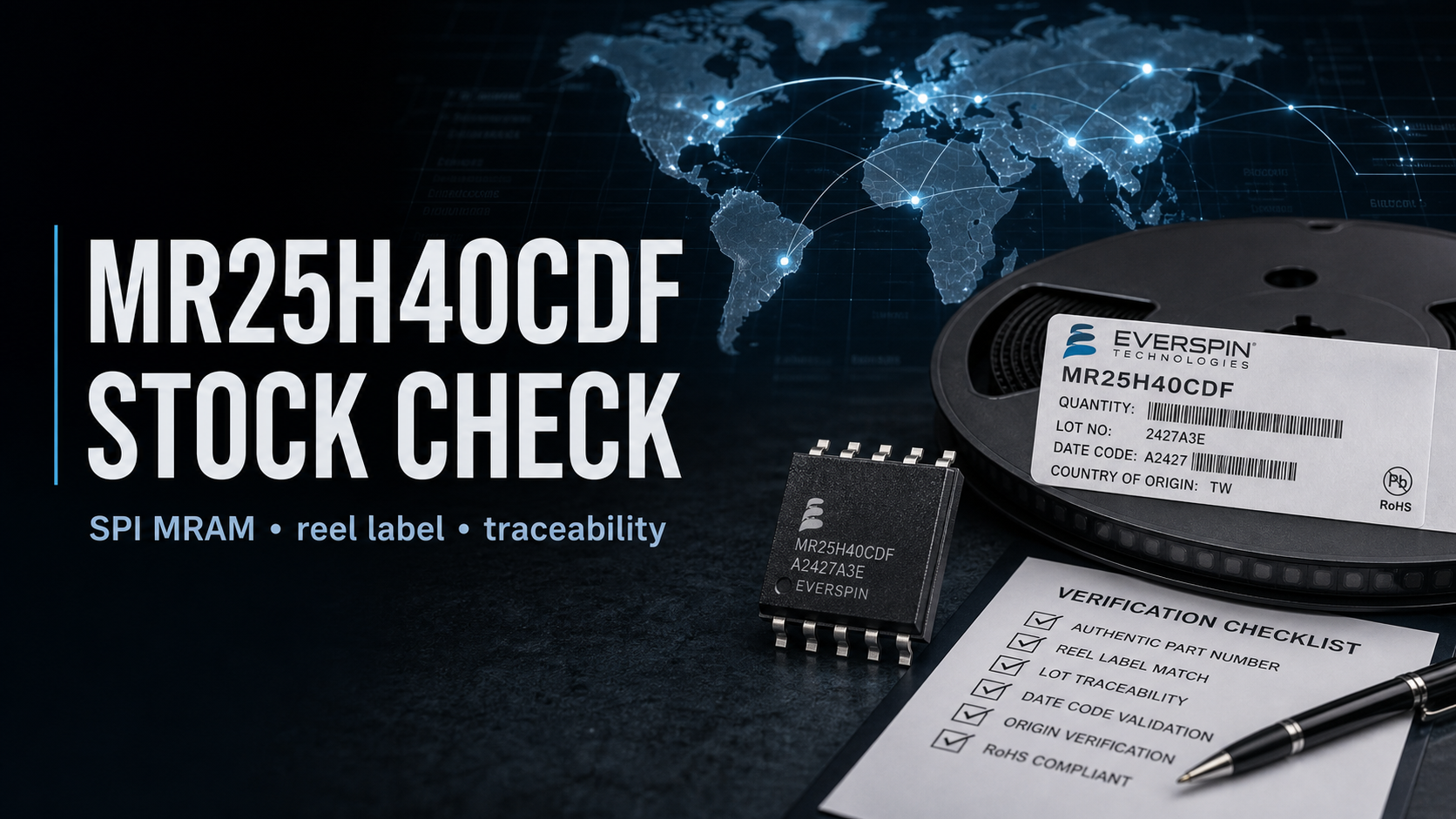
This article includes both a reel-label photo and a top-marking photo from TrustCompo stock.
Reel-label evidence
The reel-label image is useful because it helps buyers review:
- the printed part number format
- the reel presentation
- whether the supply looks like a controlled stock position
- whether the packaging posture fits line-use expectations
Top-marking evidence
The top-marking image is useful because it helps teams compare:
- package marking style
- general visual consistency
- whether the physical chip presentation broadly matches internal expectations before PO release
fact These photos do not replace incoming inspection or full quality procedures. TC judgment They are still valuable because they move the verification conversation earlier, when rejecting an unclear stock offer is much cheaper than rejecting received material.
5. Why buyers still choose MR25H40CDF instead of ordinary flash
MR25H40CDF remains attractive because some embedded systems care more about write behavior than about the cheapest cost per bit.
The practical reasons are straightforward:
Frequent updates
Controllers, instrumentation platforms, and communication nodes may rewrite parameters or logs regularly. TC judgment In these systems, avoiding flash erase management is a meaningful design benefit, not a marketing phrase.
Power-loss recovery
Some designs need to preserve the latest state quickly when power drops. MRAM's persistent-write behavior can make that easier to implement and easier to trust.
Long-service equipment
When a product remains in the field for years, engineering teams care about lifecycle behavior as much as raw memory density. That often keeps original MRAM part numbers alive longer than casual web demand would suggest.
6. When this part is the wrong answer
A disciplined buyer should also know when not to force the part into a project.
MR25H40CDF is usually a weak fit when:
- the design only needs the lowest-cost non-volatile storage
- firmware already handles flash management cleanly
- capacity and cost per bit matter more than write behavior
- the team is starting a fresh design with no continuity pressure and no need for MRAM-specific behavior
TC judgment In other words, this is often a behavior-driven choice, not a commodity-memory choice.
7. Stock-release checklist before PO approval
Before releasing an order, buyers should confirm:
- The exact part number suffix matches the approved BOM.
- The package and voltage expectations align with the real design.
- The stock is presented as original organized supply, not an unspecified mixed lot.
- The reel condition fits the intended use case, especially if SMT loading matters.
- Reel-label and top-marking evidence are available when internal approval requires pre-review.
- The supplier can support the required level of traceability and commercial documentation.
TC judgment For a specialized memory device, these checks often matter more than finding the lowest visible spot quote on the open market.
TrustCompo stock note
The TrustCompo position for MR25H40CDF is aimed at production-minded buyers who want more than a one-line stock claim. The useful commercial signals are the original full-reel context, the physical verification photos, and the fact that the stock can be reviewed as a real supply position before release.
That does not remove the need for your own incoming process. It does make it easier to decide whether this stock deserves to move to the next approval step.