- FPGA
- AMD Xilinx
- Intel Altera
- Microchip PolarFire
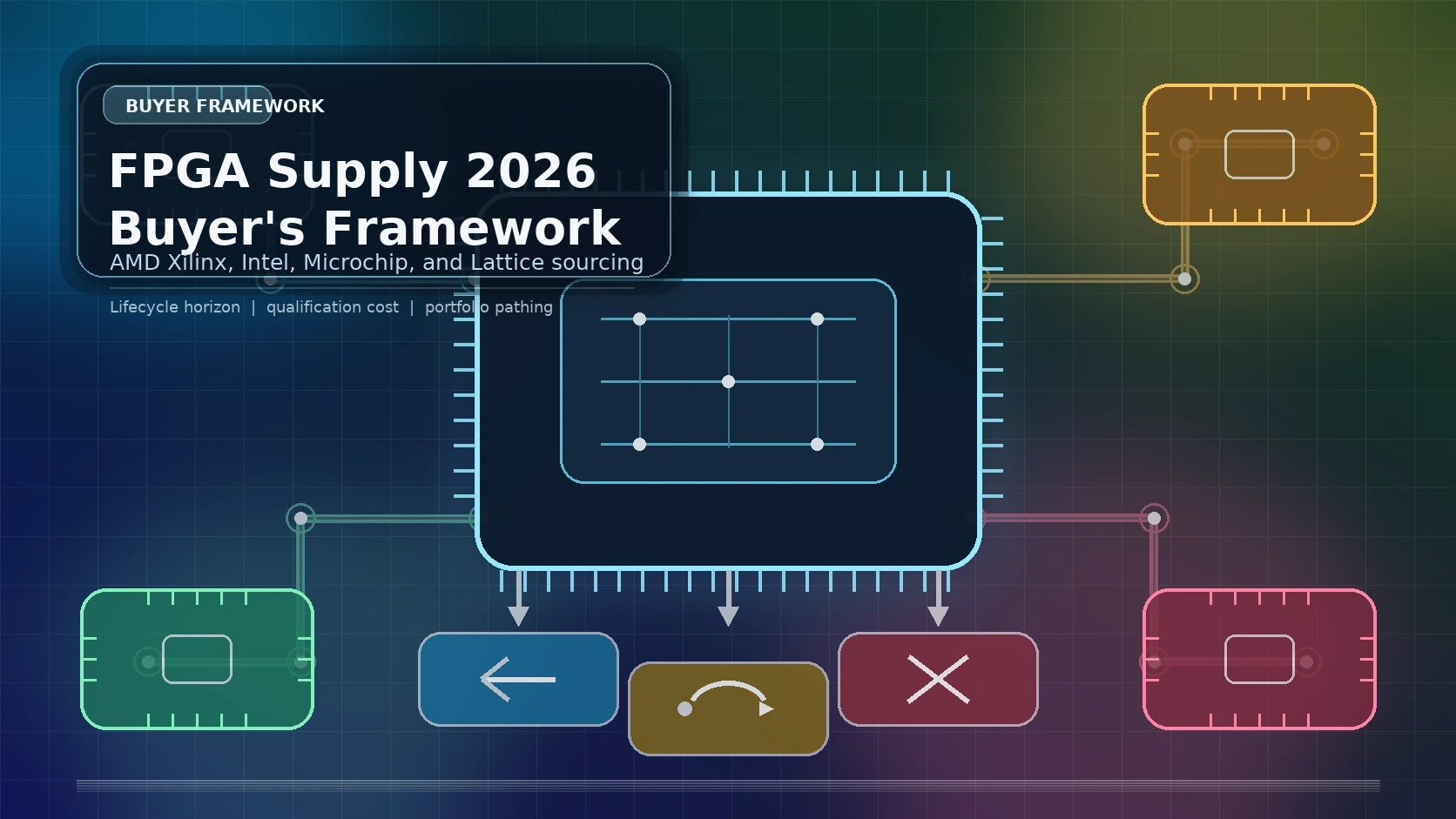
FPGA Supply 2026: A Buyer's Framework for AMD Xilinx, Intel Altera, Microchip, and Lattice Sourcing
A production-BOM FPGA sourcing guide for 2026 covering lifecycle commitment, redesign cost, and qualification boundaries across AMD Xilinx, Intel Altera, Microchip PolarFire, and Lattice families.
Quick facts
- AMD published a lifecycle extension update on February 3, 2026 saying AMD 7 Series devices are now planned through 2040 and UltraScale+ devices through 2045.
- Intel positions Cyclone 10 LP as a low-cost, low-static-power FPGA family for cost-sensitive applications on its current product page.
- Microchip positions PolarFire SoC as a low-power RISC-V SoC FPGA family and added cost-optimized PolarFire Core variants in 2025.
- This article treats cross-vendor FPGA moves as redesign-required unless package, I/O, toolchain, and application constraints are independently re-qualified.
FPGA buying in 2026 is still easy to discuss badly. Too many pages mix hobbyist dev-board demand with production-BOM planning, or they talk about "alternatives" as if any programmable-logic device can be swapped the way a buyer swaps a resistor reel. That is not how real FPGA sourcing works.
For production teams, the practical question is narrower: which vendor family is safest to commit to when lifecycle length, qualification cost, package discipline, and channel risk all matter at the same time?
This article keeps three layers separate on purpose:
- Official fact: current vendor lifecycle and product-positioning statements.
- Market inference: why some families remain easier or harder to buy in mid-2026.
- TrustCompo judgment: how a buyer should prioritize families before asking engineering to spend redesign time.
1. The 2026 FPGA Question Is Not "Who Has Stock?" It Is "What Can We Safely Commit To?"
The biggest buyer mistake is treating FPGA sourcing as a one-week availability problem. It is usually a program-risk problem.
An FPGA line can look "available" and still be commercially dangerous when:
- the approved speed grade is narrow
- the package is hard to cross
- the board already depends on specific transceiver lanes or I/O-bank behavior
- the firmware build flow is deeply tied to one toolchain
- the application is regulated enough that re-qualification cost is larger than the part-price delta
That is why the right 2026 sourcing framework starts with commitment horizon, not with the first broker quote.
Official fact
AMD published an update dated February 3, 2026 stating that AMD 7 Series devices are extended through 2040 and AMD UltraScale+ devices through 2045. On the current Spartan-7 and Artix-7 product pages, AMD repeats the same long-lifecycle message. That matters because it changes the buyer conversation from "legacy line under pressure" to "mature line still intentionally supported."
Intel's current Cyclone 10 LP page still positions that family as a low-cost, low-static-power option for high-volume and cost-sensitive applications. That keeps Cyclone 10 LP relevant when the design goal is not maximum performance, but stable logic and I/O expansion in long-running industrial designs.
Microchip's current PolarFire SoC material emphasizes power efficiency, security, and a broader RISC-V-centered platform story. Lattice continues to position ECP5 and CrossLink-NX around low power, compact form factor, and edge-interface logic rather than brute-force density.
Market inference
The practical implication is that 2026 FPGA sourcing pressure is uneven. The problem is rarely "all FPGAs are tight." It is closer to:
- mature AMD and Intel families stay attractive because they are known and widely qualified
- that popularity keeps older production programs anchored to the same few package-speed-grade combinations
- buyers looking for real escape paths often discover that Microchip and Lattice are attractive only when redesign cost is acceptable
TrustCompo judgment
Before you review a single quote, split your BOM into three buckets:
- Must stay in-family because redesign cost is too high.
- Can move within the same vendor portfolio if lifecycle or package pressure changes.
- Can move cross-vendor only if the project can afford a true redesign and re-qualification cycle.
That one sort usually saves more time than a week of random RFQ activity.
2. The Shortlist: What Each Vendor Family Is Really Good At
The buyer shortlist below is not a "best FPGA ranking." It is a commitment map.
| Family | Representative MPN | What It Is Strong At | Why Buyers Keep It on the List | Main Boundary |
|---|---|---|---|---|
| AMD Artix-7 | XC7A35T-1CPG236C | Cost-sensitive designs that still need transceivers and mature ecosystem support | Long lifecycle signal through 2040 and broad installed base | Demand concentration around common packages and speed grades |
| AMD Spartan-7 | XC7S25-1CSGA225C | Small-footprint, lower-density control and interface logic | Mature family with long-life positioning and a familiar AMD flow | Not the right answer when the design needs high transceiver bandwidth |
| Intel Cyclone 10 LP | 10CL025YU256C8G | Low-cost logic and I/O expansion in volume designs | Low-power, cost-sensitive positioning on current Intel material | Older architecture and limited upside for projects that need a bigger feature jump |
| Intel MAX 10 | 10M08SCE144C8G | Cost-sensitive control logic with embedded flash convenience | Useful when buyers want a compact Intel-family path without moving up-stack | Not a substitute for larger fabric or richer serial resources |
| Intel Cyclone IV | EP4CE22F17C6N | Legacy installed-base support | Still appears in long-tail production programs | Higher open-market and authenticity risk than families still central to new design wins |
| Microchip PolarFire | MPF300T-1FCG784E | Low-power mid-range fabric with security and deterministic compute story | Strong fit for industrial and defense-minded programs that can redesign deliberately | Toolchain and architecture shift make it a redesign path, not a quick swap |
| Lattice ECP5 | LFE5U-25F-6BG256C | Low-power mid-range logic for edge and interface work | Attractive when power, package size, and cost are balanced carefully | Limited as a cross-vendor answer if the original design expects another ecosystem's hard-IP assumptions |
| Lattice CrossLink-NX | LIFCL-40-9BG400C | Compact edge bridging and sensor/interface aggregation | Good fit when the design emphasis is connectivity and small-footprint logic | Not a generic stand-in for larger, fabric-heavy industrial FPGA designs |
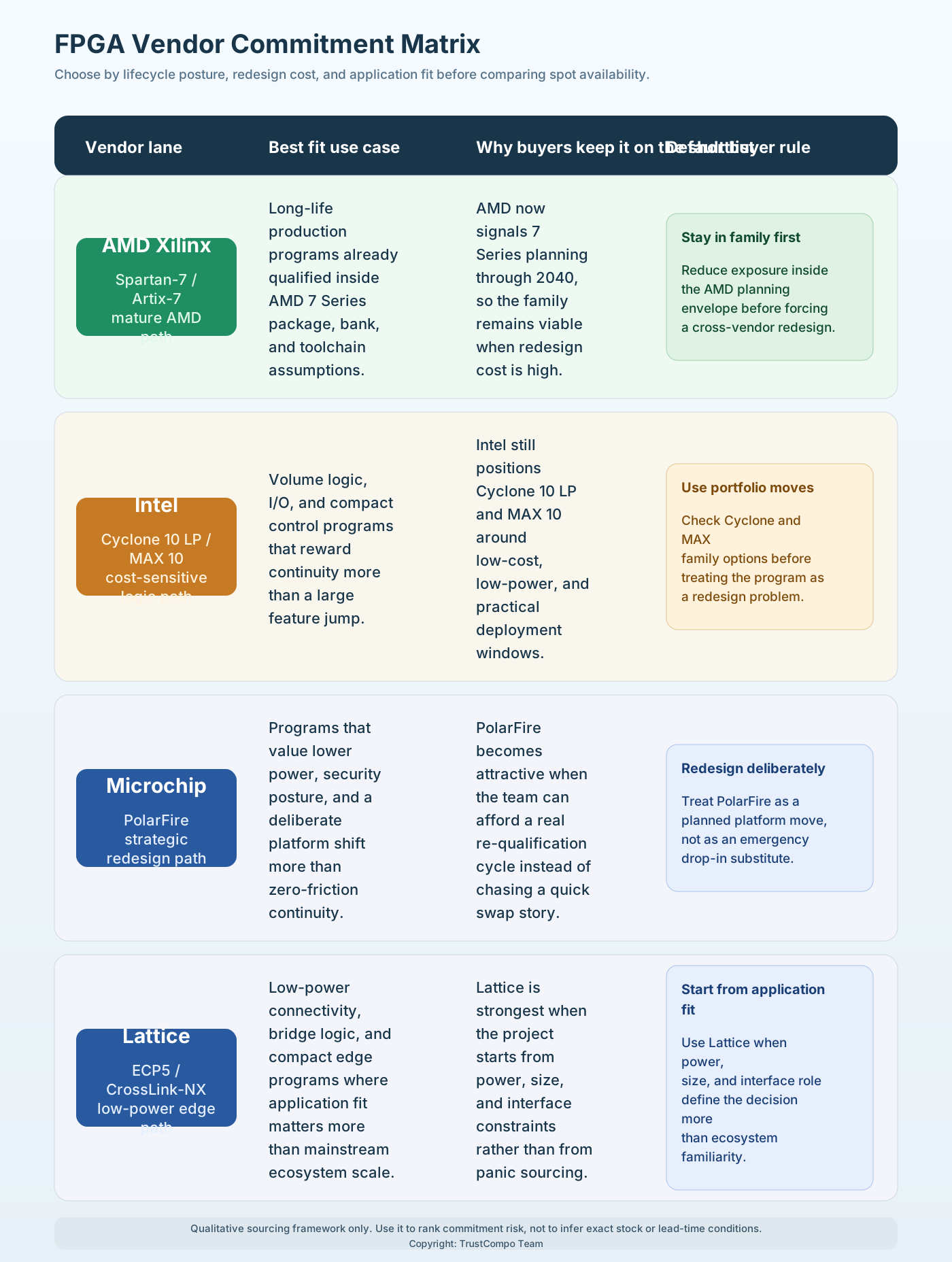
The point is not to compare only logic density. The sourcing decision is a mix of:
- lifecycle confidence
- package footprint lock-in
- transceiver or no-transceiver requirement
- embedded flash or external config preference
- toolchain stability
- re-qualification budget
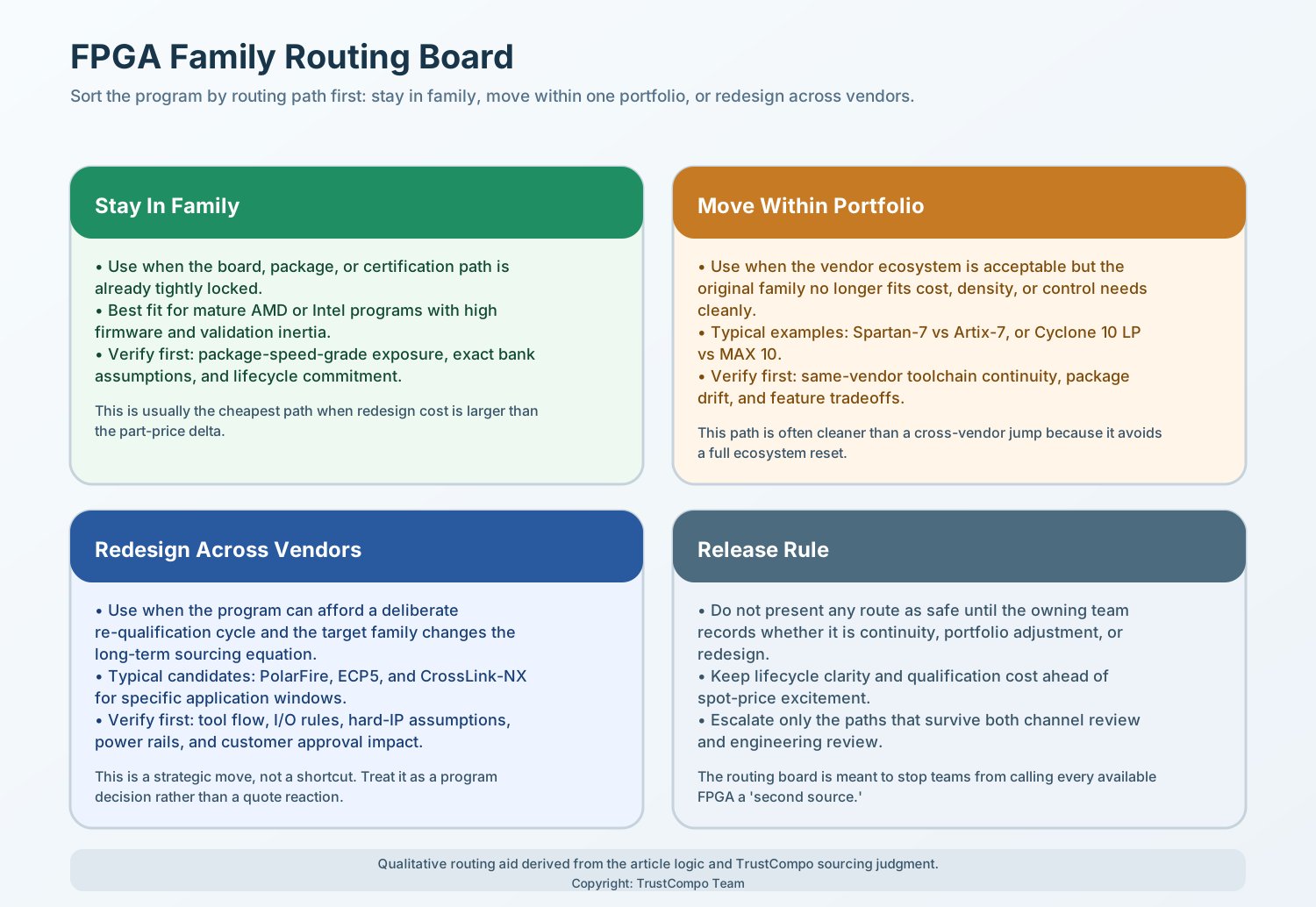
3. The First Buyer Decision: Stay In Family, Move Within Portfolio, or Redesign Across Vendors
Most FPGA sourcing mistakes happen because teams jump directly to the hardest path.
Path A: Stay in family
This is the default when the board is mature, the application is regulated, or the firmware team cannot afford disruption.
Typical examples:
- keep an AMD 7 Series design inside AMD 7 Series or adjacent AMD cost-optimized lines
- keep an Intel design inside Cyclone or MAX lines when the board assumptions are deeply Intel-specific
This path is usually the least glamorous, but it is also the cheapest if certification, EMC, timing closure, and production support matter more than theoretical piece-price gains.
Path B: Move within portfolio
This is the buyer's middle ground. You are not forcing a cross-vendor rewrite, but you are re-opening the family choice inside one supplier ecosystem.
Example logic:
- an AMD design that no longer fits its original cost window may be re-evaluated between Spartan-7 and Artix-7
- an Intel design may move between MAX 10 and Cyclone 10 LP depending on density, power, and embedded-flash priorities
This path is often underused because teams assume "same vendor" means "same risk." In practice, it can be the cleanest way to extend a program without crossing toolchains.
Path C: Redesign across vendors
This is where buyers start talking about PolarFire, ECP5, CrossLink-NX, Gowin, or Efinix. It can be strategically smart, but only when the company acknowledges what it is buying:
- a new tool flow
- different I/O and clocking assumptions
- possible IP and middleware rework
- different package and power-rail planning
- a real validation program, not a paperwork update
That is why this article treats cross-vendor moves as redesign-required by default.
4. Why AMD 7 Series Still Holds So Much Attention in 2026
AMD now gives buyers a much clearer lifecycle story than the market expected a year ago. The lifecycle extension announcement dated February 3, 2026 is a real planning signal, not just marketing polish.
For procurement teams, that means AMD 7 Series parts such as XC7A35T-1CPG236C and XC7S25-1CSGA225C are still reasonable for long-life planning when:
- the design already depends on AMD flows
- the qualification cost of leaving the ecosystem is high
- the customer needs a familiar, documented migration path rather than a radical platform change
The buyer caution is different: because these families are trusted and widely deployed, the most common packages and speed grades tend to attract the most concentrated demand. A mature family can therefore be both commercially stable and operationally tight at the same time.
TrustCompo judgment: if a program is already deep inside AMD 7 Series and still has years of production life left, the first question should be "how do we reduce exposure inside the AMD planning envelope?" not "how fast can we escape AMD entirely?"
5. Why Intel Cyclone 10 LP and MAX 10 Still Matter Even When They Are Not the Fastest Option
Intel's current product messaging for Cyclone 10 LP stays focused on cost-sensitive and low-power system integration. That is exactly why it still matters in 2026. Many production programs do not need a fashionable FPGA. They need one that closes timing, ships in volume, and does not force the board to be re-argued every quarter.
10CL025YU256C8G belongs in that conversation when:
- the design is mainly logic, I/O expansion, or glue logic
- the production volume rewards platform stability more than architectural ambition
- the procurement team wants an Intel-family path that is still clearly framed for cost-sensitive deployment
10M08SCE144C8G is useful when the embedded-flash and compact-control angle matters more than scale-out fabric.
EP4CE22F17C6N belongs in a different conversation: legacy support. It may still be operationally necessary, but buyers should treat older long-tail families with stricter channel discipline, because the open-market authenticity risk is not the same as it is for still-active mainstream program parts.
6. When Microchip PolarFire Is the Better Strategic Choice
PolarFire is not the "cheap emergency substitute" many buyer lists want it to be. It is more useful than that, but only if the team accepts that it is a deliberate platform decision.
Microchip's current product material centers PolarFire and PolarFire SoC around:
- strong power efficiency
- deterministic compute behavior
- security posture
- industrial and defense credibility
That makes MPF300T-1FCG784E attractive for programs where lower power and lifecycle confidence can justify engineering effort.
TrustCompo judgment: PolarFire is strongest when the customer is willing to spend redesign hours now to remove future dependence on a narrower set of mainstream FPGA families. It is weakest when the buyer is under immediate line-stop pressure and wants a zero-friction swap, because that is not what PolarFire is.
7. When Lattice ECP5 or CrossLink-NX Is the Smarter Low-Power Path
Lattice families are often misread in cross-vendor sourcing. They are not "small AMD" or "small Intel." They solve a different class of problem well.
LFE5U-25F-6BG256C is attractive when the design values:
- low power
- moderate logic
- edge-interface work
- smaller package discipline
LIFCL-40-9BG400C is more relevant when the project is about bridging sensors, displays, interfaces, or compact edge connectivity rather than general-purpose fabric expansion.
This makes Lattice compelling for some new designs and some redesigns. It does not make it a universal second source for Artix-7, Spartan-7, or Cyclone-class deployments.
TrustCompo judgment: buyers usually get the best Lattice outcome when they start from application fit, not from panic sourcing.
8. The Real Cost Driver Is Qualification, Not Unit Price
Many sourcing discussions look rational until the team prices the redesign correctly.
The hidden cost stack includes:
- FPGA engineer time for migration
- firmware or HDL adaptation
- timing closure reruns
- lab validation
- EMC or compliance retest
- customer approval cycles
- production documentation update
That means the cheapest quote is often attached to the most expensive program decision.
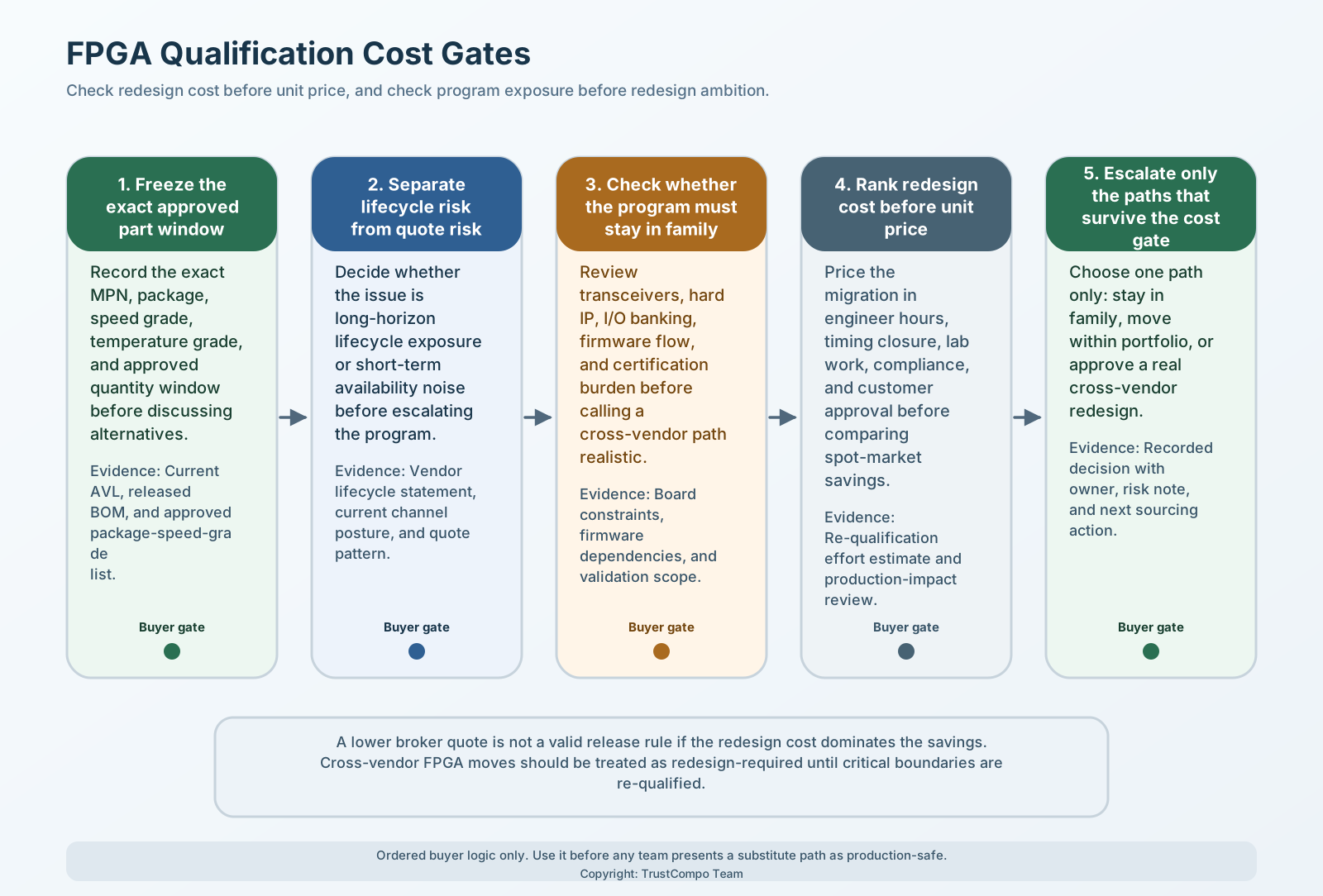
Use this qualification lens before calling anything a second source:
| Question | If the Answer Is "Yes" | Buyer Meaning |
|---|---|---|
| Is the package fixed by an already-approved PCB? | stay conservative | Cross-vendor move gets expensive fast |
| Does the design depend on transceivers or special hard IP? | stay conservative | Family shortlist narrows immediately |
| Is the product already certified or field-proven? | stay conservative | Qualification cost dominates quote savings |
| Is a board revision already planned? | be more open | Cross-vendor exploration becomes realistic |
| Is power reduction a strategic goal, not just a nice-to-have? | evaluate PolarFire or Lattice earlier | Lower-power redesign may justify the effort |
9. A Practical 2026 FPGA Buyer Checklist
The cleanest way to reduce sourcing noise is to turn the decision into a checklist.
- Freeze the exact approved MPN, package, speed grade, temperature grade, and quantity window.
- Separate lifecycle risk from short-term quote risk.
- Confirm whether the part is a stay-in-family problem or a redesign problem.
- Identify which dependencies are non-negotiable: transceivers, embedded flash, power budget, security, or toolchain.
- Rank redesign cost before ranking unit price.
- Review channel authenticity risk more aggressively for older long-tail families.
- Only then ask engineering to compare cross-vendor paths such as PolarFire or ECP5.
This sounds basic, but many FPGA RFQs still start at step 7 and work backward.
10. Where TrustCompo Thinks Buyers Should Start
If the project is already qualified and shipping, start with the smallest possible move:
- AMD program: re-check the AMD planning envelope first.
- Intel program: re-check Cyclone or MAX options first.
- Redesign-approved program: evaluate PolarFire and Lattice from an application-fit angle, not from a "drop-in replacement" angle.
If the program is still early in the design cycle, lifecycle and power strategy deserve more weight than ecosystem familiarity alone. That is where Microchip and Lattice can become stronger strategic candidates than buyers first assume.
Conclusion
The 2026 FPGA sourcing problem is not solved by finding the first available lot. It is solved by matching the family choice to the redesign budget, lifecycle horizon, and application constraints of the actual program.
AMD 7 Series remains structurally important because AMD now gives buyers a clear lifecycle commitment through 2040. Intel Cyclone 10 LP and MAX 10 remain relevant because stable, cost-sensitive logic still wins a large share of real production work. Microchip PolarFire and Lattice families become strongest when a team is willing to make a deliberate platform move instead of pretending a cross-vendor shift is frictionless.
The practical buyer rule is simple: treat lifecycle clarity as a planning asset, treat qualification cost as a first-order sourcing number, and treat cross-vendor FPGA moves as redesigns unless proven otherwise.
RFQ / CTA
If you are reviewing AMD Xilinx, Intel Altera, Microchip PolarFire, or Lattice FPGA demand for an active BOM, send the exact MPN list, package, speed grade, annual volume, and any toolchain or certification constraints. TrustCompo can help you separate stay-in-family buys from true redesign candidates, review lifecycle exposure, and build an RFQ path that is realistic for production instead of optimistic on paper.