- Hall sensor
- magnetic sensor
- current sensor
- automotive electronics
Hall Sensor Selection Guide 2026: A Buyer's Framework for Switch, Latch, Linear, and Current-Sense Designs
A practical Hall sensor selection guide for buyers and engineers covering switch, latch, linear, and current-sense devices, with representative part numbers, verification boundaries, and sourcing actions.
Quick facts
- The first Hall sensor split is output type: switch, latch, linear, or current-sense, not package alone.
- A magnetic substitute must be checked on Bop or Brp threshold, hysteresis, temperature range, and package footprint before a buyer treats it as a second source.
- Linear Hall sensors and isolated Hall current sensors solve different problems even when both are described as Hall-effect devices.
- Public evidence reviewed on July 1, 2026 showed stronger datasheet and application-note signal than news signal, so this topic should stay evergreen and buyer-framework driven.
Many Hall sensor articles explain the Hall effect well, then stop before the real buying decision starts. That is fine for theory. It is not enough for a live BOM. In practice, the question is not "what is a Hall sensor?" The question is which Hall sensor family belongs in this slot, which parameters cannot move, and which alternatives can be screened without creating hidden redesign work.
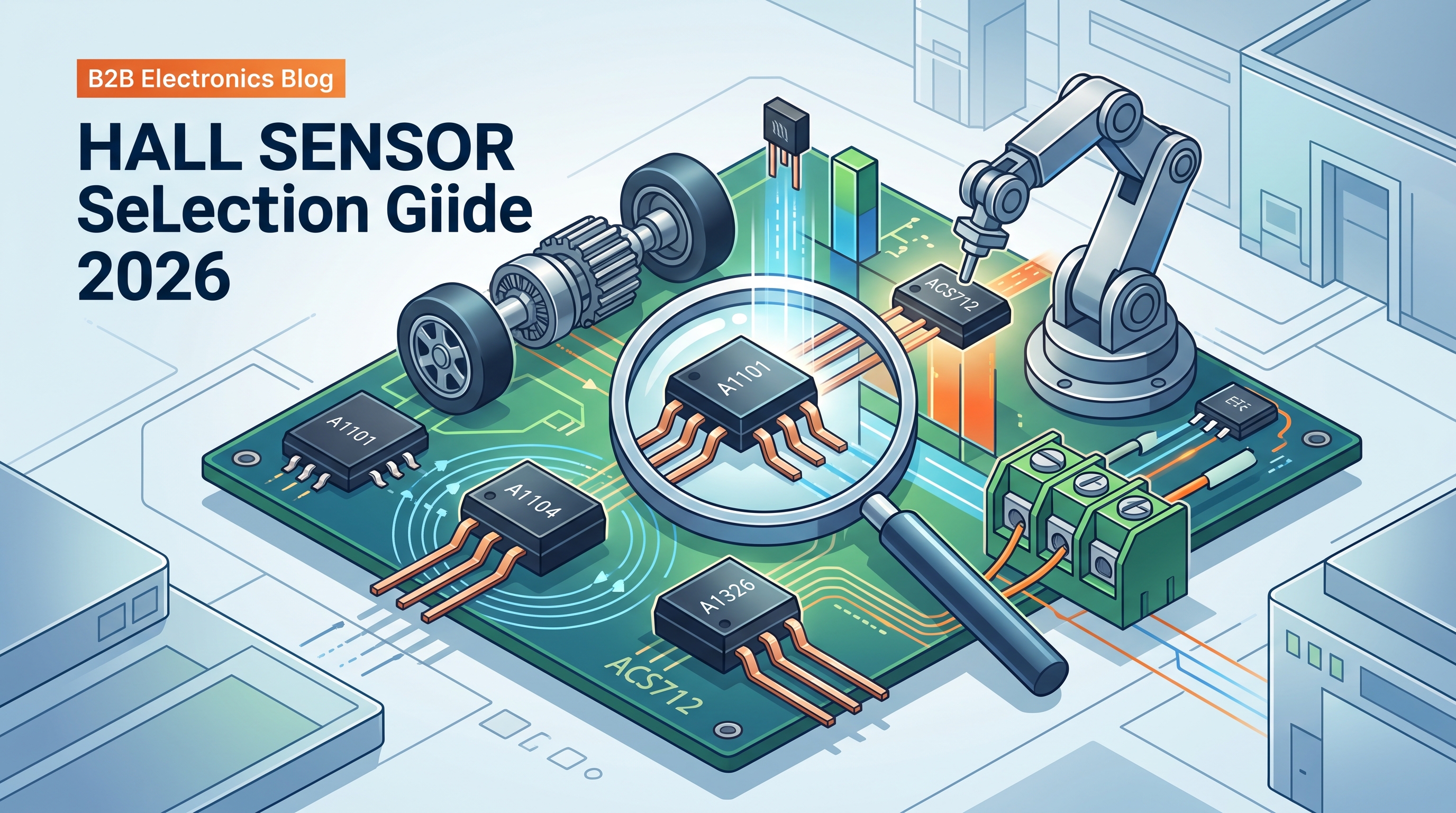
This guide is written for that second question. It treats Hall sensors as a procurement and engineering decision across four branches: switch, latch, linear, and current-sense. It uses representative devices such as A1101LLHLT-T, A1104LLHLT-T, MLX90248, A1326LLHLT-T, HAL 1820, TLE4997, DRV5055, ACS712ELCTR-20A-T, and ACS724LLCTR-20AB-T to show how a buyer should build a shortlist.
The framing matters. Public evidence reviewed on July 1, 2026 showed very little fresh news signal and much stronger datasheet and manufacturer-guide signal. So this article is deliberately an evergreen buyer framework, not a shortage headline or time-sensitive market update.
1. Start with the four-way split that removes most bad shortlists
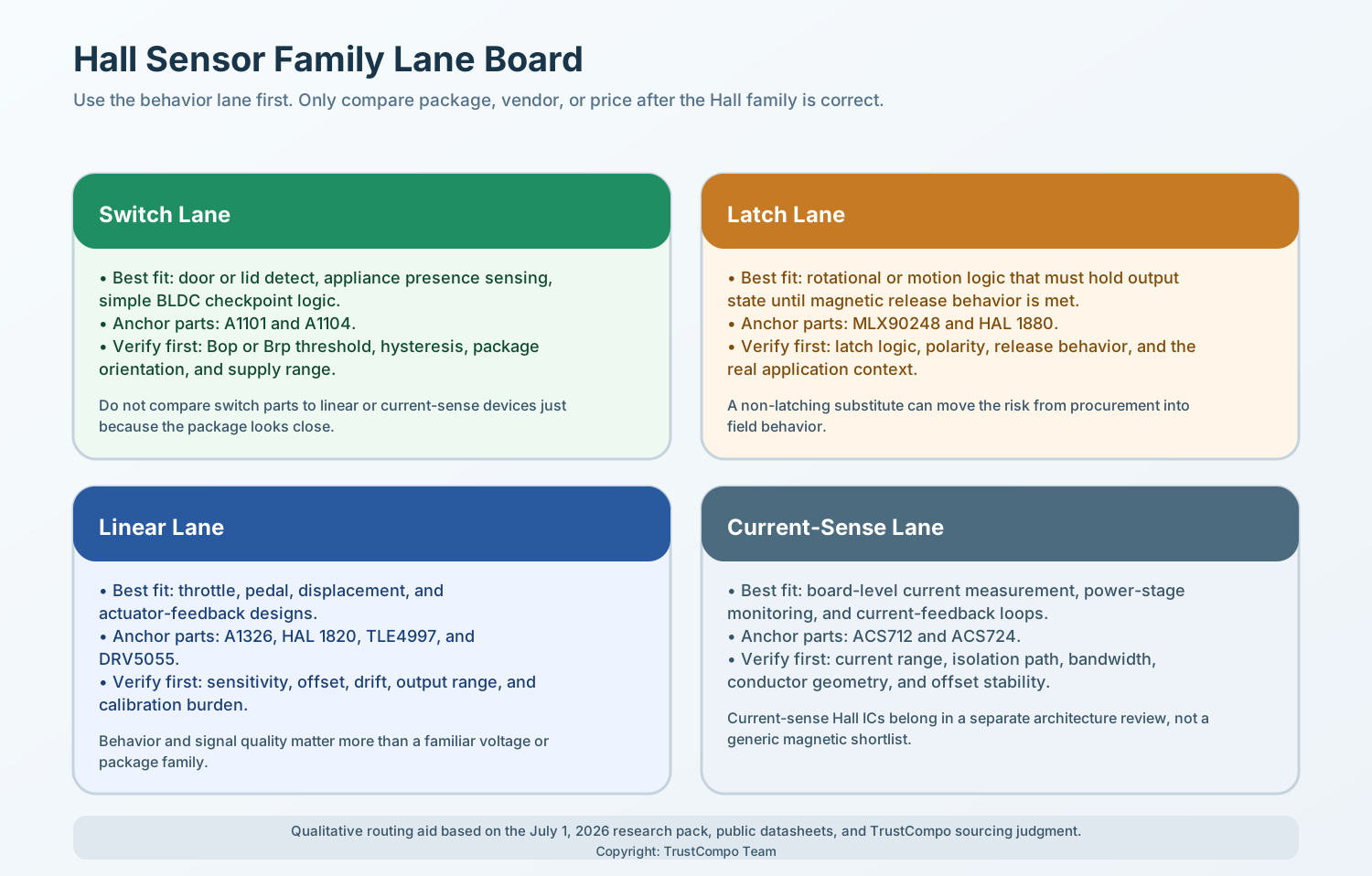
The fastest Hall sensor mistake is comparing parts that do not belong in the same decision branch.
| Device branch | Typical job | Representative anchors | What a buyer must verify first |
|---|---|---|---|
| Switch | Detect magnetic presence and toggle at a defined operate point | A1101LLHLT-T, A1104LLHLT-T | Bop or Brp threshold, hysteresis window, package, and supply range |
| Latch | Hold state until opposite polarity or release condition is met | MLX90248, HAL 1880 | Latching behavior, polarity logic, release behavior, and application context |
| Linear | Output an analog or programmable response to field strength or position | A1326LLHLT-T, TLE4997, DRV5055, HAL 1820 | Output type, sensitivity, linear range, temperature drift, and calibration burden |
| Current-sense | Measure conductor current through an integrated Hall structure | ACS712ELCTR-20A-T, ACS724LLCTR-20AB-T | Current range, isolation path, bandwidth, package geometry, and offset stability |
That is the first TrustCompo judgment in this article: package-first buying is the wrong starting point. A three-pin SIP or SOIC footprint can still hide the wrong magnetic behavior. A supplier can offer a part with a familiar package and voltage range, and it can still be unusable because the trigger threshold, hysteresis, or output response is different.
2. When a switch-type Hall sensor is the right starting point
For many appliance, motor, and industrial presence-detection designs, the first bucket is a switch-type Hall sensor. This is the right branch when the system only needs to know whether a magnetic target has crossed a threshold, not how far it moved or how much current is flowing.
The Allegro A110x family datasheet gives a clean official anchor here: it covers exact orderable variants such as A1101LLHLT-T and A1104LLHLT-T, and describes them as continuous-time Hall-effect switches positioned as next-generation replacements for older Allegro 312x and 314x lines. That tells us two useful things:
- They belong in a threshold-detection conversation, not a linear-output conversation.
- Buyers should expect family-level variants where the magnetic operating point changes even though the package family looks similar.
Representative parts in this branch:
| Part | Typical branch role | Key parameter focus | TrustCompo anchor |
|---|---|---|---|
A1101LLHLT-T | Lower-threshold switch-family candidate | Bop or Brp window, package, supply range | published anchor |
A1104LLHLT-T | Switch-family candidate often used as a comparison anchor | Magnetic threshold, hysteresis, operating temperature | published anchor |
Best-fit use cases:
- door or lid detection
- BLDC commutation checkpoints
- appliance position sensing
- simple proximity confirmation in industrial equipment
Boundary condition: if the design team actually needs distance, angle, or field-strength proportional output, a switch device is the wrong branch even if the package fits and the cost looks attractive.
3. When latch behavior changes the shortlist
Buyers often treat latch parts as if they were just switch parts with a different datasheet suffix. That is risky. A latch is chosen because the output behavior itself matters. It holds state until the magnetic condition crosses the release logic boundary. That makes it useful in some commutation and rotational-position cases, but it also makes it a poor substitute for a simple unipolar switch when the system expects immediate on/off behavior around one threshold.
For this article, MLX90248 is the cleanest representative latch anchor in the queue. It belongs in the shortlist when the design logic depends on latched behavior rather than one-direction threshold switching.
| Part | Why it belongs in a latch review | What not to assume | TrustCompo anchor |
|---|---|---|---|
MLX90248 | Useful latch-family representative for automotive or motion-oriented reviews | Do not assume a switch-type alternative will preserve release behavior | MLX90248 |
HAL 1880 | Automotive-oriented latch-family comparison point that should stay in the latch lane until exact variant behavior is confirmed | Do not treat family naming alone as proof of identical latch logic | HAL 1880 |
TrustCompo judgment: this is where many cross-reference requests get dangerous. A buyer hears "Hall sensor, same package, same temperature class" and assumes the second source is close enough. But if the original design depends on latched output behavior, a non-latching part can move the failure from procurement into the field.
4. Linear Hall sensors are selected by response quality, not by magnetic presence alone
A linear Hall sensor is not asking "magnet or no magnet?" It is asking "what analog or programmable response should this magnetic field produce?" That immediately changes the verification stack.
The Allegro A1324, A1325, and A1326 datasheet gives a good official clue here as well. It covers orderable variants such as A1326LLHLT-T and positions them as low-noise linear Hall-effect sensor ICs with analog output. That means the buyer should stop screening them like threshold switches and start screening them like analog signal devices that happen to be magnetically driven.
Representative linear anchors:
| Part | Role in the shortlist | What must be checked | TrustCompo anchor |
|---|---|---|---|
A1326LLHLT-T | Analog-output linear reference point | Sensitivity, offset behavior, analog output range, temperature drift | published anchor |
DRV5055 | TI linear Hall comparison anchor | Output slope, voltage options, package, and application fit | DRV5055 |
TLE4997 | Higher-trust programmable or automotive-oriented linear anchor | Programming model, diagnostic features, package and thermal class | TLE4997 |
HAL 1820 | Automotive-flavored linear-family checkpoint | Linearity expectations, variant handling, and package constraints | HAL 1820 |
This branch is where second-source discipline matters most. A linear part can look acceptable on voltage and package while still drifting too far on:
- sensitivity
- zero-field offset
- temperature compensation
- output swing
- programmable behavior
TrustCompo judgment: if the application is throttle position, pedal position, actuator feedback, displacement sensing, or any calibration-sensitive magnetic measurement, the real substitute boundary is system behavior, not the first page of the datasheet.
5. Current-sense Hall devices deserve their own procurement workflow
The term "Hall sensor" becomes too broad once current-sense devices enter the conversation. Parts such as ACS712ELCTR-20A-T and ACS724LLCTR-20AB-T are not primarily being chosen for magnetic target detection. They are being chosen for current measurement architecture.
The Allegro ACS712 datasheet provides an official reference, with exact orderable variants such as ACS712ELCTR-20A-T listed on the product page and datasheet. That matters because devices in this branch are screened on a different set of questions:
| Part | Typical use | First-pass verification | TrustCompo anchor |
|---|---|---|---|
ACS712ELCTR-20A-T | General isolated current measurement benchmark | Current range, bandwidth, offset, isolation path, package geometry | published anchor |
ACS724LLCTR-20AB-T | Higher-spec current-sense candidate for tighter designs | Isolation, conductor path, thermal behavior, sensitivity class | published anchor |
This is why a current-sense Hall IC should not be mixed into a generic switch or linear shortlist just because all of them use Hall-effect physics. The commercial consequences are different:
- current range and overload posture matter
- conductor package geometry matters
- board routing and creepage posture matter
- bandwidth and offset drift matter
Boundary condition: a buyer who tries to treat ACS712ELCTR-20A-T as just another generic Hall sensor is already using the wrong decision tree.
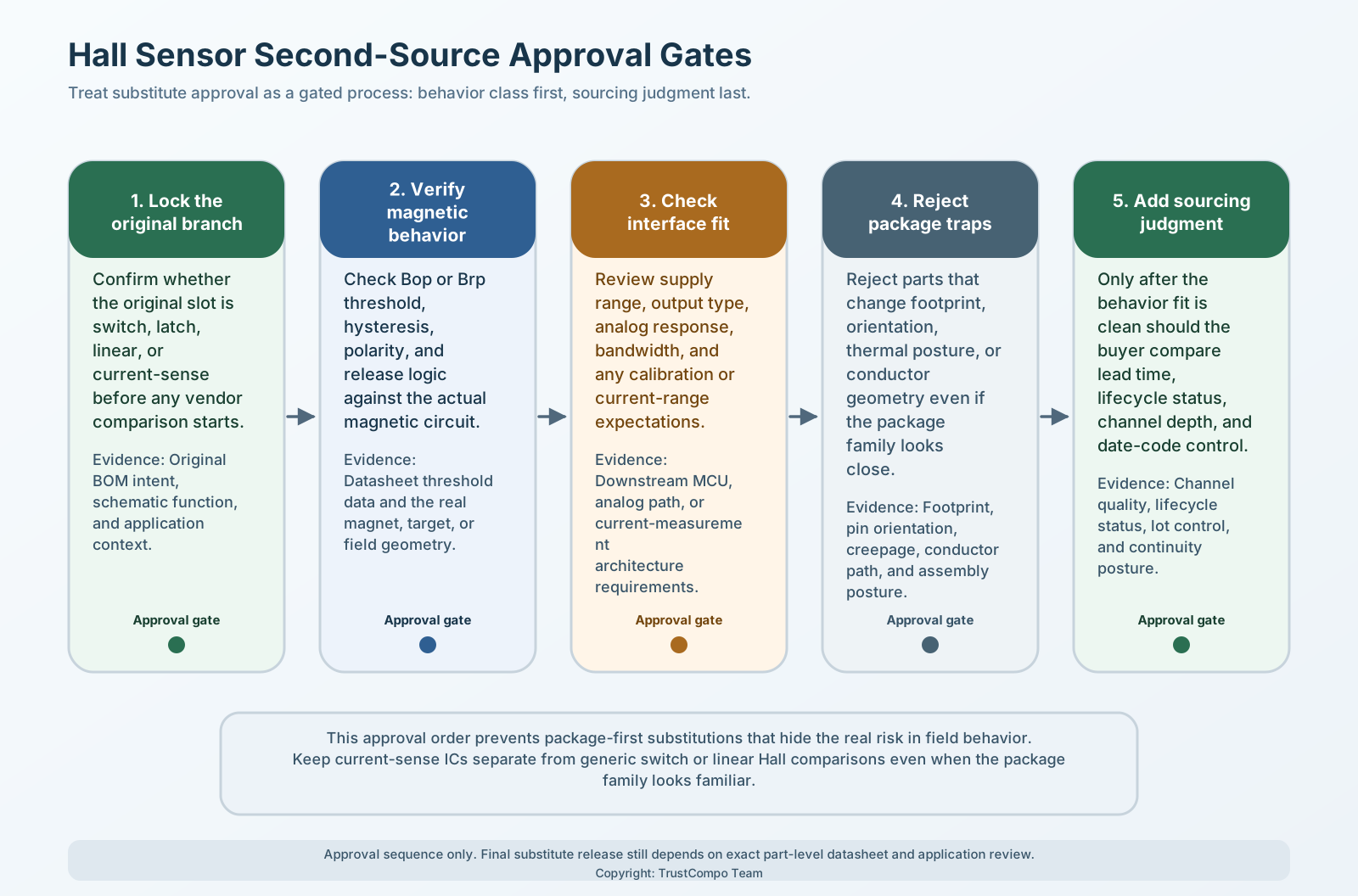
6. The real second-source checklist for Hall sensors
The backlog note for this topic was right to call out a common mistake: Hall sensor alternatives cannot be screened with a simplistic "same voltage, same package" logic. The correct review stack is magnetic and application-specific.
Use this shortlist before approving any second source:
| Verification area | Why it matters | Questions to ask |
|---|---|---|
| Output type | Prevents wrong-family substitutions | Is the original part a switch, latch, linear, or current-sense device? |
| Magnetic threshold | Protects trigger position and release behavior | Are Bop, Brp, and hysteresis windows close enough for the real magnetic circuit? |
| Temperature range | Avoids field drift and cold or hot failures | Is the substitute rated for the same thermal environment and drift expectations? |
| Package and footprint | Prevents hidden PCB or assembly rework | Is the package truly footprint compatible, and is magnetic orientation preserved? |
| Supply and output behavior | Prevents interface mismatch | Does the output stage match what the downstream MCU, comparator, or analog path expects? |
| Lifecycle and channel risk | Protects future supply continuity | Is the part active, broadly distributed, and available in the required package and grade? |
This is the core TrustCompo judgment of the article: a Hall sensor second source is a behavior match before it is a catalog match.
7. A buyer-facing framework by application
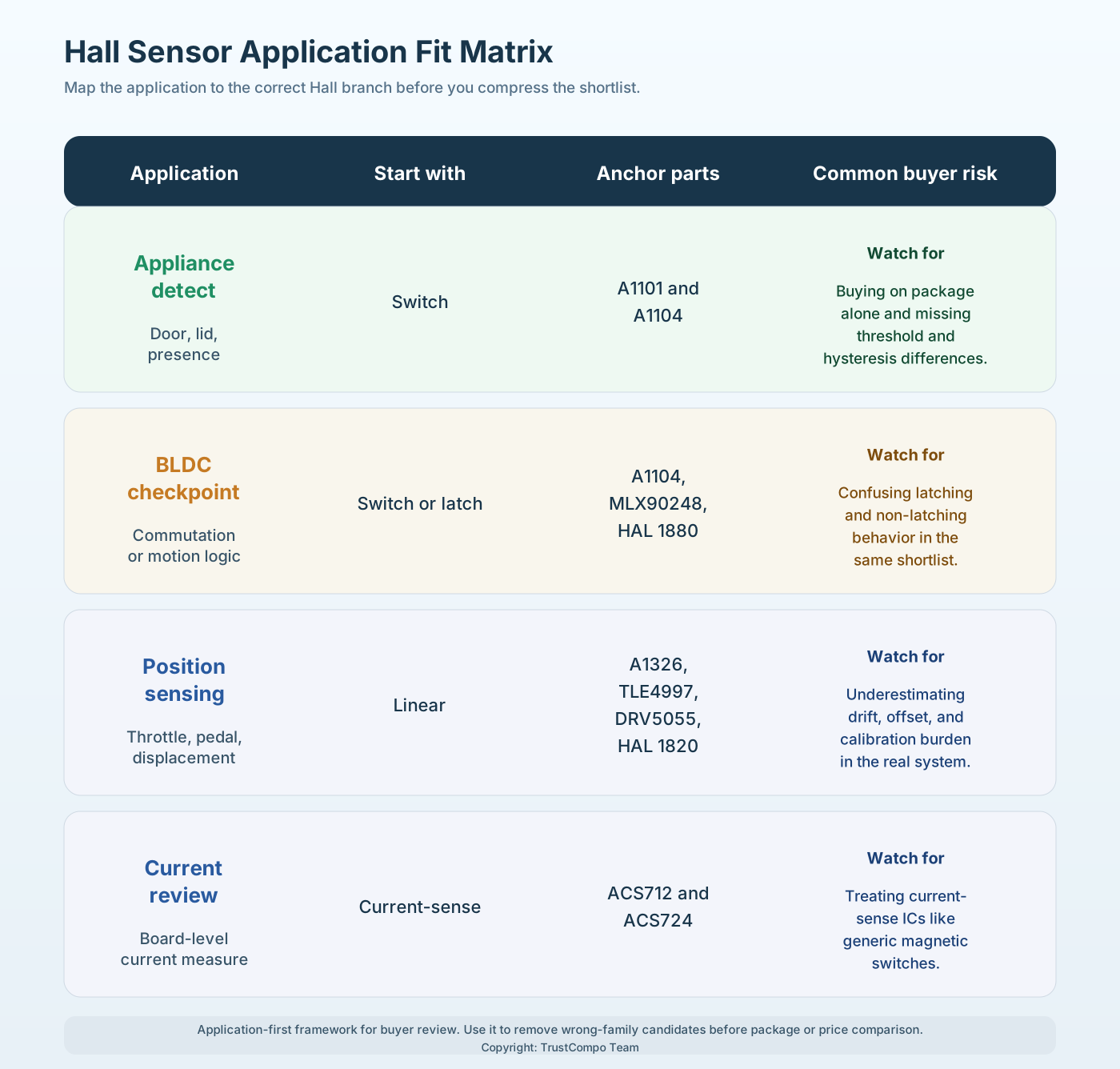
The easiest way to keep the shortlist clean is to map the Hall sensor family to the real application first.
| Application | Best starting branch | Representative anchors | Common buyer risk |
|---|---|---|---|
| Appliance lid or door detect | Switch | A1101LLHLT-T, A1104LLHLT-T | Buying on package alone and missing threshold differences |
| BLDC commutation checkpoint | Switch or latch | A1104LLHLT-T, MLX90248, HAL 1880 | Confusing latching and non-latching logic |
| Throttle, pedal, or displacement sensing | Linear | A1326LLHLT-T, TLE4997, DRV5055, HAL 1820 | Underestimating temperature drift or calibration burden |
| Board-level current measurement | Current-sense | ACS712ELCTR-20A-T, ACS724LLCTR-20AB-T | Treating current-sense ICs like generic magnetic switches |
| Automotive magnetic position review | Linear or latch depending topology | HAL 1820, HAL 1880, TLE4997, MLX90248 | Assuming one family covers all automotive magnetic tasks |
That mapping also keeps the article distinct from a pure theory guide. A manufacturer application note will often explain its own product family well. What it usually will not do is tell a buyer how to separate which family not to compare when procurement pressure starts to compress the review.
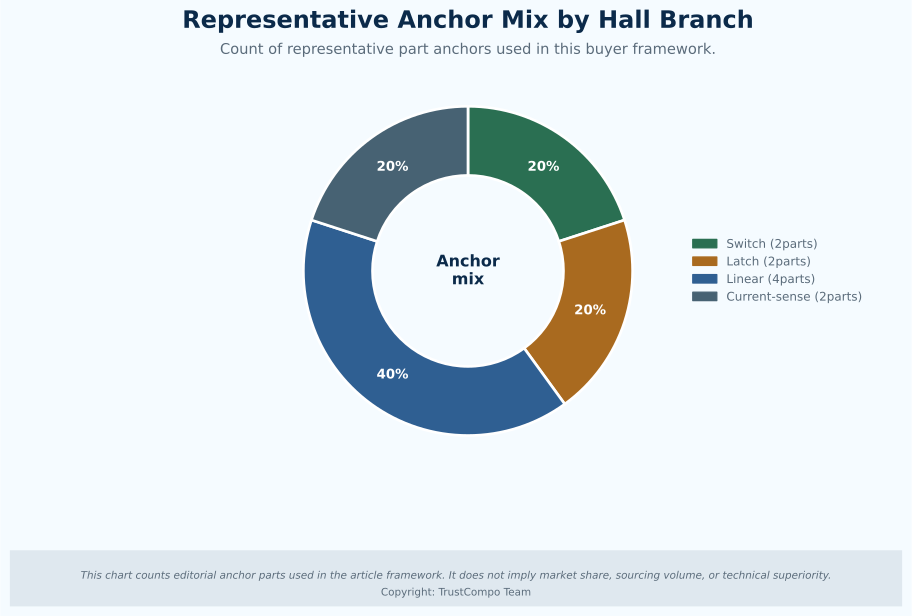
The representative-anchor mix in this article also shows where the framework is densest: the linear branch carries more named comparison points because calibration-sensitive use cases usually need more cautious review than simple threshold detection.
8. Which representative parts should TrustCompo anchor first
For this content cluster, the best first product anchors are the parts that map cleanly to different buying intents rather than ten near-duplicates from the same family.
| Priority | Part | Why it should anchor the article | Placeholder |
|---|---|---|---|
| P0 | A1101LLHLT-T | Clean switch-family entry point | published anchor |
| P0 | A1104LLHLT-T | Second switch-family comparator with practical search value | published anchor |
| P0 | A1326LLHLT-T | Strong linear analog benchmark | published anchor |
| P0 | ACS712ELCTR-20A-T | Widely recognizable current-sense anchor | published anchor |
| P0 | ACS724LLCTR-20AB-T | Higher-tier current-sense follow-up anchor | published anchor |
| P1 | MLX90248 | Distinct latch-family representative | MLX90248 |
| P1 | HAL 1820 | Automotive-oriented linear comparison point | HAL 1820 |
| P1 | TLE4997 | Higher-trust programmable linear review anchor | TLE4997 |
| P1 | DRV5055 | TI linear comparison anchor for second-source discussions | DRV5055 |
This anchor list is TrustCompo editorial judgment, not a manufacturer ranking. The point is to cover the buying branches that readers actually need to separate.
Conclusion
The safest Hall sensor buying rule in 2026 is simple: do not start with package or unit price. Start with behavior class. Separate switch, latch, linear, and current-sense devices first. Then verify the magnetic threshold, output logic, temperature range, package orientation, and lifecycle posture before a second source is treated as acceptable.
For this topic, the evidence currently supports an evergreen selection framework more than a news-driven supply update. The strongest public signal is still manufacturer and datasheet material such as the Allegro A110x, A1326LLHLT-T, and ACS712ELCTR-20A-T references and the TDK Micronas Hall sensor selection guide, not a fresh public shortage narrative.
Need a verified Hall sensor shortlist on your BOM?
- Use submit a BOM review RFQ when you already have exact MPNs such as
A1104LLHLT-T,A1326LLHLT-T, orACS724LLCTR-20AB-Tand need a controlled quote path. - Use Alternative Solutions when the original part is active but lead time, package fit, or lifecycle risk is pushing the team toward a second source.
- Use request verified stock pricing when the decision is already made and the next step is pricing and channel confirmation on a narrow shortlist.